
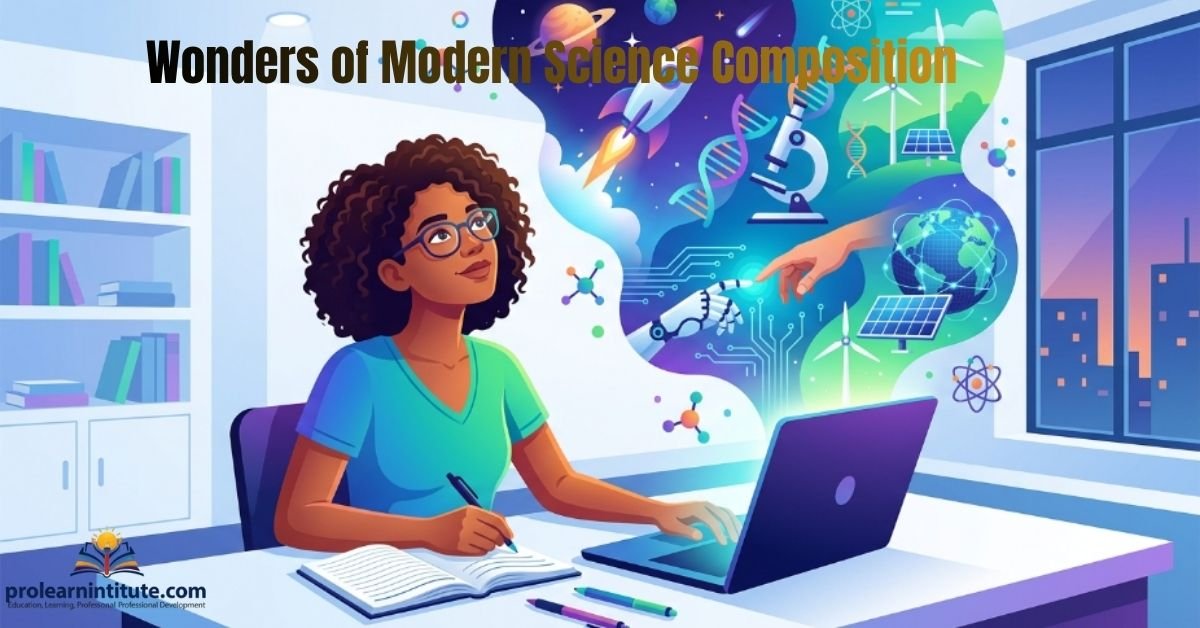
Modern science is one of the greatest gifts to humanity. It has completely transformed the way we live, think, and interact with the world. From tiny microchips to massive rockets, science surrounds every corner of our lives.
Every single day, we witness the magic of scientific discoveries working silently behind our comfort. The wonders of modern science are not just inventions—they are revolutions that changed human destiny forever.
Introduction
We live in an age where science makes the impossible possible. Diseases that once killed millions are now curable, and distances that took months to travel are now covered in hours. Modern science has given humans a power that earlier generations could only dream about.
Science has rewritten the rules of nature, time, and space. It is no longer just a subject in school — it is the backbone of our entire civilization. Understanding its wonders helps us appreciate how far humanity has truly come.
What is Modern Science?
Modern science is an advanced, organized system of knowledge based on observation, experiments, and proven facts. It covers fields like biology, chemistry, physics, technology, and space. It is constantly growing and updating itself with discoveries.
Unlike ancient beliefs, modern science demands proof and logic before accepting any idea. It uses laboratories, satellites, computers, and powerful machines to explore the deepest secrets of the universe. It is both a process and a powerful body of knowledge.
Major Wonders of Modern Science
Modern science has delivered breathtaking achievements across multiple fields. Each discovery builds upon another, creating a chain of progress that keeps accelerating. Below are some of the most remarkable wonders science has gifted the world.
Communication Revolution
Communication today is instant, borderless, and effortless. A message sent from Pakistan reaches Australia in less than a second, thanks to the internet and smartphones. The world has truly become a global village.
Mobile phones connect billions of people across the globe, while social media platforms share news and ideas in real time. Satellite technology makes communication possible even in the most remote areas of the world. Science has made human connection faster and easier than ever before in history.
Medical Advancements
Modern medicine has extended human life and reduced suffering on a massive scale. Surgeries that once seemed impossible are now performed with robotic precision and accuracy. Vaccines have eliminated diseases that once wiped out entire populations across the world.
Antibiotics cure deadly bacterial infections that were once a death sentence. Advanced tools like MRI and X-ray allow doctors to detect diseases without performing any surgery. Organ transplants and cancer treatments have given millions of patients a second chance at life.
Transportation
Science has shrunk the world through revolutionary transportation systems. Airplanes carry passengers across continents in just a few hours, and bullet trains zoom at incredible speeds on land. Even electric and self-driving cars are now becoming a common reality on roads worldwide.
Ships now carry millions of tons of goods across oceans efficiently and safely. High-speed rail networks connect major cities within minutes rather than hours. Transportation science has made the world more accessible, affordable, and connected for everyone.
Information Technology
Information technology is perhaps the fastest-growing wonder of modern science. Computers, artificial intelligence, and cloud computing have changed every industry on Earth. A single smartphone today holds more computing power than the machines that once sent humans to the moon.
Artificial intelligence is now learning and solving complex problems across medicine, education, and business. Cloud storage allows data to be accessed from anywhere in the world at any time. Coding and software development now power every digital service that people use daily.
Space Exploration
Humans have stepped beyond Earth and reached for the stars through space exploration. It has answered questions about our universe that philosophers pondered for centuries. Satellites orbiting Earth now power GPS, weather forecasting, and global communications every second.
The Moon landing in 1969 was a landmark achievement that proved the limitless power of science. Mars rovers are currently exploring the red planet for signs of ancient life. The James Webb Telescope is now capturing stunning images from billions of light-years away into deep space.
Benefits of Modern Science
The benefits of modern science touch every part of human life, from health to happiness. It has raised the standard of living, increased life expectancy, and made education accessible to all. Science-powered technology has made work faster, smarter, and more efficient across every field.
The human lifespan has grown significantly due to advances in medicine and public health science. Renewable energy sources like solar and wind power are reducing dependence on polluting fossil fuels. Increased food production through scientific farming now feeds billions of people around the world.
Disadvantages of Modern Science
Despite its wonders, modern science has also brought serious challenges and dangers to the world. The misuse of scientific knowledge has led to weapons of mass destruction, pollution, and deep social problems. Technology addiction, especially among youth, is a growing and alarming concern worldwide.
Industrial pollution has damaged air, water, and soil across the entire planet at an alarming rate. Cybercrime, including hacking and online fraud, is rising sharply with the spread of digital technology. Machines replacing human workers have caused widespread unemployment in many parts of the world.
Role of Science in Daily Life
Science is quietly working behind every single moment of our daily routine. The alarm that wakes us, the stove that cooks our food, and the fan that cools us—all are gifts of science. Even the medicines sitting in our homes are products of years of careful scientific research.
Food preservation through refrigerators reduces waste and keeps families healthy and safe. Smartphones keep billions of people connected, informed, and entertained throughout the day. Transportation systems powered by science get students to school and workers to their jobs safely every morning.
Future of Modern Science
The future of science is even more exciting and promising than its remarkable past. Scientists are working on artificial intelligence, quantum computing, and even teleportation at the atomic level. The next few decades may bring changes more dramatic than the entire last century combined.
Quantum computers will soon solve problems that are completely beyond current technology. Space colonization on Mars may become a reality within this generation’s lifetime. Gene editing science may permanently eliminate hereditary diseases that have troubled humanity for thousands of years.
Critical Analysis
Modern science is a double-edged sword—it can heal, and it can harm in equal measure. The same knowledge that builds life-saving vaccines can also be used to create deadly biological weapons. The true challenge of our era is not scientific advancement, but the wisdom and ethics to use it responsibly.
Society must ensure that science is guided by fairness, equality, and long-term human well-being. Governments, scientists, and ordinary citizens all share the responsibility of directing technology toward good purposes. Science without moral values is like fire without control—powerful, but deeply dangerous.
Wonders of Modern Science Composition — Variant 1: Simple Version
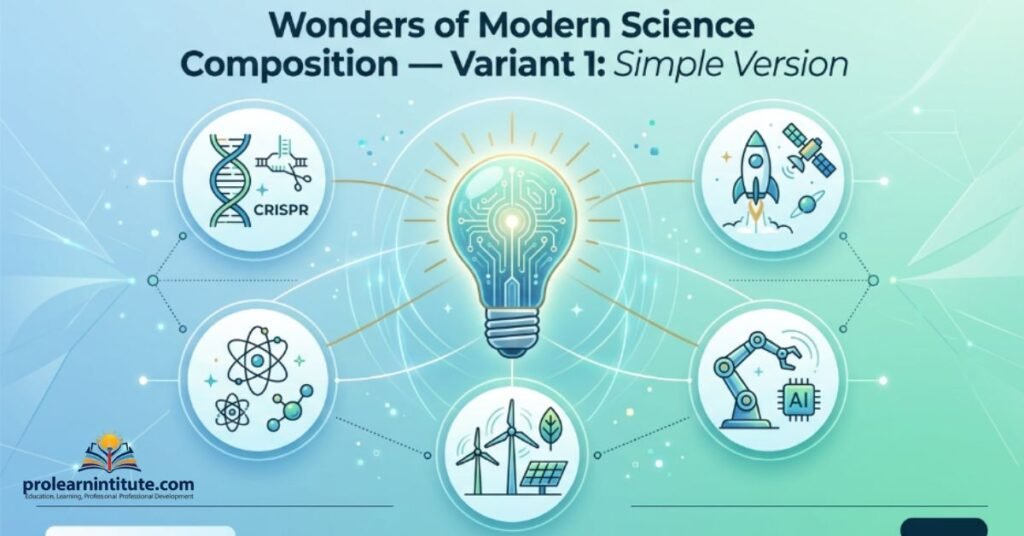
Introduction (Simple)
Science has made our world easier, safer, and more connected than ever before in history. Even simple things like lights, fans, and medicines are miracles of scientific progress all around us. Modern science is truly a blessing for all of humanity in every corner of the world.
Every student, farmer, doctor, and worker benefits from science in some way every single day. It has solved ancient problems and opened new doors of opportunity for millions of people. Science is the engine that drives the progress of the modern world forward.
Daily Life Improvements
Science has improved daily life in ways our grandparents never imagined possible. From cooking gas to mobile phones, science works in every room of our homes silently and efficiently. It makes life more comfortable, convenient, and productive for everyone around the world.
Electric appliances save valuable time and physical effort in homes every single day. Clean drinking water is made available to millions through modern water purification systems. Cars, buses, and trains powered by science make daily travel fast, safe, and reliable for all.
Advantages
The advantages of modern science are vast, visible, and life-changing for billions of people worldwide. It has connected the world, cured diseases, and made education reach every corner of the globe. Science has genuinely improved the quality of human life at every level of society.
Human life expectancy has increased dramatically because of breakthroughs in medical science. Faster communication through mobile phones and the internet has brought the entire world closer together. Scientific agriculture now efficiently feeds billions of people living across the entire planet.
Disadvantages
Science, when misused or left uncontrolled, can cause serious harm to people and the planet. Pollution from factories, addiction to social media, and the dangers of nuclear weapons are all results of science gone wrong. We must be responsible and thoughtful in how we choose to use scientific power.
Air pollution from industrial factories continues to damage human health on a massive scale. Social media overuse is leading to increasing stress, anxiety, and distraction among young people globally. Machines taking over traditional jobs are creating serious unemployment problems in many countries around the world.
Conclusion (Simple)
Modern science is, without doubt, one of the greatest achievements of the human mind across all of history. It has made life longer, healthier, faster, and more connected for people all around the world. We should learn science not just to pass exams, but to use it for the true good of humanity.
At the same time, we must always use science with wisdom, care, and a deep sense of responsibility. Science is a powerful tool, and like all tools, everything depends on the hands that hold it. Let us be the generation that uses science to build a better, safer, and more peaceful world for all.
Wonders of Modern Science Composition — Variant 2: Advanced Version
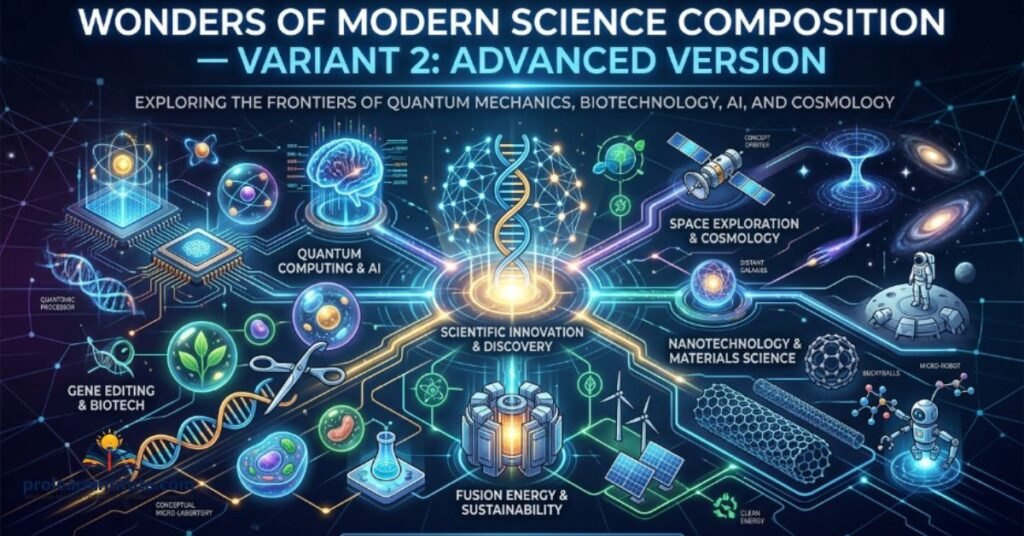
Introduction (Advanced)
In an age defined by relentless innovation, modern science stands as humanity’s most transformative achievement throughout all of history. It has dismantled geographical boundaries, defied biological limitations, and completely redefined the concept of human potential. No era in history has witnessed change as rapid, deep, and far-reaching as the scientific revolution of the modern age.
Science is no longer confined to laboratories or academic institutions—it breathes in every smartphone, every hospital, and every satellite orbiting the Earth. Its wonders are not mere technological novelties but powerful responses to the oldest and deepest challenges of human existence. To study modern science is to study the ambition, creativity, and relentless curiosity of the human spirit itself.
Scientific Breakthroughs
The twentieth and twenty-first centuries have produced scientific breakthroughs that shattered long-standing barriers of human knowledge. From mapping the entire human genome to discovering gravitational waves, science has entered dimensions once reserved only for science fiction. Each breakthrough opens a gateway to dozens of entirely discoveries waiting to be explored.
The discovery of DNA in 1953 completely unlocked the science of genetics and human heredity forever. The invention of the internet in the 1990s then revolutionized global communication in a way never seen before. Today, CRISPR gene editing technology gives scientists the remarkable ability to rewrite the genetic code of living organisms.
Positive Impacts
Modern science has generated overwhelmingly positive impacts across health, education, the economy, and the environment. It has democratized access to knowledge, allowing a student in a rural village to learn the same things as one in a global city. Science has not only extended human life—it has deeply enriched the quality of that life for billions.
Global literacy has improved significantly through digital and online education platforms powered by technology. Infant mortality rates have been dramatically reduced through breakthroughs in modern medical science. Renewable energy sources are now actively addressing the global climate crisis, threatening our planet’s future.
Negative Impacts
The shadow side of scientific progress is real, serious, and cannot be ignored by modern society. Industrial advancement has accelerated climate change, threatening ecosystems that took millions of years to develop. The weaponization of science — from nuclear bombs to chemical warfare — represents its most disturbing and dangerous misuse.
Digital surveillance is increasingly eroding personal privacy and individual civil liberties across the world. Widening economic inequality is growing sharply as automation and machines displace millions of low-skilled workers. Psychological harm from social media algorithms deliberately designed for addiction is becoming a global mental health crisis.
Critical Analysis (Advanced)
A critical analysis of modern science reveals a profound and deeply troubling paradox at its very core. The same force that saves lives can also threaten them with equal efficiency and precision. History has clearly shown that unchecked scientific power without strong ethical governance leads directly to catastrophe.
The ethical frameworks governing science must evolve just as fast as science itself continues to advance. International cooperation, transparent research, and inclusive policymaking are all essential to ensure benefits are shared equally. Science without conscience is, without question, the world’s most sophisticated and dangerous ongoing threat.
Conclusion (Advanced)
Modern science represents the absolute pinnacle of human intellectual achievement and the power of collective human ambition. It has conquered diseases, explored distant galaxies, and connected civilizations across continents and entire centuries of human history. Yet its ultimate value lies not in what it can do, but in what we consciously and wisely choose to do with it.
The responsibility of this generation is to be both scientifically literate and deeply morally aware. The wonders of science are real, boundless, and continuously growing beyond every known limit. But the greatest wonder of all will always remain the extraordinary human mind that first imagined, and then created, every single one of them.
Frequently Asked Questions
What is a Wonders of Modern Science composition?
A Wonders of Modern Science composition is an essay that explains how modern science has improved human life through inventions like the internet, medical advances, transportation, and space exploration.
Why is modern science considered a wonder in our lives?
Modern science is called a wonder because it has made life easier, faster, and more comfortable by improving communication, healthcare, travel, and education.
What are the main points of a “Wonders of Modern Science” composition?
The main points include communication technology, medical progress, transportation systems, space exploration, and the advantages and disadvantages of science.
How has modern science changed our daily life?
Modern science has changed daily life by introducing smartphones, computers, medical treatments, and fast transport, making everything more convenient and efficient.
What are the benefits of modern science in education?
Modern science has improved education through online learning, digital tools, smart classrooms, and easy access to global knowledge.
What are the disadvantages of modern science?
Some disadvantages include pollution, over-dependence on machines, misuse of technology, and the development of destructive weapons.
How can I write a good Wonders of Modern Science composition?
You can write a good composition by introducing science, explaining its major inventions, discussing its benefits and drawbacks, and ending with a balanced conclusion.
Why is science important in modern society?
Science is important because it improves living standards, supports economic growth, and solves real-world problems in health, energy, and communication.
What are the major wonders of modern science?
The major wonders include the internet, mobile phones, airplanes, space satellites, advanced medical treatments, and artificial intelligence.
How does modern science help in communication?
Modern science enables communication via mobile phones, email, social media, and video calls, allowing instant connections worldwide.

I’m Jordan Smith, a content writer with 4 years of experience and AI content expertise, creating clear, engaging, and easy-to-understand educational content.