
Introduction
A study tour is not just a fun day away from school—it is one of the most powerful ways students learn outside the classroom. Visiting real places, historical sites, and natural landscapes makes lessons come alive in ways no textbook ever can. But before any trip happens, one important step must be completed: writing a proper application to the school principal.
Many students feel confused about how to write this application — what to include, how to start, and how formal it should be. This guide gives you everything you need, from a clear format to real application samples for every class, from Class 6 all the way to HSC. Read it once, and you will never need to search again.
What is a Study Tour Application?
A study tour application is a formal written request submitted by a student to the school principal or head teacher. Its main purpose is to seek official permission to organize or attend an educational trip. It follows the standard formal letter format and must be written politely, clearly, and in a respectful tone.
The application is usually written by a class representative or a student on behalf of the whole class. It includes key details like the destination, date, number of students, supervising teacher, and the educational purpose of the trip. A well-written application shows that students are serious, responsible, and respectful of school rules.
In most schools, no study tour can take place without a written application being submitted and approved by the principal. This makes it a very important document—and it is worth taking the time to write it properly.
Importance of Study Tours for Students
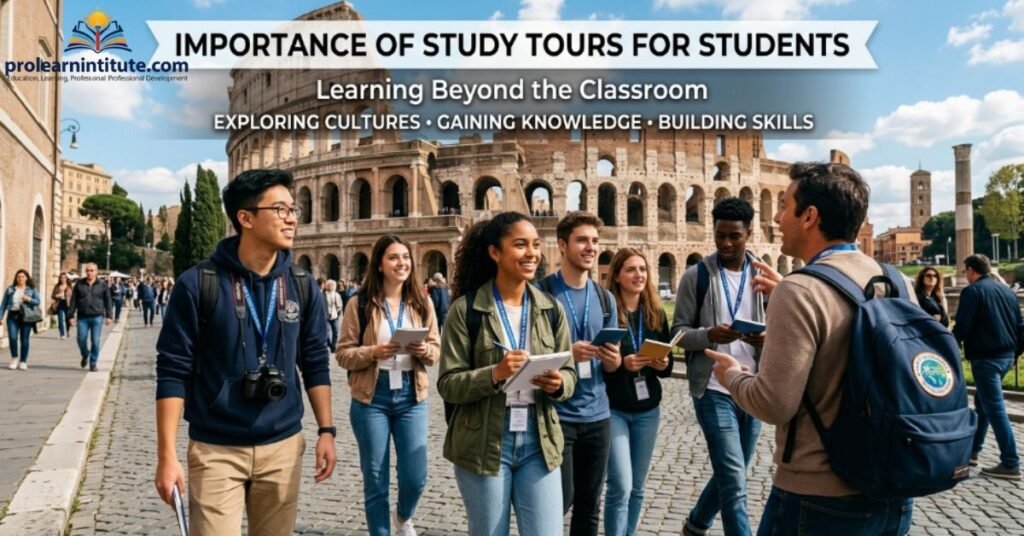
Study tours play a huge role in a student’s overall development. They connect what students learn in the classroom to the real world around them. When a student visits a museum, a factory, a national park, or a historical site, they see their lessons in a completely new light.
Education research consistently shows that experiential learning—learning by doing and seeing—produces deeper understanding and longer-lasting memory. A student who reads about the Mohenjo-daro civilization in a textbook will remember far less than one who actually visits the site and walks through its ruins.
Beyond academics, study tours teach students how to behave in public, how to manage time, how to work in groups, and how to adapt to new environments. These life skills cannot be taught in a classroom. Many students also discover new passions and interests during educational trips that shape their future career choices.
Benefits of Educational Trips
Educational trips offer a wide range of benefits for students at every level. Here is a clear breakdown:
| Benefit | What It Means for Students |
| Better Understanding | Real-world exposure makes complex topics easier to grasp |
| Improved Memory | Experiences stick in the mind far longer than notes |
| Teamwork Skills | Students learn to cooperate and support each other |
| Cultural Awareness | Visiting new places builds open-mindedness and respect |
| Confidence Building | New environments push students out of their comfort zone |
| Career Inspiration | Many students discover future interests on field trips |
| Mental Refreshment | A break from routine boosts motivation and focus |
| Communication Skills | Students practice talking, asking questions, and listening |
When Do Schools Arrange Study Tours?
Schools typically plan study tours at specific times during the academic year to avoid disrupting major exams or important classes. Most schools prefer organizing them after mid-term exams when students need a mental break, and teachers have covered enough syllabus to make a relevant trip worthwhile.
| Time of Year | Common Reason | Best For |
| After Mid-Term Exams | Students need a break and a reward | All Classes |
| Start of Academic Year | Team-building and bonding activities | Class 6–8 |
| Before Annual Exams End | Farewell educational trip for seniors | SSC / HSC |
| National Holidays | Historical or cultural visits | All Classes |
| Science / Project Week | Subject-specific field research | Class 8–HSC |
Some schools also arrange study tours as part of a specific subject project — for example, a biology class visiting a botanical garden or a physics class visiting a power plant.
Basic Format of a Study Tour Application
Every study tour application follows the same standard formal letter structure. Missing any part — like the date, your class name, or the subject line — makes the application look incomplete and unprofessional. Always follow this format carefully.
| Part | What to Write | Example |
| Date | Today’s full date | 25 April 2026 |
| Receiver | Principal’s title and school name | The Principal, ABC School |
| Subject | One clear line stating the purpose | Application for Study Tour |
| Salutation | Respectful greeting | Respected Sir/Madam, |
| Paragraph 1 | Who you are and what you are requesting | Name, class, roll number, purpose |
| Paragraph 2 | Full details of the tour | Destination, date, number of students, teacher |
| Paragraph 3 | Polite closing request | Ask for permission and express gratitude |
| Sign-Off | Formal closing and your name | Yours obediently, [Name], Class [X] |
Tips to Write a Perfect Study Tour Application
A strong application is short, polite, and complete. Principals read many letters daily, so being clear and organized makes a strong impression. Here are the most important tips to follow:
Always mention your full name, class, and roll number right at the start of the first paragraph. State the destination, number of students going, and the exact date or dates of the trip. Mention the name of the supervising teacher who will accompany the students — this is important for safety and credibility.
Keep the language formal but simple. Avoid slang or casual words like “gonna” or “wanna.” Do not write overly long sentences — two to three lines per paragraph is enough. Always end with a polite request and a thankful closing.
Proofread the application carefully before submitting. Even one or two spelling mistakes can make a well-written application look careless. If submitting a physical copy, write neatly in blue or black ink. If submitting digitally, use a clean font like Times New Roman or Arial at size 12.
Common Mistakes Students Make
Many students lose approval simply because of avoidable errors. Here are the most common mistakes to avoid:
Forgetting the subject line—The subject line tells the principal at a glance what the letter is about. Never skip it.
Not mentioning the teacher’s name—principals want to know who will supervise the students. Always include the teacher’s name and subject.
Being too casual—Phrases like “We really want to go” or “It will be so fun” sound immature. Keep the tone professional.
Missing the date of the trip—This is one of the most important details. Always clearly state the date or dates of the tour.
Writing too long—A study tour application does not need to be longer than three paragraphs. Stay focused and concise.
Using the wrong salutation—”Dear Sir” is acceptable, but “Respected Sir/Madam” is more formal and more appropriate for school applications in Pakistan and South Asia.
Main Application Samples (Class-Wise)
The following samples are ready to use. Simply change the name, destination, class, date, and school name to match your own details. Each sample is written at the right level for its class.
Application for Study Tour (General Version)
Date: [Write Today’s Date]
The Principal, [School Name], [City Name]
Subject: Application for Permission to Attend a Study Tour
Respected Sir/Madam,
I am [Your Full Name], a student of Class [X], Roll No. [X], at your esteemed school. On behalf of my classmates, I humbly request your kind permission to organize a one-day study tour to [Destination] on [Date].
The trip will include approximately [number] students and will be supervised by [Teacher’s Name], our [Subject] teacher. We plan to depart at [time] and return by [time] on the same day. This visit is directly related to our [Subject] curriculum and will help us understand [topic] in a practical and meaningful way.
We respectfully request that you grant us permission for this educational trip. We assure you that all students will maintain full discipline and follow school rules throughout the visit.
Yours obediently,
[Your Full Name] Class [X], Roll No. [X]
[School Name]
Application for Study Tour for Class 6 & 7 (Simple Version)
Date: 25 April 2026
The Principal, Bright Future School, Lahore
Subject: Application for a Study Tour to the National Museum
Respected Madam,
I am Sara Ali, a student of Class 6-B, Roll No. 12. I am writing to request your kind permission for a one-day study tour to the National Museum, Lahore, on 5 May 2026. Our whole class is very excited about this visit, which connects directly to our history lessons this term.
Our class teacher, Ms. Hina Khan, has agreed to supervise the trip. A total of 30 students will be attending. We will travel by school van and return before 4:00 PM. All expenses will be covered by the students themselves.
We kindly request that you grant us permission for this educational visit. We promise to behave responsibly and follow all school rules throughout the trip.
Yours obediently,
Sara Ali Class 6-B, Roll No. 12
Bright Future School, Lahore
Study Tour Application for Class 8
Date: 25 April 2026
The Principal, The City Grammar School, Karachi
Subject: Request for Permission to Organize a Study Tour to Lahore Fort
Respected Sir,
I am Ahmed Raza, a student of Class 8-A, Roll No. 5. I am writing on behalf of my classmates to respectfully request your permission for an educational study tour to the Lahore Fort and Badshahi Mosque on 10 May 2026. This visit is closely linked to our social studies and Pakistan studies curriculum for this term.
A total of 35 students will be participating in this trip, and two class teachers — Mr. Fahad and Ms. Nadia — will accompany us for full supervision. We plan to travel by school bus and will return before 5:00 PM on the same day. All travel and entry costs will be managed by the students.
We would be truly grateful for your approval and look forward to your positive response. This trip will greatly strengthen our understanding of Pakistan’s rich historical heritage.
Yours obediently,
Ahmed Raza Class 8-A, Roll No. 5
The City Grammar School, Karachi
Application for Study Tour for SSC
Date: 25 April 2026
The Principal, Government High School, Faisalabad
Subject: Application for Permission to Conduct an Educational Study Tour
Respected Sir,
I am Zara Mahmood, a student of Class 10-B, Roll No. 18, at your institution. With due respect, I wish to inform you that our class has planned an educational trip to the Khewra Salt Mine, Punjab, on 15 May 2026. The primary purpose of this visit is to study geological formations and natural mineral deposits as part of our Science and Geography syllabus.
A total of 40 students will be participating in this tour, and the trip will be fully supervised by Mr. Tariq Ahmed, our Science teacher, and Ms. Amna Riaz, our Geography teacher. We will travel by hired bus and are expected to return by 6:00 PM. All expenses, including transportation and entry fees, will be borne by the students themselves.
I kindly request that you grant us permission to proceed with this educational visit. Your approval will be a great source of encouragement for us, and we assure you of complete discipline and responsible behavior throughout the trip.
Yours obediently,
Zara Mahmood Class 10-B, Roll No. 18
Government High School, Faisalabad
Study Tour Application for HSC (Advanced Version)
Date: 25 April 2026
The Principal, Superior College, Lahore
Subject: Application for Formal Approval of an Educational Study Tour
Respected Sir/Madam,
I am Ali Hassan, a student of FSc Pre-Engineering, Part II, Roll No. 24, at your esteemed institution. I am writing on behalf of our class to formally request your valued permission for a two-day educational study tour to the Tarbela Dam and Attock Oil Refinery in Khyber Pakhtunkhwa, scheduled for 20 and 21 May 2026.
This tour has been carefully planned in collaboration with our physics teacher, Mr. Bilal Chaudhry, and our chemistry teacher, Ms. Sana Iqbal, both of whom will accompany the group for full supervision throughout the trip. A total of 45 students will participate. The visit is highly relevant to our FSc curriculum, as it will provide us with firsthand knowledge of energy generation, industrial chemical processes, and large-scale engineering infrastructure—topics that are directly covered in our final year syllabus. Seeing these processes in a real industrial setting will significantly strengthen our conceptual understanding before the board examinations.
All travel and accommodation expenses will be fully managed by the students. We commit to maintaining the highest standards of discipline and conduct in accordance with college rules and regulations. We are hopeful that you will view this initiative positively and grant us your kind approval.
Yours obediently,
Ali Hassan FSc Pre-Engineering, Part II, Roll No. 24
Superior College, Lahore
Conclusion
Writing a study tour application does not have to feel difficult or stressful. Once you understand the format and the tone, it takes only a few minutes to produce a clear, professional, and convincing letter. The key is to be polite, be specific, and cover all the important details — your name, class, destination, date, supervising teacher, and the educational purpose of the trip.
Use the sample that matches your class level, fill in your personal details, and you are ready to submit them. A well-written application not only gets you permission faster—it also leaves a positive impression on your teachers and principal. Good luck with your application, and even better luck with the trip itself.
Frequently Asked Questions
1. What is the best way to write a study tour application for class 6 students?
The best way is to use a formal letter format with a polite request, mentioning the destination, educational purpose, duration, and travel dates—keeping the language simple and respectful.
2. How do I write a study tour application letter for HSC students that gets approved quickly?
Write a clear, concise letter addressed to the principal, stating the academic benefit of the tour, proposed itinerary, student count, and supervision plan—attaching a teacher’s endorsement increases approval chances significantly.
3. What should be included in a study tour application format for secondary school students?
A proper format should include the date, principal’s address, subject line, body paragraphs covering purpose and details, a list of participating students, and a formal closing with the class teacher’s signature.
4. Can you give me an example of a study tour application for a science museum visit for class 8?
Yes—address the principal, mention that the class 8 science students wish to visit [Museum Name] on [Date] to supplement their curriculum, request permission and transport support, and close with your name and designation.
5. What is the difference between a study tour application and a regular school trip permission letter?
A study tour application focuses on academic objectives, linking the trip directly to curriculum goals, while a regular permission letter is more general. Study tour applications typically require stronger justification and institutional approval.
6. How long should a study tour application letter be for high school or HSC-level students?
An ideal study tour application should be one page or around 200–300 words long enough to cover the purpose, dates, destination, and logistics, but concise enough to hold the principal’s attention.
7. What are the most common mistakes students make when writing a study tour application for class 9 or 10?
The most common mistakes include missing the date or subject line, using informal language, not mentioning the educational purpose clearly, and forgetting to get the class teacher’s countersignature before submission.
8. Is there a specific study tour application format recommended for SSC or HSC students in Bangladesh?
Yes—in Bangladesh, SSC and HSC students should follow a formal Bangla or English letter format addressed to the headmaster or principal, including student roll numbers, class section, tour destination, dates, and a guardian consent note.
9. How do I convince my school principal of a study tour application that the trip is educationally valuable?
Mention specific curriculum topics the tour will reinforce, name the institution or site being visited, explain how it complements classroom learning, and, if possible, attach a brief itinerary or a supporting note from the subject teacher.
10. What tips should class 6 to class 10 students follow to make their study tour application sound more professional?
Always use formal salutations, avoid slang, organize information in clear paragraphs, proofread for spelling errors, mention safety and supervision arrangements, and submit the application at least one to two weeks before the intended tour date.

I’m Jordan Smith, a content writer with 4 years of experience and AI content expertise, creating clear, engaging, and easy-to-understand educational content.