

Once upon a time, a poor but honest woodcutter dropped his axe in a river. A fairy appeared and rewarded his honesty with gold and silver axes. This timeless story teaches one of life’s most important lessons—that honesty always wins in the end. Learning moral stories like this helps students build strong character and write better in exams.
Introduction
The Honest Woodcutter is one of the most popular moral stories taught in Pakistani schools from Class 6 to HSC. It is simple enough for young students yet rich enough in meaning for advanced learners. Moral-based storytelling builds both language skills and good values at the same time, making it a perfect topic for all grade levels.
The Honest Woodcutter Story (Simple Version for Beginners)
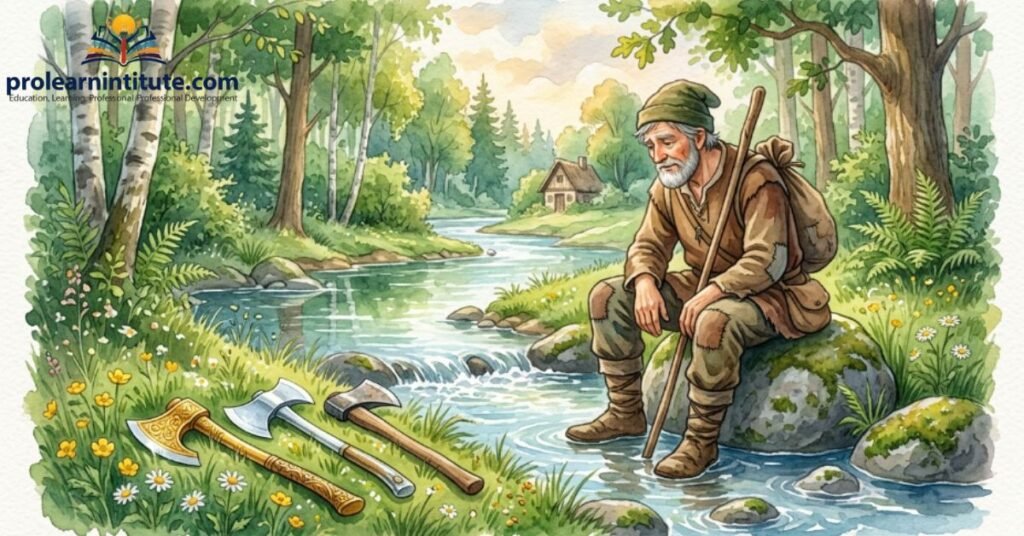
A poor woodcutter was cutting wood near a river. His axe fell into the water by accident. A fairy came out of the river and showed him a golden axe, but he said it was not his. She then showed a silver axe, and again he refused. Finally, she brought his iron axe, and he happily accepted it. The fairy was so pleased with his honesty that she gave him all three axes as a reward.
Detailed Story with Dialogue (Middle Level)
A woodcutter lived in a small village and worked hard every day to feed his family. One afternoon, while cutting a tree near the riverbank, his iron axe slipped from his hands and fell into the deep water. He sat down sadly, not knowing what to do.
Suddenly, a fairy rose from the river and asked, “Why are you sad, dear woodcutter?”
“I have lost my axe,” he replied. “Without it, I cannot work, and my family will go hungry.”
The fairy dived into the river and came back with a golden axe. “Is this yours?” she asked.
“No,” said the woodcutter honestly. “That is not mine.”
She dived again and returned with a silver axe. Again, he shook his head. Finally, she brought his old iron axe, and the woodcutter’s face lit up with joy.
“Yes! That is mine!” he said happily.
The fairy smiled and rewarded him with all three axes for his honesty.
Expanded Story with Description (Class 8 Level)
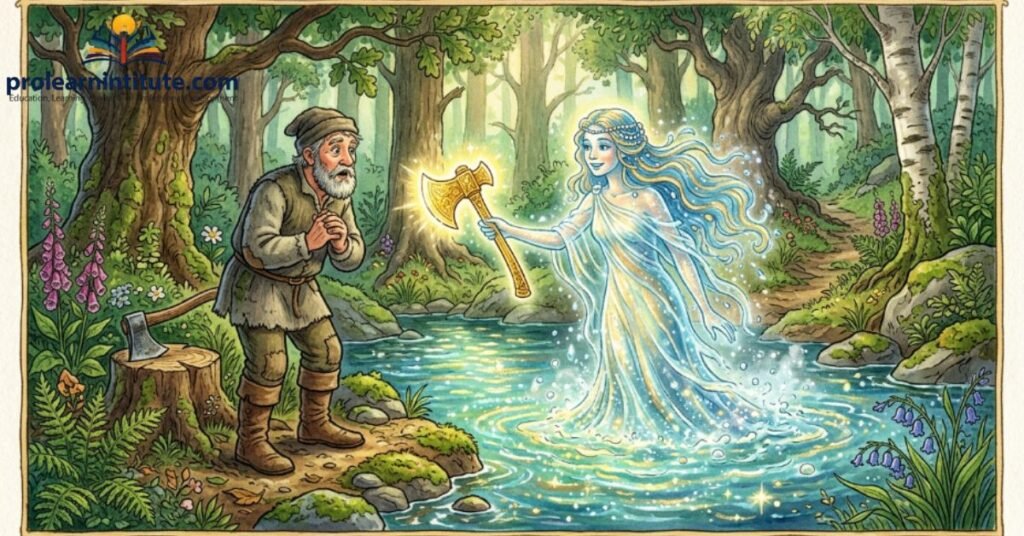
Deep inside a green forest, where tall trees touched the sky, and a clear river flowed quietly, a poor woodcutter worked from morning to evening. He earned very little but never complained. One day, while he was cutting wood near the river, his only axe slipped and sank into the deep, cold water. He felt helpless because that axe was his only source of income.
Just then, the calm surface of the river rippled, and a kind fairy appeared, glowing softly in the afternoon light. She listened to the woodcutter’s problem and dived into the river three times, each time bringing a different axe. The woodcutter refused both the golden and silver axes because they were not his. When his own simple iron axe appeared, he grabbed it with a grateful heart.
Moved by his honesty, the fairy rewarded him with all three axes. That evening, the woodcutter returned home not just with wealth, but with proof that an honest heart is the greatest treasure of all.
Completing Story Format (Exam Preparation)
In exams, students are often given the beginning of a story and asked to complete it. Here is a common starting and two sample completions:
Given Opening: “A woodcutter was working near a river when suddenly his axe fell into the water…”
Sample Completion 1: He sat down and cried. A fairy appeared and offered him a golden axe, but he refused it. She then offered silver, which he also denied. When she brought his iron axe, he joyfully accepted it. The fairy rewarded his honesty with all three axes.
Sample Completion 2: He looked into the river with a worried face. Suddenly, a bright light appeared from the water, and a fairy stepped out. After testing his honesty three times with different axes, she rewarded him greatly. The woodcutter returned home rich, all because he told the truth.
Class-Wise Story Sections
For Class 6–7 (Very Simple Version)
A woodcutter lost his axe in a river. A fairy came and showed him golden and silver axes. He said no to both because they were not his. The fairy gave him his own iron axe and rewarded him for being honest. The moral is: always tell the truth.
For Class 8 (Moderate Level)
A poor woodcutter accidentally dropped his axe into a deep river while working in the forest. A fairy appeared and tested his honesty by offering him a golden axe and then a silver axe. Each time, the woodcutter politely refused, saying they did not belong to him. Impressed by his truthfulness, the fairy rewarded him with all three axes. This story teaches us that honesty brings far greater rewards than greed ever could.
For SSC (Secondary Level)
A hardworking woodcutter lost his iron axe in a river and was overcome with grief, as it was his only means of earning a living. A river fairy appeared before him and tested his character by presenting a golden axe and then a silver one. The honest woodcutter rejected both without hesitation, insisting that only his plain iron axe belonged to him. Deeply moved by his integrity, the fairy generously rewarded him with all three axes. This story powerfully illustrates that honesty is not just a moral virtue—it is a practical key to success and reward in life.
For HSC (Higher Secondary Level)
The story of the honest woodcutter is a timeless parable that explores the eternal conflict between integrity and temptation. A humble woodcutter, stripped of his only livelihood when his axe falls into a river, faces a defining moral test. When a fairy presents him with axes of gold and silver, he refuses both with quiet dignity, choosing truth over temptation. This act of selfless honesty distinguishes him not just as a good man, but as a rare one. The fairy’s reward is symbolic — it suggests that the universe responds generously to those who act with genuine integrity. In a world driven by greed and self-interest, the woodcutter stands as a compelling reminder that moral courage, however simple it may seem, carries profound and lasting value.
Key Elements of the Story
Main Characters
| Character | Role in the Story |
| Woodcutter | Poor, hardworking, and deeply honest hero of the story |
| Fairy / Angel | Tests his honesty and rewards him for passing the test |
Setting
The story takes place in a dense, peaceful forest beside a flowing river. The natural environment — tall trees, calm water, soft light — creates a magical atmosphere that makes the fairy’s appearance feel believable and enchanting.
Theme
The central theme is honesty vs greed. The woodcutter represents honesty, while the story warns against the greed shown by others who try to copy him dishonestly and are punished for it.
Moral of the Story
“Honesty is the best policy” is the core message. It means that telling the truth, even when it costs you something, always leads to better outcomes in the long run. An honest person earns trust, respect, and real reward—things that greed and lies can never provide.
Alternative Versions of the Story
Version 1 — The Greedy Neighbor: After hearing the woodcutter’s story, a greedy neighbor throws his own axe into the river on purpose. When the fairy shows him a golden axe, he claims it eagerly. The fairy sees through his lie, and he loses everything, including his own axe.
Version 2 — The Modern Twist: A student finds a wallet full of money and returns it to its owner. Instead of keeping it, he hands it in to the authorities. The owner, moved by his honesty, rewards the student with a scholarship. Same moral, fresh setting.
Version 3 — The Shorter Ending: The fairy simply returns the iron axe and vanishes. The woodcutter learns that being honest is its own reward, even without gold or silver.
Exam Tips for Students
Here are the most important things to remember when writing this story in an exam:
- Always write in clear, simple paragraphs—do not write the story as a list
- Start with a strong opening line that sets the scene immediately
- Include at least one line of dialogue to make your story feel alive
- Always end with the moral, either as a sentence or a short final paragraph
- Keep your handwriting neat and your sentences short and clean
Common mistakes to avoid:
- Do not confuse the woodcutter’s axe with gold or silver from the start
- Do not forget to write the moral—examiners always look for it
- Do not make the story too short—aim for at least five to six sentences at minimum
- Avoid copying word for word—write in your own style using the ideas given
Conclusion
The story of the honest woodcutter is more than just a fairy tale—it is a lesson that stays with a person for life. Honesty, hard work, and the courage to refuse temptation are values that every student should carry into the real world.
No matter which class you are in, this story has something valuable to offer you. Learn it, understand its moral deeply, and write it in your own words—because the best version of this story is always the one that comes from an honest heart.
Frequently Asked Questions
1. What is the moral lesson of the Honest Woodcutter story for class 6 students?
The moral of the Honest Woodcutter story is that honesty is the best policy—when the woodcutter truthfully admitted his axe was made of iron, the god rewarded him with golden and silver axes as well.
2. Can you tell me a summary of the Honest Woodcutter story suitable for HSC students?
A poor woodcutter accidentally dropped his iron axe into a river. A god appeared and offered him golden and silver axes, but he honestly claimed only his own iron axe, and was rewarded with all three for his truthfulness.
3. Who are the main characters in the Honest Woodcutter story?
The two main characters are the poor woodcutter and the river god (or Mercury/an angel), whose test of honesty forms the entire foundation of the story.
4. Why did the woodcutter refuse to take the golden axe in the Honest Woodcutter story?
The woodcutter refused the golden and silver axes because they were not his own—he valued honesty over greed and only claimed the iron axe that truly belonged to him.
5. How does the Honest Woodcutter story teach children the value of truthfulness?
The story teaches children that telling the truth, even when tempted by reward, leads to greater blessings, while dishonesty — as shown by the greedy neighbor — leads to loss and punishment.
6. What happened to the dishonest woodcutter at the end of the Honest Woodcutter story?
The dishonest woodcutter deliberately threw his axe into the river, then falsely claimed the golden axe as his own—the god punished him by taking away all the axes, leaving him with nothing.
7. How do you write the Honest Woodcutter story as a paragraph for class 6, 7, or 8?
Start with the setting (a poor woodcutter working near a river). Describe the axe falling into the water, and introduce the god’s test with golden and silver axes. Show the woodcutter’s honest response, and conclude with the reward—keeping it within 100–150 words for classes 6–8.
8. What is the best way to write a composition on the Honest Woodcutter story for SSC and HSC exams?
For SSC and HSC, write the story in five clear paragraphs — introduction, rising conflict, climax (the god’s test), resolution (the reward), and a concluding moral — using past tense, vivid descriptive language, and a strong final moral statement.
9. Is the Honest Woodcutter story based on a real event, or is it a fable or fairy tale?
The Honest Woodcutter story is a classic moral fable, often attributed to Aesop’s Fables, and is not based on a real event—it uses symbolic characters to deliver a timeless ethical lesson about honesty.
10. What are some alternative titles for the Honest Woodcutter story used in Bangladeshi and Pakistani textbooks from class 6 to HSC?
In South Asian textbooks, this story is commonly found under titles such as “The Woodcutter and the River God,” “The Golden Axe,” “An Honest Poor Man,” or simply “Honesty is the Best Policy”—all referring to the same classic moral tale.

I’m Jordan Smith, a content writer with 4 years of experience and AI content expertise, creating clear, engaging, and easy-to-understand educational content.