
Introduction
Sheikh Saadi was one of the greatest Persian poets and moral storytellers of all time. His stories have been taught in schools for hundreds of years because they carry powerful life lessons. Students from Class 6 to HSC can learn wisdom, honesty, and kindness through his timeless tales.
This article gives you the same story written at different levels—from simple to advanced. You will also find moral lessons, writing tips, and exam guidance all in one place.
Who Was Sheikh Saadi?
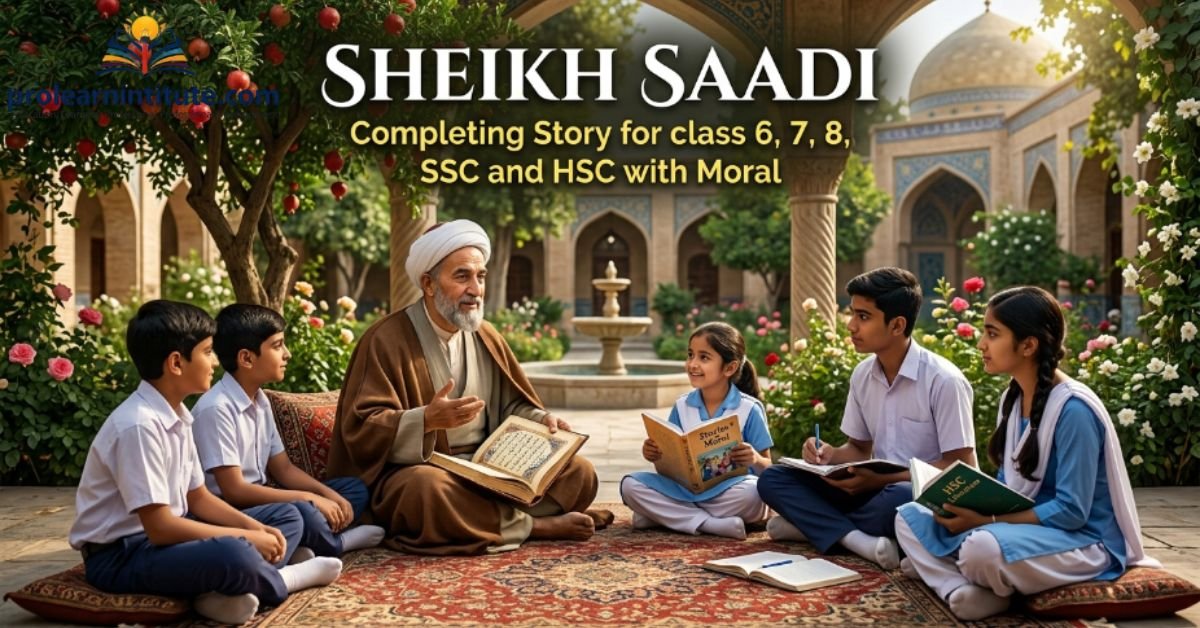
Sheikh Saadi was born around 1210 AD in Shiraz, Iran. He traveled the world for many years and wrote about his experiences in two famous books—Gulistan and Bustan. His stories are full of wisdom, humor, and deep moral lessons.
His work has been part of school syllabuses across South Asia for generations. Teachers use his stories to build both language skills and character in students. That is why his name still appears in textbooks from Class 6 all the way to HSC.
Story for Class 6 (Simple Version)
One day, Sheikh Saadi visited a rich man’s house wearing old clothes. The servants did not let him in. He went home, wore expensive clothes, and came back. This time, everyone welcomed him with great respect.
At dinner, Saadi put food into his coat sleeve and said, “Eat, my coat—they invited you, not me.” The rich man felt ashamed when he understood the message.
Moral Lesson (Class 6 Level)
| Lesson | Meaning |
| Do not judge by looks | A person’s clothes do not show their true worth |
| Respect everyone | Kindness should not depend on wealth or dress |
Story for Class 7 & 8 (Moderate Version)
Sheikh Saadi was traveling and stopped at a wealthy man’s home to rest. Because he wore simple, torn clothes, the servants treated him rudely and refused him entry. Saadi left quietly without saying a word.
He returned later wearing fine robes and a grand turban. The servants bowed, and the rich man welcomed him with great honor. During the feast, Saadi began pushing food into his sleeves. When the host asked why, Saadi replied, “You invited my clothes, not me—so I am feeding them.” The entire room fell silent in shame.
Moral Lesson (Class 7–8 Level)
- True respect is given to a person’s character, not their appearance.
- A wise person responds to injustice with wisdom, not anger.
- Wealth and fine clothes can fool the foolish but never the wise.
Story for SSC Students (Detailed Version)
Sheikh Saadi, the great Persian scholar, was on a long journey when he arrived at the house of a wealthy merchant. Dressed in the plain robes of a traveler, he knocked on the door and politely asked for shelter. The servants looked him up and down, mocked his simple clothing, and turned him away without a second thought.
Saadi did not argue. He calmly returned to his inn, dressed himself in his finest silk robes, and went back to the merchant’s house. The reaction was completely different. The doormen bowed, the servants rushed to serve him, and the merchant himself came forward with a warm welcome.
At the dinner table, Saadi began stuffing food into the sleeves of his expensive coat. The guests stared in confusion. The merchant asked him to explain. Saadi stood up and said with quiet dignity, “The first time I came, you turned me away. The second time, you welcomed me. The only thing that changed was my coat. So it is only fair that my coat should enjoy this meal, not I.”
The merchant’s face turned red. He apologized deeply and learned that a man’s worth lies in his soul, not his silk.
Key Themes and Morals (SSC Level)
| Theme | Explanation |
| Appearance vs. Reality | People often judge others by clothes and status, not character |
| Social Hypocrisy | The rich treat people differently based on wealth |
| Wisdom over Anger | Saadi corrected the wrong without losing his dignity |
| True Respect | Respect must be earned by character, not bought by wealth |
Story for HSC Students (Advanced Version)
The story of Sheikh Saadi and the rich man’s feast is not merely a tale of personal insult and clever response—it is a sharp critique of the social structures that elevate appearance over substance. Saadi, already a man of immense intellectual reputation, deliberately chose to test the household’s moral character by appearing in humble dress.
When turned away, he did not react with bitterness or complaint. Instead, he constructed a quiet, precise demonstration of the very hypocrisy he had experienced. His act of feeding his coat at the dinner table transformed a personal slight into a universal lesson—one that forced every person in that room to confront their own shallow values.
This story reflects Saadi’s broader philosophy: that true dignity cannot be worn or removed. It also reveals the emptiness of a society that assigns human worth based on material wealth. The merchant’s shame at the end is not simply embarrassment—it is the moment of moral awakening that Saadi intended all along.
Critical Analysis and Moral (HSC Level)
- Irony as a Tool: Saadi uses irony masterfully — the very clothes that earned him entry become the subject of his criticism.
- Social Commentary: The story critiques class-based discrimination that was common in medieval society and remains relevant today.
- Philosophical Depth: Saadi’s response reflects Sufi values—that the soul is more important than the body, and wisdom more powerful than wealth.
- Character of Saadi: He is portrayed not as a victim but as a teacher — calm, deliberate, and deeply humane.
Main Moral Lessons of the Story
- Honesty — Saadi honestly showed the world its own ugly truth through a simple act.
- Wisdom — He used intelligence instead of anger to make his point.
- Kindness — Despite being insulted, Saadi did not humiliate anyone—he taught them.
- Justice — He made sure the lesson was felt by everyone present, not just the merchant.
Why This Story Is Important for Students
This story appears in exams at almost every level because it carries a strong, clear moral. It helps students write better essays, paragraphs, and story completions with a proper ending. More importantly, it teaches students how to behave with dignity and treat others with fairness.
Understanding Saadi’s stories also builds emotional intelligence. Students learn that how you react to unfair treatment says more about your character than the treatment itself.
Writing Tips for Completing the Story
- How to Start Effectively: Begin with a setting or action—”Sheikh Saadi was traveling through a busy city when…” This pulls the reader in immediately.
- How to Build the Plot: Introduce a conflict early (Saadi being turned away), then build tension, and finally deliver the turning point (the dinner scene).
- How to End with a Strong Moral: Always close with a sentence that reflects the lesson — “From that day on, the merchant learned never to judge a man by his coat.”
Common Mistakes Students Should Avoid
- Overwriting: Do not add too many unnecessary details. Keep the story focused and clean.
- Weak Moral: The moral must connect directly to what happened in the story. A vague ending loses marks.
- Poor Structure: Every story needs a clear beginning, middle, and end. Jumping around confuses the reader and the examiner.
Conclusion
Sheikh Saadi’s story teaches us that true value lies in character, not clothing. His wisdom has survived for centuries because it speaks to something every human being understands — the pain of being judged unfairly.
Whether you are in Class 6 or preparing for HSC, this story will help you in exams and in life. Read it carefully, understand its layers, and let its moral guide your own actions.
Frequently Asked Questions
1. What is the most famous Sheikh Saadi story taught in classes 6 through HSC with a strong moral lesson?
The most famous Sheikh Saadi story taught from Class 6 to HSC is “The Ungrateful Son” (or similar tales from Gulistan and Bustan), which teaches that kindness, gratitude, and humility are the foundation of a virtuous life.
2. What moral lesson do students learn from Sheikh Saadi’s stories in their school curriculum?
Sheikh Saadi stories teach students timeless morals such as honesty, compassion, humility, and the consequences of greed, making them essential readings for character development across all academic levels.
3. Which Sheikh Saadi story is best for Class 6 students with an easy-to-understand moral?
The story of “The Greedy Man and the Wise Man” from Saadi’s Gulistan is ideal for Class 6 students, as it simply and clearly illustrates that greed leads to destruction while contentment brings peace.
4. How does Sheikh Saadi use storytelling to teach moral values to young students from Class 6 to HSC?
Sheikh Saadi uses short, engaging parables filled with real-life characters—kings, beggars, and wise men—to deliver powerful moral messages that are easy for students of all ages to understand and remember.
5. What is the summary and moral of Sheikh Saadi’s story about the ungrateful child for school students?
In this story, a father sacrifices everything for his child, who later ignores him in old age. The moral is that those who forget their parents’ sacrifices will face regret, reminding students to always honor and respect their elders.
6. Why are Sheikh Saadi stories included in the Bengali and English syllabus from Class 6 to the HSC level?
Sheikh Saadi’s stories are included in the syllabus because they combine literary beauty with ethical wisdom, helping students develop both language skills and strong moral character simultaneously.
7. What is the main theme of Sheikh Saadi stories that makes them relevant for students of all classes?
The main theme across Sheikh Saadi’s stories is the triumph of wisdom, kindness, and virtue over arrogance, greed, and cruelty—a universal message that remains relevant for every generation of students.
8. Can you tell me a short Sheikh Saadi story with a moral suitable for HSC exam preparation?
One popular HSC-level story tells of a proud king humbled by a wise dervish, teaching that true greatness lies in wisdom and humility, not wealth or power — a theme frequently tested in board exams.
9. What is the difference between the morals in Sheikh Saadi stories written for junior classes versus HSC-level students?
For junior classes, morals are simple and direct (e.g., “be honest”), while HSC-level Saadi stories explore deeper philosophical themes like justice, the nature of the soul, and the social responsibilities of leaders and citizens.
10. How can students use Sheikh Saadi’s stories to write better moral paragraphs and essays in their exams?
Students can use Saadi’s stories by quoting the core moral as a thesis statement, supporting it with story details as evidence, and concluding with a real-life application—a structure that scores highly in both SSC and HSC exams.

I’m Jordan Smith, a content writer with 4 years of experience and AI content expertise, creating clear, engaging, and easy-to-understand educational content.