
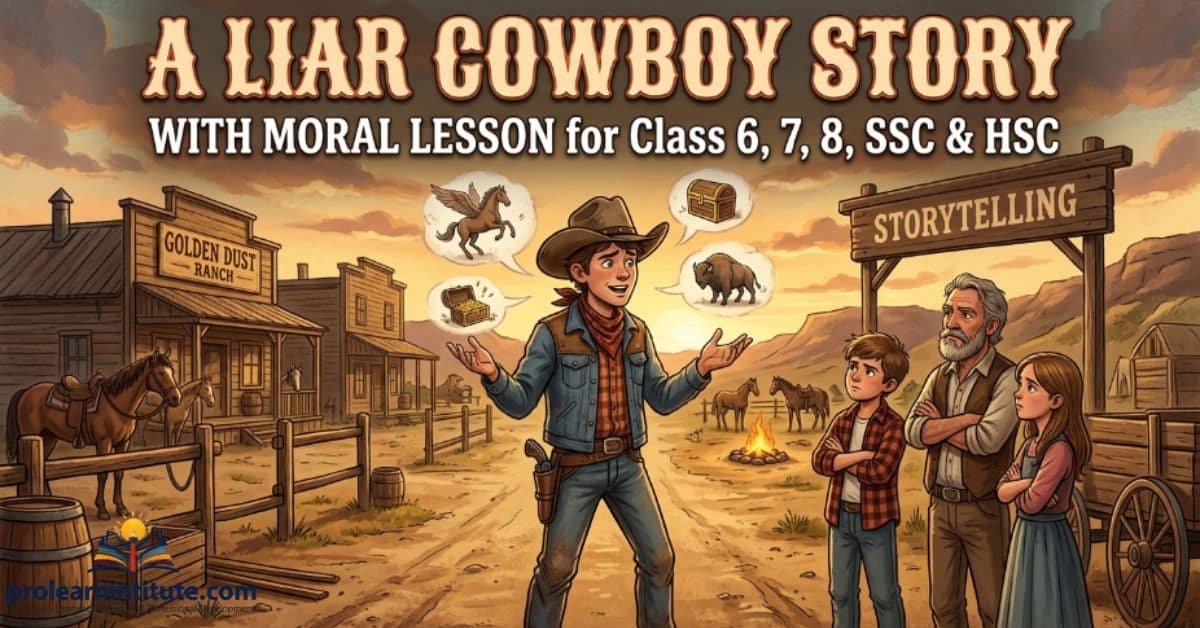
The story of the liar cowboy is one of the most popular and powerful moral stories ever told. It teaches students an important life lesson about honesty, trust, and the consequences of lying.
This guide is designed for students from Class 6 all the way to HSC. It gives different versions of the story for different levels, along with tips, lessons, and practice questions.
Introduction
The Power of Storytelling
Stories have been used for thousands of years to teach important lessons to young people. A good story stays in the mind much longer than any lecture or lesson from a textbook.
The liar cowboy story is one such tale that has been told in classrooms all over the world. It is short, simple, and carries a message that everyone needs to hear.
What Kind of Story Is This
This is a morality-based story similar to classic honesty tales like “The Boy Who Cried Wolf.” It shows how lying, even as a joke, can destroy the trust people have in you.
The story is easy to understand but carries a deep and lasting message. It teaches students what happens when you lose your reputation for telling the truth.
Who This Guide Is For
This guide is written for students from Class 6 to HSC who need to write this story in their exams or assignments. Each section gives a version of the story that matches the vocabulary and style expected at each level.
Whether you are in junior school or preparing for your higher secondary exams, this guide has exactly what you need. Read the version that matches your class and practice it well.
The Core Story (Standard Version)

The Story at a Glance
Once there was a cowboy who lived near a small village. He spent his days watching over the village cattle in the open fields. Life was peaceful, but the cowboy found it boring and wanted some excitement.
One day, he decided to play a trick on the villagers. He ran toward the village shouting, “A wolf! A wolf is attacking the cattle!” The worried villagers dropped everything and rushed to help him.
When they arrived at the field, there was no wolf. The cowboy laughed and said it was just a joke. The villagers were angry, but they went back to their work.
A few days later, the cowboy did the same thing again. “Wolf! Wolf!” he screamed. Once again, the villagers came running to help, and once again, there was no wolf.
Then one afternoon, a real wolf appeared from the forest and began attacking the cattle. The cowboy screamed with all his might, “Wolf! Wolf!” Please help me!” But this time, no one came.
The villagers heard him but thought it was another joke. They stayed in the village and continued their work. By the time anyone checked, the wolf had gone, and many cattle were lost.
The cowboy sat alone in the field, sad and sorry. He had learned his lesson the hard way — nobody believes a liar, even when he tells the truth.
Simplified Version for Junior Classes (Class 6–7)
Easy Version for Young Students
Once there was a cowboy who looked after cows near a village. He was bored, so one day he shouted, “Wolf! Wolf!” to trick the villagers. They all came running, but there was no wolf. They felt angry and went back home.
He did the same thing a second time. The villagers came again and again, but found no wolf. They warned him to stop lying, but he did not listen.
One day, a real wolf came. The cowboy shouted for help, but nobody believed him this time. The wolf hurt the cattle and ran away.
The cowboy cried alone. He understood that lying had made people stop trusting him.
Moral: Never tell lies. A liar is not believed even when he speaks the truth.
Why This Version Works
This version uses very short and simple sentences that are easy for Class 6 and Class 7 students to read and remember. The vocabulary is basic and does not include any difficult words.
The story moves quickly from one event to the next, which makes it easy to follow. Students can memorize this version in a short time and write it confidently in exams.
Tips for Class 6–7 Students:
- Use short and clear sentences
- Do not add unnecessary details
- Always write the moral at the end
- Practice writing it two or three times before the exam
Extended Version for Middle Level (Class 8)
A More Detailed Story
Once upon a time, there was a young cowboy who lived on the edge of a small, quiet village. His job was to take the village cattle to the open green fields every day and watch over them carefully. The days were long and peaceful, but the cowboy grew bored with the silence.
One afternoon, he thought of a mischievous plan to entertain himself. He ran toward the village screaming, “Wolf! Wolf! A wolf is attacking the cattle!” The villagers were frightened and rushed to the field with sticks and tools to protect the animals.
But when they arrived, they found nothing. The cowboy was laughing at his own clever trick. The villagers felt embarrassed and angry. They warned him seriously not to do this again and returned to the village.
However, the cowboy could not resist. A few days later, he raised the same false alarm again. The villagers came once more, only to find the cowboy laughing. This time, they were very upset and told him they would not come again.
Then one evening, a real and hungry wolf crept out of the forest. It began attacking the cattle fiercely. The terrified cowboy screamed as loud as he could, “Wolf! Wolf! Please, someone, help me!”
The villagers heard his cries but shook their heads. “It is that lying boy again,” they said, and did not move. No one came to help. The wolf caused great damage and disappeared into the forest.
The cowboy returned to the village ashamed, with tears in his eyes. He had learned a painful lesson that day — once you lose people’s trust, it is very hard to get it back.
Moral: A liar is not believed even when he speaks the truth.
Detailed Version for Secondary Level (SSC)
Story with Better Expression
Once there lived a young cowboy on the outskirts of a small farming village. His daily responsibility was to lead the village cattle to the vast open fields and guard them from any danger. The villagers trusted him completely with this important task.
However, the cowboy was a careless and immature young man who did not understand the value of that trust. One afternoon, overcome by boredom, he came up with a mischievous plan. He sprinted toward the village, waving his arms and screaming, “Wolf! Wolf! A wolf is attacking our cattle!” The entire village panicked, and the men rushed to the field carrying tools and weapons.
When they arrived, breathless and frightened, they found no wolf at all. The cowboy stood there grinning, clearly amused by the chaos he had caused. The villagers were furious. They warned him with serious faces that lying was dangerous and that he must never do it again. The cowboy nodded but did not take their words seriously.
A few days passed, and the cowboy played the same trick once more. The villagers came running again, only to find the same foolish grin on his face. This time, their anger turned into firm disappointment. They told him clearly that they would not fall for his tricks again.
Then came the day the cowboy had never prepared for. A large, fierce wolf appeared from the dark forest and launched a violent attack on the cattle. The cowboy screamed in genuine terror, “Wolf! Wolf! Please help me! This time it is real!” His voice echoed through the fields and into the village.
The villagers heard him but exchanged tired glances. “He is lying again,” they said calmly, and returned to their work. No one came to his rescue. By the time the wolf was gone, several cattle had been badly hurt.
The cowboy sat alone in the ruined field, filled with regret and shame. He finally understood what his foolish tricks had cost him — not just cattle, but something far more valuable: the trust and belief of the people around him.
Moral: Dishonesty destroys trust, and a person who lies is not believed even when he speaks the truth.
Advanced Version for Higher Secondary (HSC)
Mature and Reflective Narrative
Human nature has always been drawn to shortcuts and amusement, often without considering the consequences. The story of the liar cowboy is a timeless illustration of this very truth — that dishonesty, even when practiced carelessly and without harmful intent, carries a heavy price.
A young cowboy was entrusted with the responsibility of guarding the village cattle in the open fields each day. The villagers placed complete faith in him, expecting him to alert them in case of any real danger. However, the cowboy, lacking both maturity and wisdom, found his days monotonous and craved some form of entertainment.
On a quiet afternoon, he gave in to a reckless impulse and ran toward the village, shouting desperately, “Wolf! Wolf! The cattle are under attack!” The villagers, driven by genuine concern, immediately abandoned their work and rushed to the field. What they found instead was a laughing cowboy who took great pleasure in their panic. The incident left them embarrassed and angry, and they delivered a firm warning.
Weeks passed, and the cowboy repeated his deceitful performance. Once again, the villagers came running, and once again, they found nothing but the cowboy’s cruel amusement. Their patience ran out. They vowed, this time sincerely, that they would no longer respond to his calls.
Fate, however, is rarely forgiving. A wolf eventually appeared — real, hungry, and dangerous. The cowboy screamed louder than ever before, his voice trembling with genuine terror. But the village had gone silent. No footsteps approached. No help came. The wolf attacked and disappeared, leaving behind destruction and a cowboy drowning in regret.
The tragedy of this story lies not only in the loss of cattle but in something far more irreplaceable—trust. Once broken, trust is not easily rebuilt. The cowboy’s experience serves as a powerful reminder that our words carry weight, our reputation is fragile, and the choices we make in moments of carelessness can define how others see us forever.
Moral: A man who deceives others for amusement will find no one to believe him when he needs help the most. Honesty is not just a virtue — it is the foundation of every meaningful relationship.
Moral of the Story
Simple Moral
A liar is not believed even when he speaks the truth. Honesty is the most important thing in life.
Once you lose the trust of others, it is very hard to get it back. Always think before you speak, and never use lies for fun or entertainment.
Extended Explanation of the Moral
The cowboy’s story teaches us that every lie we tell takes away a little bit of our reputation. When you lie once, people may forgive you. When you lie twice, they become careful. When you lie a third time, they stop believing you completely.
This is a natural and unavoidable result of dishonesty. Trust is not something you can buy or borrow — it is built slowly through honest words and actions.
The cowboy lost his credibility not because the villagers were cruel, but because he had given them no reason to believe him. His joke was fun for a moment, but it cost him everything in the end.
The moral goes beyond just “don’t lie.” It teaches us to think about the future consequences of our present choices. A single habit of dishonesty can damage relationships, careers, and reputations that took years to build.
Key Lessons Learned
The Importance of Honesty
Honesty is the most powerful tool a person can have. When you are known as an honest person, people respect you, trust you, and come to your help without question.
The cowboy had a chance to be that kind of person, but chose entertainment over integrity. His story shows us what we lose when we do not value the truth.
Consequences of Lying
Every lie has a consequence, even if you do not see it right away. The cowboy’s lies seemed harmless at first, but slowly destroyed the villagers’ trust in him.
When the real danger came, those lies became his biggest enemy. The punishment for his dishonesty was not given by any person — it came naturally as a result of his own actions.
Consequences of Lying:
- People stop trusting you
- Your reputation gets damaged
- Nobody takes you seriously
- You face problems alone when real trouble comes
- Relationships break down slowly
Trust and Reputation
Trust is the most valuable thing a person can earn from others. It takes a long time to build, but it can be destroyed in seconds.
The cowboy’s reputation went from “trustworthy guard” to “the boy who lies” very quickly. Once that label was attached to him, even his honest words were dismissed.
Trust vs Dishonesty:
| Honest Person | Dishonest Person |
| People believe him easily | People doubt his words |
| Gets help when needed | Faces problems alone |
| Is respected in society | Loses social standing |
| Builds strong relationships | Relationships fall apart |
| Sleeps with a clear mind | Lives with guilt and regret |
Character Overview
The Cowboy (Main Character)
The cowboy is the central character of this story. He is young, careless, and bored with his daily life and responsibilities.
He is not a naturally evil person — he simply lacks wisdom and does not think about the consequences of his actions. His journey from a careless liar to a regretful young man is the heart of the story.
Character Traits of the Cowboy:
- Bored and restless
- Immature and careless
- Seeks entertainment without thinking
- Does not listen to warnings
- Learns his lesson only after facing real loss
The Villagers
The villagers represent the honest, hardworking people of society. They trust the cowboy completely at the start and respond to every alarm without hesitation.
They are not cruel or heartless — they are simply people who have been deceived too many times. Their decision not to help at the end is completely understandable and fair.
Role of the Villagers:
- Represent the trusting public
- Show how trust works in a community
- Teach the reader about broken trust
- React naturally and realistically
- Their absence at the end teaches the biggest lesson
The Wolf
The wolf is a symbol of real danger and real consequences. It appears at the worst possible moment — when the cowboy has already used up all his credibility.
The wolf does not represent evil in a deep sense but rather the reality that life does throw real problems at us. And those problems require real help, which is only available if you have built real trust.
Themes in the Story
Truth vs Lies
The most central theme of this story is the battle between truth and lies. The cowboy chooses lies over truth multiple times, and each time he does, the truth becomes harder for others to recognize when he finally speaks it.
This theme is a reminder that lying blurs the line between what is real and what is fake. People begin to see you through the lens of your past dishonesty.
Trust
Trust is the invisible thread that connects people in a community. The story shows how trust is built, damaged, and ultimately broken through repeated dishonesty.
Without trust, the cowboy was completely alone in his moment of need. The theme of trust teaches students that their words today determine whether people will stand by them tomorrow.
Responsibility
The cowboy had been given a serious responsibility — to guard the cattle and protect the village. He treated this responsibility as a burden rather than an honor.
The theme of responsibility teaches us that when others count on us, we must take our role seriously. Misusing a position of trust is one of the worst forms of dishonesty.
The Theme Summary Table
| Theme | What It Teaches |
| Truth vs Lies | Lying makes the real truth unbelievable |
| Trust | Trust is earned slowly and lost quickly |
| Responsibility | Taking duty seriously is a sign of maturity |
| Consequences | Every action has a result, good or bad |
| Community | Society works only when people are honest with each other |
Short Summary (Quick Revision Section)
The Story in Brief
A cowboy guarded cattle near a village and cried “Wolf!” twice as a joke. Both times the villagers came running, found no wolf, and felt angry.
When a real wolf finally attacked, the cowboy called for help again. But the villagers did not believe him this time and did not come.
The cattle were hurt, and the cowboy was left alone with his regret. He learned that no one believes a person who has a habit of lying.
Quick Revision Points:
- Cowboy lies twice for fun
- Villagers stop trusting him
- Real wolf attacks — nobody helps
- Cowboy loses cattle and trust
- Moral: Liars are not believed even when they tell the truth
Class-wise Writing Tips
For Class 6–7 Students
At this level, simplicity is your biggest strength. Use short sentences, common words, and tell the story clearly and directly.
Do not try to add big words or long descriptions—examiners at this level want to see that you understand the story, not that you know complicated vocabulary.
Writing Tips for Class 6–7:
- Write in simple present or past tense
- Use easy connecting words like “then,” “but,” “so.”
- Keep the story between 80 and 100 words
- Always end with the moral
- Practice writing from memory at least three times
For Class 8 Students
At the Class 8 level, you are expected to add a little more detail and use slightly richer language. Describe the scene a little, explain the feelings of the characters, and use linking words to connect your ideas.
Your story should be between 120 and 150 words and should have a clear beginning, middle, and end.
Writing Tips for Class 8:
- Use linking words like “however,” “as a result,” and “eventually.”
- Add small descriptions to make the story more vivid
- Include feelings of the characters
- Structure your story into clear paragraphs
- Use the past tense throughout the story
For SSC Students
At the SSC level, the examiner expects well-structured writing with proper paragraphs and good use of language. Focus on how the story flows from one event to the next.
Your vocabulary should be stronger, and your sentences should vary in length. Write between 150 and 180 words.
Writing Tips for SSC:
- Use a proper introduction, body, and conclusion
- Vary your sentence length for better flow
- Use strong verbs and descriptive language
- Make sure every paragraph connects to the next
- Proofread your work before finishing
For HSC Students
At the HSC level, your writing should reflect maturity, depth, and a strong command of the English language. Do not just tell the story — reflect on it and show that you understand its deeper meaning.
Use advanced vocabulary, complex sentence structures, and include a thoughtful conclusion. Write between 180 and 220 words.
Writing Tips for HSC:
- Open with a reflective or thought-provoking sentence
- Use advanced vocabulary naturally, not forcefully
- Show the psychological side of the characters
- Include a reflection on the moral at the end
- Write with confidence and a mature tone
Level Comparison Table
| Class Level | Word Count | Language Style | Focus Area |
| Class 6–7 | 80–100 words | Very simple | Clarity and brevity |
| Class 8 | 120–150 words | Slightly richer | Description and flow |
| SSC | 150–180 words | Structured | Paragraphs and expressions |
| HSC | 180–220 words | Advanced and mature | Depth and reflection |
Common Mistakes Students Make
Making the Story Too Long or Too Short
One of the most common mistakes is not following the word limit. Writing too much wastes time and can confuse the examiner, while writing too little shows poor preparation.
Always practice staying within the required word count for your level. Quality matters more than quantity in story writing.
Forgetting the Moral
Many students tell the story well but forget to write the moral at the end. The moral is one of the most important parts of this type of story.
Without the moral, the story feels incomplete. Always make it a habit to write the moral clearly at the very end.
Using Difficult Words Incorrectly
Some students try to impress examiners by using big words they do not fully understand. This often leads to awkward and incorrect sentences that hurt their marks.
Use vocabulary that you are confident with. One sentence written perfectly is far better than three sentences full of errors.
Common Mistakes Summary:
- Writing too much or too little
- Forgetting to write the moral
- Using the wrong vocabulary to sound impressive
- Not organizing the story into paragraphs
- Changing the story so much that the message is lost
- Starting every sentence the same way
- Writing in the wrong tense
Practice Questions
Question 1 — Write the Story in Your Own Words
Write the story of the lying cowboy in your own words. Use the version that matches your class level. Try to write it from memory without looking at any notes.
This is the best way to prepare for your exam. Writing from memory helps you understand how well you actually know the story.
Question 2 — Change the Ending
Rewrite the ending of the story. This time, imagine that the villagers do come to help the cowboy when the real wolf attacks. What happens? Does the cowboy learn his lesson? Does the wolf get chased away?
Write a new ending in 60 to 80 words and think about what moral would come from this new version of the story.
Question 3—Explain the Moral in 5 Lines
Write five lines explaining the moral of the liar cowboy story in your own words. Do not just copy the moral — explain what it means and why it is important in real life.
Think about how this lesson applies to your own life, your friendships, and your school environment.
Question 4 — Character Analysis
Write a short paragraph describing the character of the cowboy. What kind of person is he? What mistakes does he make? What does he learn in the end?
Use at least five to seven sentences and focus on his personality and his change throughout the story.
Question 5 — Exam-Style Practice
| Practice Task | Instructions |
| Write the story | Use your class-level version, from memory |
| Change the ending | Write a new ending in 60–80 words |
| Explain the moral | Write 5 lines in your own words |
| Describe the cowboy | Write a short character analysis |
| Identify the theme | Name three themes and explain each briefly |
Conclusion
The story of the liar cowboy is a timeless lesson that every student must read, understand, and remember. It teaches us that honesty is not just a good habit — it is the very foundation of trust, respect, and meaningful relationships in life.
No matter which class you are in, this story has something important to offer you. Practice it well, understand its message deeply, and carry its lesson with you not just for your exams, but for the rest of your life.
Frequently Asked Questions
1. What is the best liar cowboy story for Class 6 students with a moral lesson?
The best liar cowboy story for Class 6 is about a young cowboy who repeatedly fools his ranch friends with false danger alerts, only to be ignored when a real threat arrives—teaching students that honesty builds trust.
2. What is the moral lesson of the liar cowboy story taught in HSC English classes?
The core moral lesson of the liar cowboy story is: “Once a liar, always a liar”—meaning that habitual dishonesty destroys your credibility, and people will stop believing you even when you tell the truth.
3. How does the liar cowboy story help Class 6 to HSC students learn about honesty?
The liar cowboy story uses a relatable Western setting to show students of all levels—from Class 6 to HSC—that deception has real consequences, making the lesson about honesty memorable, engaging, and easy to apply in real life.
4. Can you tell me a short liar cowboy story suitable for an HSC English composition?
A cowboy named Jake kept tricking his fellow ranchers by shouting, “Wolves are attacking the cattle!” for fun. When real wolves finally struck, no one believed him—and the herd was lost. The moral: a liar is never trusted, even when speaking the truth.
5. What are the main characters in a typical liar cowboy story for school students?
A typical liar cowboy story features three main characters: the dishonest young cowboy, the trusting ranch community, and the real threat (wolves, bandits, or a storm)—together, they drive home the lesson that lies always lead to loss.
6. Why is the “Liar Cowboy” story a popular choice for Class 6 English paragraphs and compositions?
The liar cowboy story is popular for Class 6 English because it has a simple plot, vivid setting, relatable characters, and a clear moral—making it easy for young students to retell, analyze, and write compositions or paragraphs around.
7. How is the liar cowboy story different from Aesop’s “The Boy Who Cried Wolf” for HSC students?
While both stories share the same moral about dishonesty, the liar cowboy story replaces the Greek shepherd boy with a Wild West cowboy and cattle ranch setting, making it feel more adventurous and culturally diverse—a fresh angle HSC students can use in comparative essays.
8. What writing style should I use when retelling the liar cowboy story in my HSC English exam?
When retelling the liar cowboy story in your HSC exam, use a third-person narrative style with vivid descriptive language, dialogue, and a clear story arc—beginning (the lies), middle (the habit grows), and end (the real consequence)—followed by a one-line moral statement.
9. What is a good moral paragraph to add at the end of a liar cowboy story for Class 6 to HSC?
A strong closing moral paragraph reads, “This story teaches us that honesty is the foundation of trust. A person who lies frequently loses the confidence of those around them, and when they face a real crisis, no help comes. Therefore, we must always speak the truth.”
10. How can teachers use the liar cowboy story as a lesson plan for Class 6 up to the HSC level?
Teachers can use the liar cowboy story as a multi-level lesson plan by having Class 6 students retell it in simple sentences, Class 8–10 students analyze its moral theme, and HSC students write critical essays comparing it to real-life examples of dishonesty and its social consequences.

I’m Jordan Smith, a content writer with 4 years of experience and AI content expertise, creating clear, engaging, and easy-to-understand educational content.