
Introduction
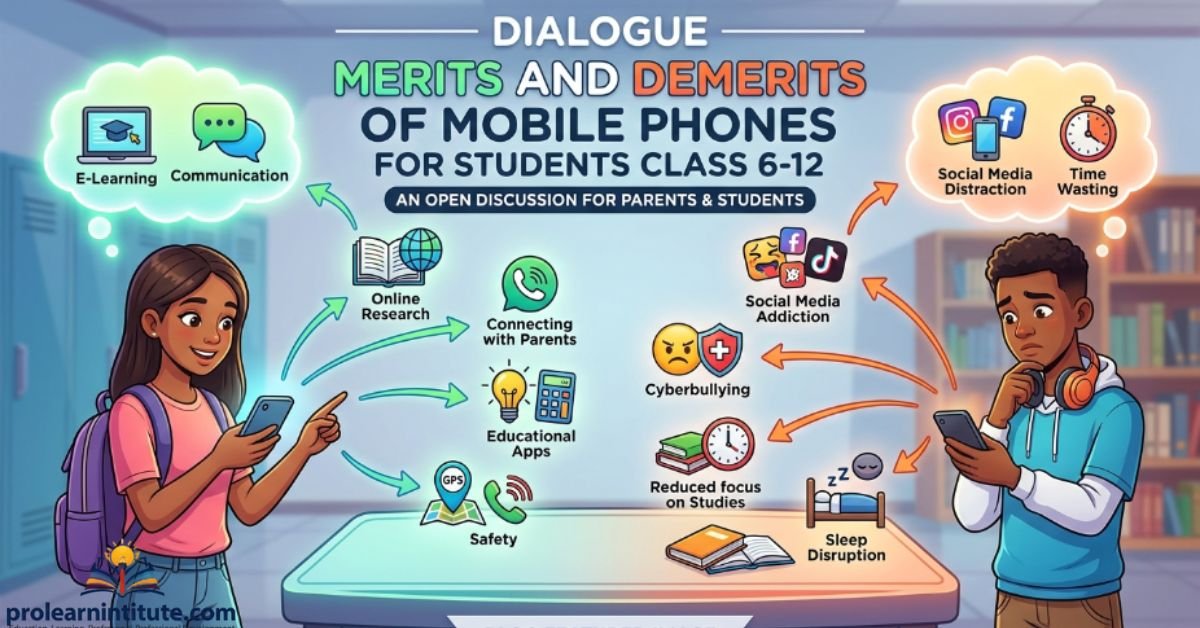
Mobile phones are small electronic devices that people use to call, text, and browse the internet. Today, they are one of the most common tools used by students and adults all around the world.
Students from grades 6 to 12 need to write dialogues about mobile phones in their exams. Knowing the right advantages and disadvantages helps students write better and score higher marks.
Dialogue for Primary & Middle Classes
Dialogue for Class 6–7 (Simple Version)
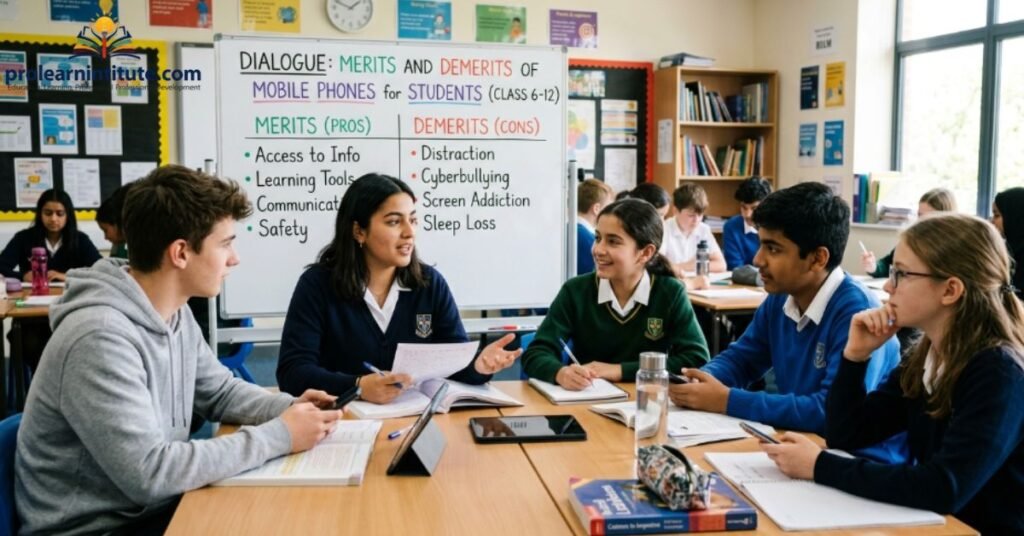
This dialogue is written for younger students who are just learning how to write conversations. It uses easy words and short sentences that are simple to understand and easy to remember.
Easy Vocabulary
The words used in this dialogue are basic and common. Students do not need difficult vocabulary to write a good dialogue at this level.
Short Lines
Each line in the dialogue should be short and clear. Long sentences can confuse the reader and lower your marks.
Basic Advantages and Disadvantages
Ali: Do you have a mobile phone?
Sara: Yes, I do. It helps me call my parents when I need them.
Ali: That is nice. But my teacher says it can also be bad.
Sara: Yes, it wastes time if we play games all day on it.
Ali: I agree. We should only use it for good purposes.
Sara: Exactly. Mobile phones are helpful when used wisely.
Dialogue for Class 8 (Moderate Level)
A Detailed Discussion
At the class 8 level, students are expected to give a little more detail in their dialogues. You should explain why something is an advantage or a disadvantage with a short reason.
Better Sentence Structure
Your sentences should be complete and grammatically correct. Using connecting words like “however,” “because,” and “but” makes your dialogue sound much better.
Ahmed: Do you think mobile phones are useful for students?
Bilal: Yes, they help us search for information online and study better.
Ahmed: But don’t you think they also waste our time?
Bilal: That is true. Many students spend hours on social media instead of studying.
Ahmed: My parents say I should only use it for one hour a day.
Bilal: That sounds like a good rule. Balance is very important for every student.
Ahmed: I also heard that too much screen time is bad for your eyes.
Bilal: Yes, we should take breaks and avoid using phones late at night.
Dialogue for Secondary Level
Dialogue for Class 9–10 (SSC Level)
Balanced Arguments
A good SSC-level dialogue must clearly include both sides of the topic. Students should not only praise or only criticize mobile phones in their writing.
Real-Life Examples
Adding real-life examples makes your dialogue more convincing and interesting. You can mention online classes, Google searches, or social media addiction as examples.
Exam-Oriented Format
Always write the speaker’s name clearly before each line in the dialogue. Use a colon after the name and keep the conversation natural and easy to follow.
Hamza: Mobile phones have completely changed how students learn today.
Zara: I agree. During online classes, my phone was my only way to attend school.
Hamza: That is a great point. But we cannot ignore the negative effects either.
Zara: You are right. Many students get addicted to TikTok and YouTube very easily.
Hamza: I read that too much phone use can cause anxiety and poor sleep habits.
Zara: Yes, mental health is a serious concern among teenagers these days.
Hamza: So do you think schools should ban mobile phones completely?
Zara: Not completely, but there should be strict rules about when to use them.
Hamza: That makes sense. Responsible use is the best solution for this problem.
Zara: Absolutely. A phone is a tool, not a toy for wasting time.
Dialogue for Higher Secondary Level
Dialogue for Class 11–12 (HSC Level)
Mature Discussion
At this level, your dialogue should sound like a real and thoughtful conversation between two educated students. Avoid childish language and focus on logic and clear thinking.
Logical Reasoning
Each point you make should have a clear reason behind it. Using facts, real examples, or references to studies adds strength to your arguments.
Formal Tone
Keep the tone respectful and formal throughout the dialogue. Avoid slang or casual words like “yeah” or “nah” in written dialogues for exams.
Aisha: The role of mobile phones in education has grown significantly over the past few years.
Raza: Indeed. They provide instant access to information, educational apps, and online resources.
Aisha: However, the negative impact on student concentration cannot be overlooked at all.
Raza: That is correct. Research shows that smartphone notifications reduce student focus greatly.
Aisha: Social media platforms are particularly addictive for young people in school.
Raza: Agreed. Many students spend four to six hours daily on non-educational content online.
Aisha: On the other hand, platforms like YouTube have made learning more accessible to all.
Raza: True. Students in remote areas now get quality education through their mobile phones.
Aisha: So the issue is not the device itself but how it is being used by students.
Raza: Precisely. Digital literacy and self-discipline are the real solutions we need today.
Short Dialogue (Quick Revision)
5–6 Lines ka Compact Version
This short dialogue is perfect for last-minute revision before your exam. It covers all the main points in just a few clear lines.
Ali: Are mobile phones helpful for students?
Sara: Yes, they help us study and stay in touch with our teachers easily.
Ali: But they can also be very distracting during study time.
Sara: True. Many students waste hours on social media every single day.
Ali: So we should use them with time limits and proper rules.
Sara: I completely agree. Smart use of phones leads to smart learning.
Long Dialogue (Detailed Version)
Fully Developed Conversation
A long dialogue gives you enough space to explore the topic in full detail. It should flow naturally from the beginning all the way to a conclusion.
Debate-Style Format
You can write a long dialogue in a debate style where both speakers argue for and against mobile phones. This format looks very impressive in board exams.
Faraz: Technology has brought mobile phones into every classroom, but is it truly beneficial?
Nadia: Without a doubt, mobile phones offer many benefits for students in today’s world.
Faraz: Can you explain what kind of benefits you are referring to exactly?
Nadia: Of course. Students can access textbooks, watch educational videos, and take online tests.
Faraz: I understand that. But does easy access always lead to better learning results?
Nadia: Not always. That is why students need discipline alongside access to technology.
Faraz: Many parents complain that their children are glued to screens all day long.
Nadia: That is a valid concern. Screen addiction is a real problem in many homes today.
Faraz: It also affects physical health. Students suffer from eye strain and back pain.
Nadia: Yes, and poor sleep is another major issue caused by using phones at night.
Faraz: What about cyberbullying? It is becoming more common among school students now.
Nadia: Sadly, that is true. Mobile phones have made it easier to bully others online.
Faraz: So it seems like the disadvantages of mobile phones are quite serious for students.
Nadia: They are, but so are the advantages. The solution is proper guidance and parental control.
Faraz: I think schools and parents both play an important role in teaching digital responsibility.
Nadia: Exactly. A mobile phone in the right hands is a very powerful learning tool for students.
10 Important Points to Include in Dialogue
When writing a dialogue on this topic, include these key points to make it strong, complete, and high-scoring.
| Point | Description |
| Communication Benefits | Mobile phones help students contact parents and teachers easily at any time |
| Educational Use | Students can use learning apps, videos, and websites for their studies |
| Time Wastage | Social media and games reduce productive study time significantly |
| Health Issues | Eye strain, headaches, and poor posture are very common problems |
| Addiction | Students can become too dependent on phones and start neglecting studies |
| Safety | Parents can stay in contact with their children and feel more secure |
| Online Resources | Dictionaries, libraries, and study tools are always available on phones |
| Cyberbullying | Online harassment and bullying is a growing concern among young users |
| Distraction in Class | Phone notifications disturb focus and concentration during lessons |
| Digital Literacy | Learning responsible phone use prepares students well for the future |
Common Mistakes Students Make
Over-Lengthy Sentences
Many students write very long sentences when doing dialogues in exams. This makes the conversation sound unnatural and very hard to follow or read.
Irrelevant Arguments
Some students bring up points that are not related to the main topic at all. Every single line in your dialogue should stay focused on mobile phones and students only.
Poor Dialogue Format
Not writing the speaker’s name, wrong punctuation, or mixing up speaking turns are common errors. Always follow the correct format carefully to avoid losing valuable marks.
Tips to Write a High-Scoring Dialogue
Natural Conversation Style
Your dialogue should sound like two real people having a normal conversation. Avoid writing it like an essay and keep it flowing, simple, and easy to read.
Clear Speaker Labels
Always write the speaker’s name clearly at the start of every single line. Use a colon after the name, for example, Ali: or Sara:, and keep it consistent.
Balanced Pros and Cons
A high-scoring dialogue always presents both advantages and disadvantages clearly. Showing both sides of the topic proves that you have a full understanding of the subject.
Here are some quick tips to always remember before writing your dialogue:
- Keep each line short and directly to the point
- Use simple but grammatically correct English throughout
- Include at least three advantages and three disadvantages in the dialogue
- Never repeat the same point twice in your conversation
- End the dialogue on a positive or solution-based note for a better impression
Conclusion
Mobile phones are both helpful and harmful for students depending on how they are used every day. The dialogues in this article give you a clear and complete guide for every class level from 6 to 12.
Practice writing dialogues regularly and always use balanced arguments to score high marks in your exams. Remember, a good dialogue is natural, clear, focused on the topic, and easy to understand.
Frequently Asked Questions
What are the main advantages of mobile phones for students in class 6 to 12?
Mobile phones help students access educational content instantly, stay connected with teachers and classmates, and use learning apps that make studying easier and more engaging.
What are the biggest disadvantages of using mobile phones for school students?
The biggest disadvantages include distraction from studies, exposure to harmful content, reduced physical activity, and poor sleep habits caused by excessive screen time.
How can students use mobile phones for learning without getting distracted?
Students can use mobile phones for learning by setting specific study hours, turning off social media notifications, and using apps like Khan Academy or Google Classroom only during study time.
What is a simple dialogue between two students about the advantages and disadvantages of mobile phones?
A simple dialogue would have one student explaining how phones help with research and online classes, while the other points out issues like addiction and reduced face-to-face communication, ending with both agreeing on balanced use.
Why are mobile phones considered both useful and harmful for students?
Mobile phones are useful. They provide instant access to information and communication, but are harmful because they can cause addiction, eye strain, and poor academic focus if not used responsibly.
How do mobile phones affect the academic performance of students in middle and high school?
Mobile phones can improve academic performance when used for studying and research, but they often lower grades when students spend too much time on games and social media instead of focusing on lessons.
What should students say in a dialogue about whether mobile phones should be allowed in school?
In a dialogue, one student can argue that phones support digital learning and emergency communication, while the other can highlight cheating risks and classroom disruption, with both agreeing that a clear school policy is the best solution.
What are the health disadvantages of mobile phones that students should know about?
Students should know that excessive mobile phone use can lead to eye strain, headaches, neck pain, poor posture, disrupted sleep, and even anxiety caused by constant social media pressure.
How can class 6 to 12 students write a dialogue on the topic of mobile phones for their English assignment?
Students can write a dialogue by introducing two characters with opposite views, having one discuss educational benefits like e-books and video lectures, and the other raise concerns like cyberbullying and screen addiction, then concluding with a balanced opinion.
Is it good or bad for students to carry mobile phones to school every day?
It depends on how they are used. Carrying a mobile phone to school is beneficial for safety and digital learning, but it becomes harmful when it disturbs classroom focus, encourages cheating, or leads to social isolation among students.

I’m Jordan Smith, a content writer with 4 years of experience and AI content expertise, creating clear, engaging, and easy-to-understand educational content.