
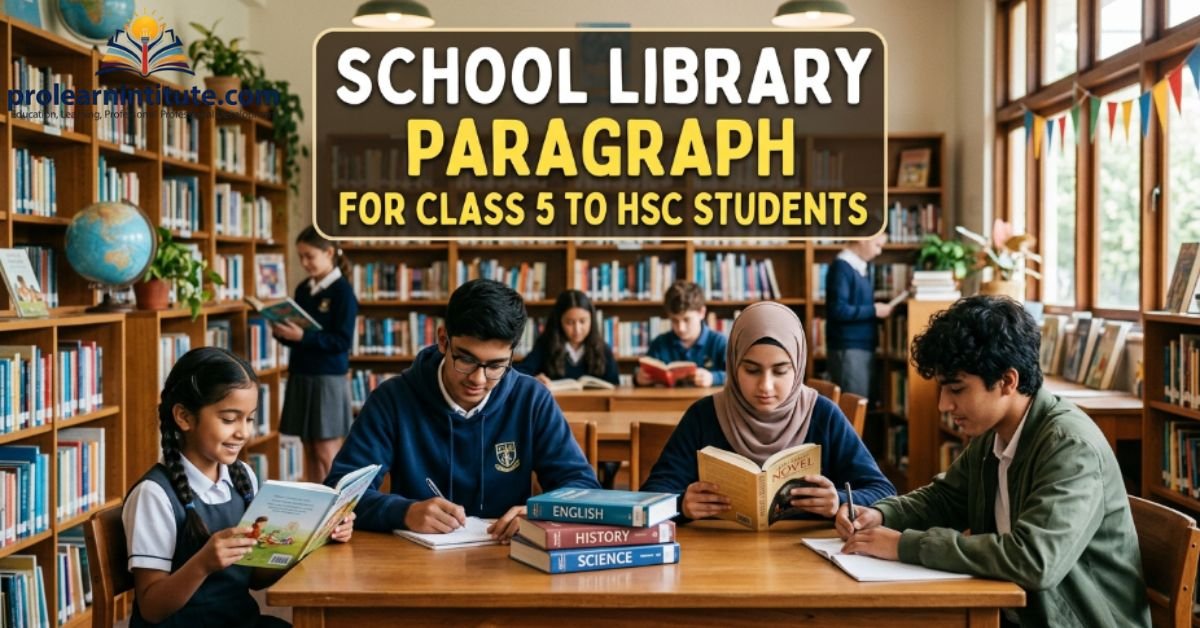
A school library is one of the most important places in any educational institution. It is a quiet, organized room filled with books, knowledge, and endless learning opportunities. Whether you are a young student in Class 5 or preparing for your HSC exams, the library has something valuable to offer you at every stage of your education.
Introduction
A school library is a dedicated space where students can read, study, and explore subjects beyond their regular textbooks. It contains books, magazines, newspapers, encyclopedias, and other learning materials carefully arranged for easy access. Every school should have a well-maintained library because it directly supports the academic growth of its students. A good library does not just store books—it builds curious, independent, and knowledgeable minds.
Importance of a School Library
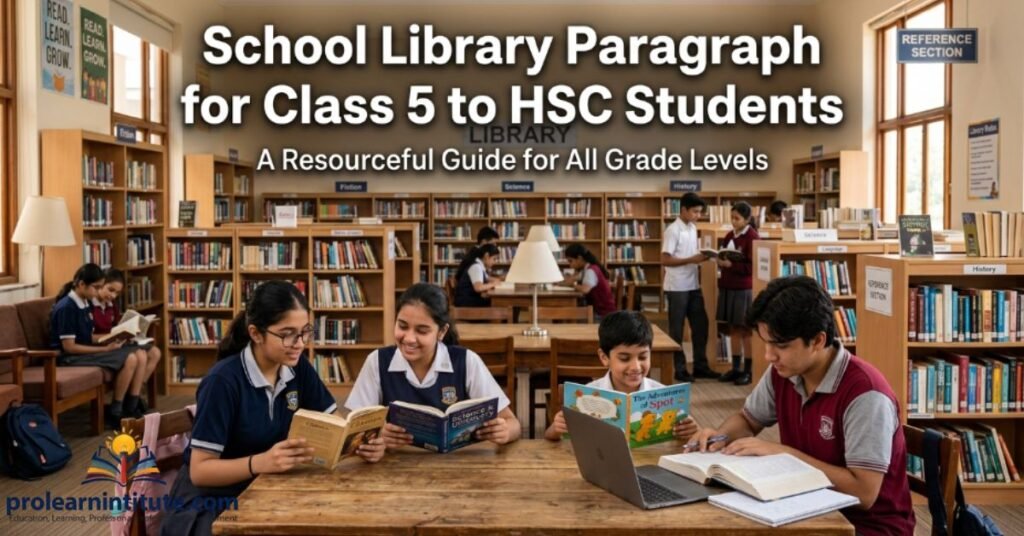
A school library plays a vital and irreplaceable role in a student’s overall education. It gives students access to hundreds of books that a single classroom can never provide. Students who visit the library regularly develop stronger reading habits, a wider vocabulary, and a deeper understanding of every subject. It also helps students complete research assignments, prepare for exams, and explore topics they are personally interested in.
| Benefit | Description |
| Reading Habit | Encourages daily and independent reading |
| Knowledge Growth | Provides information far beyond the textbook |
| Research Support | Helps complete assignments and projects properly |
| Quiet Study Space | Offers a peaceful, distraction-free environment |
| Free Access | Students can use books without buying them |
| Vocabulary Building | Regular reading improves language and expression |
| Self-Discipline | Library rules teach students focus and responsibility |
Features of a Good School Library
Not every library is equally useful. A truly good school library has specific qualities that make it a welcoming and effective place for learning.
- A large, well-organized collection of books covering all subjects and grade levels
- Clean, well-lit, and properly ventilated reading space
- Comfortable seating arrangements for all students
- A trained, experienced, and helpful librarian
- Separate sections for fiction, non-fiction, reference, and general knowledge books
- A proper system for borrowing, returning, and renewing books
- Availability of newspapers, magazines, and academic journals
- Computer or digital resources for modern research needs
- A notice board displaying new arrivals, reading challenges, and library news
Class-Wise Paragraphs on School Library
For Class 5
A school library is a big room filled with many colorful and interesting books. Students go there to read storybooks and learn new and exciting things. The librarian keeps all the books neatly in order so that every student can find them easily. It is the quietest and most peaceful place in the whole school. Visiting the library every week helps students learn things they do not find in their regular lessons.
For Class 6
Our school has a beautiful library with hundreds of books arranged on long wooden shelves. We visit the library during free periods to read, study, and explore different topics. The books are organized by subject so that finding the right one is never difficult. The library helps us learn things that are never taught inside the classroom. It is a place where curiosity is always welcomed and rewarded.
For Class 7
A school library is a true treasure house of knowledge and information for every student. It contains textbooks, storybooks, science books, history books, and important reference materials. Students can borrow books and take them home to read at their own pace. A school library builds strong and lifelong reading habits in young students from an early age. It teaches students that learning does not stop when the school bell rings.
For Class 8
A school library is an essential part of every well-functioning educational institution. It offers students a wide variety of books on different topics, subjects, and areas of interest. Students regularly use the library to prepare for upcoming exams, complete homework, and work on school projects. Regular use of the library improves both language skills and general knowledge naturally and enjoyably. Students who spend time in the library consistently perform better than those who rely only on their textbooks.
For SSC Students
Our school library is a well-organized and highly resourceful place that supports the academic needs of all students. It has a large and diverse collection of books, including textbooks, literary works, general knowledge references, and past examination papers. Students can sit quietly inside and focus fully on their studies without any noise or disturbance from outside. The library has helped countless students improve their academic performance, develop research skills, and build confidence in their studies. It also provides daily newspapers and weekly magazines, keeping students informed and aware of the world around them. For SSC students preparing for board exams, the library is one of the most valuable resources available in school.
For HSC Students
A school library serves as the true academic backbone of any serious educational institution. For HSC students, it provides essential reference books, past papers, subject guides, and research materials that are critical for thorough exam preparation. Students can conduct independent research, analyze complex topics, and develop the kind of critical thinking skills that board exams and university life both demand. The disciplined environment of the library encourages self-motivation, focus, and a mature attitude toward studies. It is a place where students go beyond memorizing facts and begin to truly understand, question, and connect ideas. A student who makes full use of the library during HSC has a clear and measurable advantage over those who do not.
Uses of a School Library for Students
The school library serves students in a wide variety of practical and academic ways that go far beyond simply reading books.
- Students can read beyond their syllabus and gain knowledge on any subject they choose
- It helps in preparing assignments, projects, presentations, and research papers.
- Students improve their English language skills and vocabulary through consistent reading.
- It provides a quiet, calm space for focused and distraction-free individual study.
- Borrowing books from the library saves students from buying expensive study materials.
- Students develop independent learning habits and self-confidence through regular visits.
- It supports both academic excellence and the personal growth of every student.
- Reading fiction and literature in the library develops creativity, empathy, and imagination.
- Students preparing for competitive exams find past papers and practice materials easily.
Role of a Librarian in a School Library
The librarian is the most important and often most underappreciated person in a school library. He or she is fully responsible for organizing all the books, maintaining the library‘s systems, and creating an environment where students feel welcome to learn. A good librarian helps students find exactly the right books for their academic needs and personal interests. He or she also maintains careful records of all borrowed and returned books to ensure nothing is lost or misplaced. Beyond managing books, a skilled librarian actively encourages students to read more, suggests new titles, and organizes reading events and competitions. Without a dedicated and knowledgeable librarian, even the most well-stocked library cannot function to its full potential.
Rules and Discipline in a School Library
Every school library operates according to a clear set of rules. These rules exist to protect the books, respect fellow students, and maintain the peaceful atmosphere that makes the library useful for everyone.
- Complete silence must be maintained at all times inside the library
- Books must be handled with care and never torn, folded, or damaged in any way
- Borrowed books must be returned on or before the due date without fail
- Eating, drinking, and chewing gum are strictly not allowed inside the library
- Mobile phones must be kept on silent mode or switched off completely
- Books must always be placed back on the correct shelves after reading
- Students must not disturb or distract others who are studying
- Library cards must be carried and presented during every visit
- Loud conversations, laughing, and running inside the library are not permitted
- Any lost or damaged book must be reported to the librarian immediately
How to Make the Best Use of Your School Library
Many students visit the library but never use it to its full potential. Here are practical ways to get the most out of your school library:
Set a Regular Schedule—Visit the library at the same time each week so it becomes a healthy habit rather than an occasional activity.
Explore Beyond Your Textbook — Pick up books on topics your teachers mention in class but never have time to cover in full detail.
Use Reference Books Wisely—Dictionaries, encyclopedias, and atlases are available for a reason. Use them when you want quick, reliable information.
Read for Pleasure Too—Not every library visit has to be for exam preparation. Reading fiction, poetry, and biographies is equally valuable for your mind and language skills.
Ask the Librarian—Do not hesitate to ask the librarian for help. They know the collection better than anyone and can point you to exactly what you need.
Take Notes While Reading — Bring a notebook and jot down interesting facts, new words, or useful quotes. This makes your reading active instead of passive.
Library vs. Internet — Which is Better for Students?
Many students today prefer the internet over the library. Both have their advantages, but they serve different purposes.
| Factor | School Library | Internet |
| Reliability | Books are checked and verified | Information can be inaccurate |
| Focus | No distractions, quiet space | Full of distractions |
| Depth | Deep, detailed knowledge | Often surface-level content |
| Cost | Completely free for students | Requires data or Wi-Fi |
| Reading Habit | Builds serious reading skills | Encourages quick scrolling |
| Availability | Limited to school hours | Available anytime |
The best students use both — the library for deep, reliable study and the internet for quick research and current information.
A School Without a Library
Imagine a school with no library at all. Students would have access only to what their one teacher covers in a forty-minute class. There would be no space to explore, no quiet corner to think, and no books to spark a new interest or idea. Such a school would produce students who know only what they were directly taught—nothing more. A school without a library is truly like a body without a heart. It may function on the surface, but it lacks the depth, the richness, and the life that genuine education requires.
Conclusion
A school library is a priceless gift for every student who takes education seriously. It opens the door to unlimited knowledge, builds strong reading habits, and helps students become independent, confident, and well-rounded learners. Every student, from Class 5 to HSC, should make visiting the library a regular and meaningful part of their school life.
The love for reading that begins inside a school library does not stay in school — it travels with a person throughout their entire life. Students who learn to use the library well do not just perform better in exams. They think more deeply, speak more clearly, and understand the world more fully than those who never developed the habit of reading. A great library, used well, can truly change the direction of a student’s life.
Frequently Asked Questions
1. What is a school library, and why is it important for students from Class 5 to HSC?
A school library is a dedicated space in a school that provides books, reference materials, and digital resources to help students from Class 5 to HSC level enhance their knowledge, research skills, and reading habits.
2. How does a school library help Class 5 students improve their reading and learning skills?
A school library helps Class 5 students by offering age-appropriate books, story collections, and guided reading programs that build vocabulary, comprehension, and a lifelong love for learning.
3. What kinds of books and resources can HSC students find in a school library?
HSC students can find textbooks, past exam papers, reference books, scientific journals, encyclopedias, and digital databases in a school library to support their exam preparation and academic research.
4. How do I write a paragraph about my school library for a Class 5 assignment?
To write a school library paragraph for Class 5, describe its location, size, the types of books available, how students use it, and why it is important—keeping the language simple, clear, and personal.
5. What should be included in a school library paragraph for HSC-level students?
An HSC-level school library paragraph should include its role in academic research, availability of reference materials, digital resources, reading environment, and how it supports higher-order thinking and exam preparation.
6. Why is the school library considered the heart of a school for students of all classes?
The school library is called the heart of a school because it serves as the central hub of knowledge, imagination, and intellectual growth for students at every level, from primary to HSC.
7. How often should Class 5 to HSC students visit the school library to benefit academically?
Students from Class 5 to HSC should ideally visit the school library at least two to three times a week to read, research, and borrow books that complement their classroom learning.
8. What is the role of a school librarian in helping students from Class 5 to the HSC level?
A school librarian helps students select appropriate books, locate research materials, develop information literacy skills, and maintain a quiet, organized space that encourages focused study and reading.
9. How can a school library paragraph be made interesting and SEO-friendly for a student blog or website?
To make a school library paragraph SEO-friendly, use the target keyword naturally in the first line, include specific details like book genres and student benefits, and write in a clear, engaging voice that answers common student questions.
10. What are the main features of a well-equipped school library for students from Class 5 to HSC?
A well-equipped school library for Class 5 to HSC students includes a wide collection of fiction and non-fiction books, a quiet reading zone, digital catalogs, internet access, study tables, and a helpful librarian to guide learners.

I’m Jordan Smith, a content writer with 4 years of experience and AI content expertise, creating clear, engaging, and easy-to-understand educational content.