

Introduction
English is one of the most important languages in the world today. Students who learn English from an early age get better opportunities in education and life.
Dialogue is one of the best ways to practice English. It helps students speak, read, and understand the language naturally and easily.
Why English Is the World’s Most Important Language (With Real Data)

English has become the closest thing the world has to a common lingua franca, and the numbers prove it. According to Ethnologue’s 2025 global language data, roughly 1.53 billion people worldwide speak English as either a native or second language, making it the most spoken language on Earth when both groups are counted together.
Nearly three out of every four English speakers use it as a second language, not their mother tongue — which shows exactly why learning English as a second language is so valuable for students in Pakistan and Bangladesh. English also dominates the internet, with close to half of all website content published in English, meaning students who master it gain direct access to a huge share of the world’s information, research, and opportunities.
This global reach is exactly why the dialogues below focus on real, practical reasons for learning English — from exams to careers to international communication. For a deeper look at English’s vocabulary strength, you might also enjoy exploring common English idioms and phrases, which build the same communication skills these dialogues teach.
(Source: Statista/Ethnologue data on most spoken languages worldwide)
Dialogue for Class 6–7

At this level, students need simple and short conversations. The sentences should be easy to understand and use basic words.
Dialogue:
Raza: Hello Amir! How are you today?
Amir: I am fine, thank you. How are you?
Raza: I am good too. Do you like English class?
Amir: Yes, I like it very much. English is fun.
Raza: I agree. It helps us talk to new people.
Amir: Yes, and our teacher is very kind.
Raza: Let us practice English every day.
Amir: That is a great idea. See you tomorrow!
Dialogue for Class 8
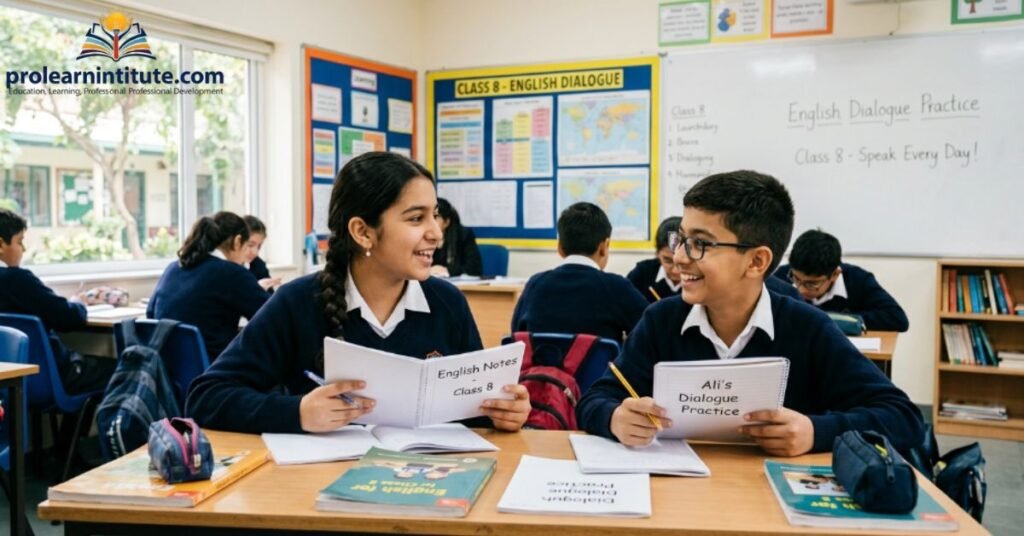
At the Class 8 level, students can use slightly longer sentences. The ideas become a little clearer and more detailed.
Dialogue:
Sara: Good morning, Ali. Are you ready for the English test today?
Ali: Good morning, Sara. Yes, I studied last night. Did you?
Sara: Yes, I did. I practiced some dialogues and read a few passages.
Ali: That is good. I think English is very useful for our future.
Sara: I agree. We need English for higher studies and good jobs.
Ali: My father says English is important for success in life.
Sara: Yes, that is true. We should practice speaking every day.
Ali: Let us form a small group and speak English together after school.
Sara: That sounds wonderful. I will tell our other friends too.
Dialogue for SSC (Class 9–10)

At the SSC level, students should write well-structured dialogues. The topics should focus on education, career goals, and daily communication.
Dialogue:
Hamza: Assalam o Alaikum, Usman. You look busy. What are you doing?
Usman: Walaikum Assalam. I am preparing for my English exam. It is very important for SSC.
Hamza: You are right. English is needed in almost every subject these days.
Usman: Exactly. Even in science and math, instructions are often in English.
Hamza: I think learning English also helps us in our future careers.
Usman: Yes, most companies and universities require English communication skills.
Hamza: Do you think dialogue practice is helpful for the exam?
Usman: Definitely. Dialogue improves both writing and speaking skills at the same time.
Hamza: I will start practicing dialogues from today. Can you help me?
Usman: Of course. Let us meet in the library after school and practice together.
Hamza: That is a great plan. Thank you, Usman.
Usman: No problem. Together, we will improve faster.
Dialogue for HSC (Class 11–12)

HSC students need a more mature and detailed discussion. Topics should include global opportunities, higher education, and career planning.
Dialogue:
Bilal: Good afternoon, Fahad. I heard you got admission to an English-medium university. Congratulations!
Fahad: Thank you, Bilal. I worked very hard on my English skills. It really paid off.
Bilal: I agree. In today’s world, English is not just a subject—it is a life skill.
Fahad: Absolutely. Whether you want to study abroad, work in a multinational company, or do research, English is essential.
Bilal: I have been thinking about improving my English too. Where should I start?
Fahad: Start with reading English newspapers and watching English news channels daily.
Bilal: That sounds practical. What about speaking skills?
Fahad: Join a debate club or speak with friends in English as much as possible.
Bilal: I also want to appear in the IELTS exam to study abroad. Is English really that important for it?
Fahad: IELTS is entirely based on English. You need strong reading, writing, listening, and speaking skills.
Bilal: Then I must start preparing seriously from now.
Fahad: Yes, the earlier you start, the more confident you will become. English opens doors all over the world.
Bilal: Thank you for the motivation, Fahad. I will begin my preparation today.
Fahad: Best of luck, Bilal. Believe in yourself and keep practicing every single day.
Short Dialogue Version (For Quick Practice)
This version is short and easy to memorize. Students can use it for quick exam preparation.
Dialogue:
Ali: Why is English important?
Sara: English helps us in studies, jobs, and communication.
Ali: Should we practice it daily?
Sara: Yes, daily practice makes us fluent and confident.
Ali: How can we improve quickly?
Sara: Read, write, speak, and listen to English every day.
Ali: Thank you. I will start from today.
Sara: Great. Consistency is the key to success.
Long Dialogue Version (Detailed Discussion)
This version covers many important points about English learning. It is useful for exams that require long and detailed dialogues.
How to Write This Dialogue in Exams (Format Guide)

Examiners look for specific things when grading a dialogue answer, so following the right structure matters as much as the content itself. Start with a proper greeting between the two characters, then build the conversation around 3–4 clear points — such as why English matters for education, careers, and global communication. Each turn should stay short, natural, and grammatically correct rather than overly long or repetitive. Always end the dialogue with a closing line that shows agreement or a decision to act, such as one character promising to start practicing English seriously. For SSC and HSC level answers, aim for 10–12 exchanges total, and avoid switching topics mid-conversation, since staying focused on one theme — the importance of English proficiency — earns higher marks. Students preparing well-rounded answers on national identity and language topics can also review the International Mother Language Day paragraph, which explores the balance between mother-tongue pride and global language skills — a common companion topic in exams.
Dialogue:
Noman: Assalam o Alaikum, Kashif. I want to ask you something important.
Kashif: Walaikum Assalam, Noman. Sure, please go ahead.
Noman: Do you think learning English is really that necessary for Pakistani students?
Kashif: Yes, absolutely. English is the international language of education, business, and technology.
Noman: But we have our own national language, Urdu. Why must we learn English too?
Kashif: Urdu is important for our culture and identity. But English connects us with the rest of the world.
Noman: Can you give me some examples where English is really needed?
Kashif: Of course. All major university textbooks are in English. Most global websites and research papers are in English, too.
Noman: What about jobs? Is English really needed in Pakistan’s job market?
Kashif: Yes. Banks, hospitals, IT companies, and government offices all prefer candidates who know English.
Noman: That is a strong reason. What about studying abroad?
Kashif: For admissions to foreign universities, you must pass IELTS or TOEFL, which are English language tests.
Noman: So, is English important from the school level itself?
Kashif: Yes. The earlier you start, the better. Students who learn English in Class 6 have a clear advantage later.
Noman: How should students practice English in daily life?
Kashif: They should read English storybooks, watch English cartoons or documentaries, and write a few sentences daily.
Noman: What about speaking? Many students feel shy to speak English.
Kashif: That is very common. The best way is to speak slowly and without fear. Mistakes are part of learning.
Noman: Should we use a dictionary while learning?
Kashif: Yes. A good habit is to learn at least five new words every day and use them in sentences.
Noman: What do you think about dialogue practice for exams?
Kashif: Dialogue practice is one of the most effective methods. It improves vocabulary, grammar, and confidence together.
Noman: I feel more motivated now. Thank you for explaining everything so clearly.
Kashif: You are welcome, Noman. Remember, English is a tool — the more you use it, the sharper it becomes.
Noman: I will make a daily English practice plan starting from tomorrow.
Kashif: That is the spirit. Hard work and consistency will surely bring good results.
Key Points About Learning English
These are the most important ideas students should keep in mind while learning or writing about English.
Why English Matters:
- English is the most widely spoken language in the world
- It is the official language of education, science, and technology
- Most internet content is available in English
- English is required for higher studies and professional careers
Benefits for Students:
- Better performance in exams and competitive tests
- More confidence in speaking and communication
- Access to global knowledge and opportunities
- Higher chances of getting scholarships abroad
Tips to Improve English:
- Read English newspapers, books, and articles daily
- Practice dialogue and conversation with friends
- Write a short diary or paragraph in English every day
- Watch English content with subtitles to improve listening
Dialogue Importance of Learning English — Bangla Meaning (বাংলা অর্থ)

নিচে সংক্ষিপ্ত বাংলা অনুবাদ দেওয়া হলো, যা বাংলা মাধ্যমের শিক্ষার্থীদের বুঝতে সাহায্য করবে:
রাজা: আসসালামু আলাইকুম, আমির। তুমি কেমন আছো?
আমির: ওয়ালাইকুম আসসালাম, আমি ভালো আছি। ইংরেজি শেখা কেন গুরুত্বপূর্ণ?
রাজা: ইংরেজি একটি আন্তর্জাতিক ভাষা। এটি আমাদের সারা বিশ্বের মানুষের সাথে যোগাযোগ করতে সাহায্য করে।
আমির: এটা পরীক্ষা, উচ্চশিক্ষা এবং চাকরির জন্যও গুরুত্বপূর্ণ।
রাজা: ঠিক বলেছো। প্রতিদিন অনুশীলন করলে আত্মবিশ্বাস বাড়ে।
মূলকথা: ইংরেজি শেখা শুধু পরীক্ষার জন্য নয়, বরং সারা জীবনের জন্য একটি মূল্যবান দক্ষতা। Real-life practical knowledge ke connection ke liye, students A Scholar and a Boatman Story bhi zaroor padhein, jo dikhata hai ke practical language skills bookish knowledge se kam important nahi hain.
Common Mistakes to Avoid:
| Mistake | Correct Approach |
| Fear of making errors | Speak without fear, learn from mistakes |
| Only reading, not speaking | Balance all four skills equally |
| Skipping daily practice | Practice for at least 20–30 minutes every day |
| Memorizing without understanding | Focus on the meaning and usage of words |
| Ignoring grammar rules | Learn basic grammar and apply it |
Conclusion
Learning English is not just about passing exams. It is about building a bright future, communicating with the world, and growing as a person. Every student from Class 6 to HSC should take English seriously.
Start small, stay consistent, and never be afraid to make mistakes. Dialogue practice is one of the best tools available. With daily effort, every student can become fluent and confident in English.
Frequently Asked Questions
Why is learning English dialogue important for students from Class 6 to the HSC level?
Learning English dialogue helps students build real-life communication skills, improve grammar naturally, and gain confidence in speaking—all of which are essential for academic success from Class 6 through HSC.
How does practicing English dialogue help Class 6 students improve their speaking skills?
Practicing English dialogue teaches Class 6 students how to form sentences naturally, respond quickly in conversations, and develop a strong foundation in spoken English from an early age.
What are the biggest benefits of learning English dialogue for SSC and HSC students?
For SSC and HSC students, learning English dialogue boosts exam performance, sharpens writing skills, and prepares them for university interviews, job applications, and competitive English exams.
How can English dialogue practice help students score better in their board exams?
Regular dialogue practice improves grammar, vocabulary, and sentence structure — all key areas tested in board exams — giving students a direct advantage in both written and oral English assessments.
Why do teachers recommend English dialogue practice for middle school students in Bangladesh?
Teachers recommend dialogue practice for middle school students because it makes English learning interactive and fun, helping students move beyond memorization and actually use the language in everyday situations.
How does learning English dialogue prepare students for higher education and career opportunities?
Mastering English dialogue equips students with professional communication skills needed for university presentations, job interviews, and working in global environments where English is the primary language.
What is the best way for Class 8 and Class 9 students to practice English dialogue at home?
The best way for Class 8 and Class 9 students to practice at home is to read dialogues aloud daily, record themselves speaking, watch English conversations on YouTube, and practice with a friend or family member.
How does English dialogue learning help shy students become more confident speakers?
Dialogue practice gives shy students a structured script to follow, which reduces anxiety, builds speaking confidence step by step, and gradually helps them express their thoughts freely in English.
Why is understanding English dialogue structure important for writing good compositions and essays?
Understanding how dialogue flows teaches students natural sentence construction, proper use of punctuation, and how to express ideas clearly—skills that directly improve essay writing and composition quality.
How early should students start learning English dialogue to get the best results by the HSC level?
Students should start learning English dialogue as early as Class 6, so by the time they reach HSC, they have years of practice that make fluent, confident English communication feel completely natural and effortless.

I’m Jordan Smith, a content writer with 4 years of experience and AI content expertise, creating clear, engaging, and easy-to-understand educational content.