
International Mother Language Day Paragraph is an important topic that helps us understand the value of our native language. It reminds us that every language carries culture, history, and identity from one generation to the next.
People around the world celebrate this day to respect linguistic diversity and promote the right to speak their mother tongue. It also encourages us to learn about and appreciate different languages and cultures.
Writing an International Mother Language Day Paragraph helps students understand why languages are important in daily life. By honoring our mother language, we keep our traditions alive and strengthen our connection to our roots.
see also: An Essay on Wonders of Modern Science Composition for Students
International Mother Language Day Paragraph for Class 3, 4, 5
International Mother Language Day is observed on February 21 every year. On this day, we remember the importance of our mother language. It teaches us to love and respect the language we speak at home.
Our mother language is the first language we learn from our parents. It helps us express our feelings, thoughts, and emotions easily. Every child should feel proud of their native language.
This day was started to protect languages from disappearing. Many languages in the world are dying because people stop using them. We must keep our language alive by speaking, reading, and writing it every day.
Key Facts for Kids:
- Celebrated every year on February 21
- Started by the United Nations in 1999
- Inspired by the language movement in Bangladesh
- More than 7,000 languages exist in the world
- Many languages are endangered and need protection
International Mother Language Day Paragraph for Class 6, 7
International Mother Language Day is a global event celebrated on February 21 every year. This day was officially declared by UNESCO in 1999 and has been observed worldwide since 2000. It honors the love people have for their mother tongue and promotes the protection of all languages.
The history of this day is deeply connected to Bangladesh. On February 21, 1952, students and activists in Dhaka sacrificed their lives for the right to use the Bengali language. Their bravery inspired the world to value and protect every mother language.
Languages carry the traditions, stories, and wisdom of a community. When a language dies, a unique part of human culture disappears forever. This day calls everyone to celebrate linguistic diversity and keep their native languages alive.
Why Mother Language Matters:
- It is the first language a child learns naturally
- It helps in better understanding and learning
- It connects people to their roots and culture
- It preserves oral traditions, stories, and history
- It builds confidence and identity in children
| Language Group | Number of Languages |
| Living Languages in the World | Over 7,000 |
| Endangered Languages | Around 2,500 |
| Languages Lost in the Last Century | Over 200 |
| Official UN Languages | 6 |
International Mother Language Day Paragraph for Class 8
International Mother Language Day is observed globally on February 21 to celebrate linguistic diversity and protect endangered languages. UNESCO declared this day in November 1999, and it has been celebrated worldwide since February 21, 2000. The day holds deep historical significance, especially for the people of Bangladesh.
The origin of this day lies in the tragic events of February 21, 1952, in Dhaka, East Pakistan (now Bangladesh). Students from the University of Dhaka peacefully protested to make Bengali an official state language. Police opened fire on the crowd, killing several young students, including Abul Barkat, Rafiquddin Ahmed, and others. These martyrs became symbols of the love for a mother language, and their sacrifice inspired the world.
Today, more than 7,000 languages are spoken across the world, but nearly 43% of them are considered endangered. This day encourages governments, communities, and individuals to take action to preserve their native languages. Schools, universities, and cultural organizations hold special events to highlight the value of mother languages.
Themes of Recent International Mother Language Day Celebrations:
- 2024 Theme: Multilingual education is a pillar of learning and intergenerational learning
- 2023 Theme: Multilingual education — a necessity to transform education
- 2022 Theme: Using technology for multilingual learning
Steps to Protect Your Mother Language:
- Speak your mother language at home daily
- Read books, newspapers, and literature in your native language
- Teach younger generations words, poems, and stories
- Support local language education programs
- Use your native language in digital and social media
International Mother Language Day Paragraph for SSC
International Mother Language Day, celebrated on February 21 every year, is a significant global observance established by UNESCO in 1999. The day honors linguistic diversity and promotes the protection of mother languages around the world. It holds special emotional and historical value for Bangladeshis and the Bengali-speaking community worldwide.
The foundation of this day rests on the Language Movement of 1952 in East Pakistan. When the Pakistani government tried to impose Urdu as the only state language, Bengali students and intellectuals rose in protest. On February 21, 1952, police killed several students at Dhaka University during a peaceful demonstration. These martyrs — Abul Barkat, Rafiq, Jabbar, Salam, and others — died for their right to speak Bengali. Their sacrifice gave birth to a powerful movement that eventually led to Bangladesh’s independence in 1971.
UNESCO recognized the significance of this event and declared February 21 as International Mother Language Day. The first official celebration took place on February 21, 2000, with countries across the globe participating. Since then, this day is observed every year with cultural programs, discussions, seminars, and educational activities to highlight the importance of protecting all world languages.
Global Language Statistics:
| Fact | Data |
| Total living languages worldwide | 7,168 |
| Languages with fewer than 1,000 speakers | Over 2,000 |
| Languages lost since 1950 | Over 230 |
| Countries observing this day | 188+ |
| Year UNESCO declared the day | 1999 |
The theme of this day changes every year to focus on different aspects of language preservation and multilingual education. Governments, NGOs, and cultural institutions use this day to launch programs for documenting and revitalizing endangered languages. The Shaheed Minar (Martyr’s Monument) in Dhaka, Bangladesh, becomes the center of national observance with thousands of people paying tribute to the language martyrs.
Ways to Observe This Day Meaningfully:
- Visit the Shaheed Minar or language memorials
- Participate in cultural events celebrating your native language
- Read literature written in your mother language
- Write poems or essays in your native tongue
- Spread awareness about endangered languages on social media
International Mother Language Day Paragraph for HSC
International Mother Language Day, observed on February 21 every year, stands as a powerful reminder of humanity’s rich linguistic heritage. Established by UNESCO in November 1999 and first celebrated globally in February 2000, this day underscores the critical need to protect and promote linguistic diversity. At its heart lies one of history’s most moving stories of sacrifice — the Bengali Language Movement of 1952.
In 1948, the Pakistani government declared Urdu the sole official language of Pakistan, despite Bengali being spoken by the majority of East Pakistan’s population. This decision sparked widespread anger and organized resistance. Students, teachers, and cultural leaders demanded that Bengali be recognized as a state language. On February 21, 1952, peaceful protesters gathered at the University of Dhaka and defied a government ban and marched in demonstration. Police fired upon the unarmed crowd, killing Abul Barkat, Rafiquddin Ahmed, Abul Jabbar, Shafiur Rahman, and others. These martyrs became eternal symbols of linguistic pride and human rights.
Their blood did not fall in vain. In 1956, Bengali was finally recognized as the state language of Pakistan. The spirit of the Language Movement continued to fuel Bangladesh’s independence movement, culminating in the Liberation War of 1971. Today, Bangladesh officially observes February 21 as Shaheed Dibosh (Martyrs’ Day) — a national public holiday filled with mourning, tribute, and celebration.
When UNESCO proclaimed February 21 as International Mother Language Day, it honored not just Bengali but every language of the world. The proclamation acknowledged that language is not merely a communication tool — it is the vessel of culture, identity, memory, and knowledge. With around 7,000 languages spoken worldwide and an alarming 2,500 of them considered endangered, the need for global action has never been greater.
Annual Themes and Their Focus:
| Year | Theme |
| 2020 | Languages without borders |
| 2021 | Fostering multilingualism for inclusion in education and society |
| 2022 | Using technology for multilingual learning |
| 2023 | Multilingual education — a necessity to transform education |
| 2024 | Multilingual education is a pillar of learning |
Celebrations of this day take various forms across the globe. In Bangladesh, people walk barefoot to the Shaheed Minar before dawn, placing flowers at the base of the monument in a deeply emotional tribute. Schools and universities host debates, recitations, and cultural performances. International organizations publish reports on endangered languages and launch new literacy programs.
Impact and Significance:
- Promotes respect for all languages, big and small
- Encourages governments to include mother languages in education
- Supports documentation of endangered and dying languages
- Builds awareness about the link between language loss and cultural loss
- Celebrates the diversity that makes humanity unique
International Mother Language Day Paragraph for College Students
International Mother Language Day, observed annually on February 21, represents a global commitment to linguistic diversity, cultural preservation, and the human right to communicate in one’s native tongue. The day was proclaimed by UNESCO in 1999 and officially recognized by the United Nations General Assembly in 2002 through Resolution 56/262. It was inspired by the heroic Bengali Language Movement of 1952, a defining moment in South Asian history where ordinary students stood against state oppression to protect their right to speak their mother language.
Language is the most fundamental tool of human civilization. It carries within it the accumulated wisdom, stories, traditions, laws, and emotions of generations. When a language disappears, an entire worldview is lost — unique metaphors, concepts, and ways of understanding reality vanish forever. According to UNESCO, one language disappears roughly every two weeks. This alarming rate means that within a century, up to half of the world’s 7,000 languages could be silenced permanently.
The sociological and psychological importance of the mother language cannot be overstated. Research consistently shows that children learn better and faster when taught in their mother tongue during early education. Cognitive development, emotional health, and academic performance all improve when students can express themselves in the language closest to their identity. This is why UNESCO advocates strongly for multilingual education policies that include indigenous and regional languages alongside national languages.
Key Arguments for Protecting Mother Languages:
- Mother language education improves academic outcomes for children
- Native languages preserve indigenous knowledge systems and ecological wisdom
- Language diversity drives cultural innovation and artistic expression
- Multilingualism has proven cognitive advantages, including improved memory and focus
- Language rights are fundamental human rights recognized by the UN
At the college level, students play a vital role in language advocacy. Writing in native languages, supporting regional literature, participating in language documentation projects, and promoting linguistic awareness on digital platforms all contribute to the global effort to protect languages. Cultural clubs, debate societies, and literary organizations in colleges can organize events that celebrate linguistic heritage while also examining the political and social dimensions of language rights.
Global Organizations Working on Language Preservation:
| Organization | Role |
| UNESCO | Declares and coordinates International Mother Language Day |
| Endangered Languages Project | Documents and revitalizes threatened languages |
| SIL International | Linguistic research and Bible translation in native languages |
| First Peoples’ Cultural Council | Supports indigenous language revitalization in Canada |
| Living Tongues Institute | Field documentation of endangered languages |
International Mother Language Day Paragraph for University Students
International Mother Language Day, celebrated on February 21 each year, offers scholars, linguists, and academic communities an opportunity to engage with some of the most pressing questions in sociolinguistics, political philosophy, postcolonial theory, and human rights discourse. The day, declared by UNESCO in 1999 and subsequently recognized by the UN General Assembly, was born from the ashes of the Bengali Language Movement — a mass civil resistance movement in East Pakistan that challenged the linguistic imperialism of the Pakistani state and paid for that resistance in blood.
From an academic standpoint, the Language Movement of 1952 represents a fascinating intersection of nationalism, identity politics, colonialism, and democratic resistance. The imposition of Urdu as the sole national language of Pakistan was not merely a bureaucratic decision — it was an act of cultural domination that sought to erase the distinct identity of East Bengal’s majority population. The response from Bengali students, academics, and ordinary citizens constituted what scholars now recognize as one of the earliest and most powerful examples of linguistic rights activism in the postcolonial world. The martyrdom of Abul Barkat, Rafiq, Jabbar, Salam, and Shafiur on February 21, 1952, galvanized not just a language movement but the seeds of a national liberation movement that culminated in the independence of Bangladesh in 1971.
At the theoretical level, International Mother Language Day raises profound questions about the relationship between language, power, and identity. Michel Foucault’s insights about discourse and power are directly relevant — those who control language control the terms of social reality. Pierre Bourdieu’s concept of linguistic capital explains how dominant languages accumulate social and economic power while minority languages are marginalized. These theoretical frameworks help us understand why language movements are never merely about language — they are about dignity, belonging, and the right to exist on one’s own cultural terms.
Sociolinguistic Dimensions of Language Endangerment:
- Language shift occurs when speakers abandon their native tongue for a more dominant language due to social, economic, or political pressures
- Language death is accelerated by urbanization, globalization, and monolingual education systems
- Revitalization efforts require community engagement, institutional support, and documentation
- Digital tools such as language apps, online dictionaries, and AI translation are now critical for preservation
- Oral languages face unique challenges as traditional knowledge transmission systems break down
UNESCO’s Atlas of the World’s Languages in Danger classifies languages on a scale from vulnerable to extinct. Today, over 2,500 languages fall within the endangered range, with many spoken by fewer than 100 elderly speakers. The academic response to this crisis has generated a rich body of interdisciplinary research spanning linguistics, anthropology, ecology, education, and information technology. The field of documentary linguistics has emerged specifically to record and analyze endangered languages before their last speakers pass away.
Frameworks for Understanding Language Rights:
| Framework | Key Concept |
| Universal Declaration of Linguistic Rights (1996) | Languages as collective cultural rights of communities |
| UN Declaration on the Rights of Indigenous Peoples (2007) | Right of indigenous peoples to maintain, protect, and develop their cultural heritage and languages |
| Education for All (UNESCO) | Mother tongue-based multilingual education as a foundation for quality learning |
| Sustainable Development Goals | SDG 4 targets inclusive, equitable, quality education in native languages |
University students and researchers have a unique responsibility at this moment. Whether through fieldwork in endangered language communities, developing digital language archives, creating multilingual educational content, analyzing language policy through critical lenses, or simply writing about these issues for broader audiences, academic engagement with language diversity is an ethical imperative in the 21st century.
Importance of International Mother Language Day
International Mother Language Day plays a critical role in keeping the world’s linguistic heritage alive. It raises global awareness about the disappearance of languages and urges governments and communities to take active steps in language preservation. Without this awareness, hundreds of languages could silently fade from existence.
This day is also vital for education. Research proves that children understand and retain knowledge better when taught in their mother language. By advocating for mother tongue-based education, this day supports better learning outcomes for millions of children around the world.
Beyond education, the day celebrates cultural identity. A language carries the songs, poetry, proverbs, religious texts, and oral traditions of its people. Keeping a language alive means keeping a culture alive, and this day dedicates itself to that noble mission.
Why This Day Matters:
- Protects endangered languages from extinction
- Promotes mother tongue-based multilingual education
- Honors the sacrifice of the language martyrs of 1952
- Encourages cultural pride and linguistic diversity
- Supports indigenous communities in preserving their heritage
History of International Mother Language Day
The history of International Mother Language Day is rooted in the Bengali Language Movement of 1952 in East Pakistan (now Bangladesh). When the Pakistani government declared Urdu the only state language, the Bengali-speaking majority protested strongly. On February 21, 1952, police fired on student demonstrators at Dhaka University, killing several young men who became known as the language martyrs.
In 1999, two Canadians of Bangladeshi origin — Rafiqul Islam and Abdus Salam — proposed to the United Nations Secretary-General that February 21 be declared International Mother Language Day. UNESCO accepted the proposal and officially proclaimed the day in November 1999. The first global celebration was held on February 21, 2000.
In 2002, the United Nations General Assembly formally recognized the day through Resolution 56/262. Since then, February 21 has been celebrated in over 188 countries, with events ranging from cultural performances to academic conferences to language documentation projects.
Timeline of Key Events:
| Year | Event |
| 1948 | The Pakistani government declares Urdu the only state language |
| 1952 | Students martyred on February 21 in Dhaka for demanding Bengali |
| 1956 | Bengali is recognized as the state language of Pakistan |
| 1971 | Bangladesh gains independence |
| 1999 | UNESCO declares February 21 as International Mother Language Day |
| 2000 | First global celebration of the day |
| 2002 | The UN General Assembly formally recognizes the day |
How International Mother Language Day is Celebrated
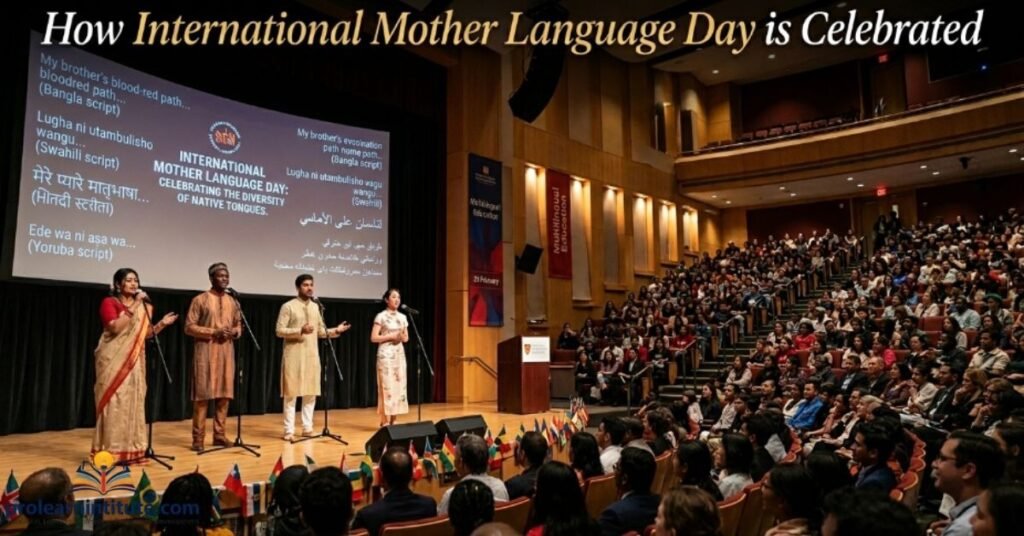
International Mother Language Day is celebrated with great enthusiasm around the world. In Bangladesh, the day begins before dawn as thousands of people walk barefoot to the Shaheed Minar in Dhaka to lay flowers and pay tribute to the language martyrs. The national flag flies at half-mast as a sign of respect and remembrance.
Schools, colleges, and universities organize cultural programs including poetry recitations, essays, debates, and art competitions based on the theme of language. Governments and cultural organizations hold seminars and conferences on linguistic diversity and the preservation of endangered languages. UNESCO publishes reports and launches awareness campaigns highlighting languages at risk.
Across the world, communities celebrate by holding events in their native languages — music, theater, storytelling, and food festivals that reflect the richness of each culture. Social media campaigns in local languages also gain popularity every year as young people use digital platforms to celebrate their mother tongues.
Common Ways to Celebrate:
- Visit monuments and memorials dedicated to language martyrs
- Attend cultural events, poetry readings, and music performances
- Participate in school debates and essay competitions
- Share posts in your mother language on social media
- Read a book, poem, or story written in your native tongue
- Watch films or documentaries about language preservation
- Support organizations working to document endangered languages
International Mother Language Day Speech Ideas
Giving a speech on International Mother Language Day is a wonderful way to honor linguistic diversity and the martyrs who gave their lives for the right to speak their native language. A good speech should combine historical facts, emotional appeal, and a call to action. Here are some strong ideas and structures you can use for your speech.
The most effective speeches start with a powerful opening. You can begin with a quote about language, a short story about the 1952 Language Movement, or a thought-provoking question such as — “Imagine waking up one day and being told you can never speak your mother language again.” This immediately captures the audience’s attention and creates an emotional connection.
Speech Structure Ideas:
- Opening: Start with a quote, question, or short story about language
- Historical Context: Briefly explain the 1952 Language Movement and its significance
- Current Situation: Talk about how many languages are endangered today
- Importance of Mother Language: Discuss identity, culture, education, and emotional connection
- Call to Action: Encourage the audience to celebrate and protect their native language
- Closing: End with a powerful statement or tribute to the language martyrs
Sample Opening Lines for Your Speech:
- “On this day in 1952, young men shed their blood so that a language could live. Their sacrifice reminds us that language is not just words — it is life itself.”
- “Every language in the world is a universe of thought, feeling, and culture. When a language dies, that universe disappears forever.”
- “Today, we do not just celebrate a language. We celebrate identity, heritage, dignity, and the unbreakable bond between a people and their mother tongue.”
Topics You Can Cover in Your Speech:
- The story of the Bengali Language Martyrs of 1952
- The role of UNESCO in protecting world languages
- Why children should be educated in their mother language
- The connection between language and cultural identity
- How technology can help preserve endangered languages
- What students can do to protect their native language
Conclusion
International Mother Language Day is more than a celebration — it is a call to every person on earth to value, protect, and cherish the language they were born into. Languages are living bridges between the past and the future, and every language that disappears takes with it an irreplaceable piece of human heritage.
As we honor the brave martyrs of the 1952 Language Movement and observe this day every February 21, let us commit to keeping our mother languages alive. Whether through education, literature, art, or daily conversation, each of us has the power to ensure that the languages of our ancestors continue to speak to the generations that come after us.
see also: 85 Metaphors for Flowers
FAQs
What is the International Mother Language Day paragraph all about?
The International Mother Language Day paragraph is a short piece of writing that explains the meaning, history, and importance of February 21 — a global day declared by UNESCO to honor and protect all mother languages in the world.
Why do we celebrate International Mother Language Day on February 21?
We celebrate it on February 21 to remember the brave students in Dhaka, Bangladesh, who were killed in 1952 while peacefully protesting for their right to speak Bengali, their mother language.
What is the best short paragraph on International Mother Language Day for school students?
The best paragraph for school students explains that February 21 is celebrated worldwide to honor our mother languages, remember the 1952 language martyrs of Bangladesh, and promote the protection of all languages around the world.
How can I write an International Mother Language Day paragraph in simple English?
You can write a simple paragraph by stating that February 21 is International Mother Language Day, explaining that UNESCO declared it in 1999, mentioning the 1952 Language Movement in Bangladesh, and noting why every language deserves to be protected.
What are the main points to include in an International Mother Language Day paragraph?
The main points to include are the date of the event (February 21), the role of UNESCO, the history of the 1952 Bangladesh Language Movement, the importance of mother languages for culture and identity, and the global effort to protect endangered languages.
What is the theme of International Mother Language Day this year?
The theme for recent years has focused on multilingual education, emphasizing that learning in one’s mother language is key to quality education, inclusion, and intergenerational learning for children around the world.
Why is the mother language important for a child’s education?
Research shows that children learn faster, understand more deeply, and perform better academically when they are taught in their mother language, because it is the language closest to their thinking, emotions, and natural understanding.
How many languages are there in the world, and how many are endangered?
There are over 7,000 languages spoken in the world today, and approximately 2,500 of them are considered endangered, meaning they are at risk of disappearing as fewer and fewer people speak or teach them.
What is the connection between International Mother Language Day and Bangladesh?
International Mother Language Day is directly connected to Bangladesh because it was inspired by the 1952 Language Movement in Dhaka, where students sacrificed their lives to protect the Bengali language from being eliminated by the Pakistani government.
How is International Mother Language Day celebrated around the world?
It is celebrated through cultural events, poetry readings, seminars, school competitions, flower-laying ceremonies at language monuments, and social media campaigns where people express pride in their native languages.

I’m Jordan Smith, a content writer with 4 years of experience and AI content expertise, creating clear, engaging, and easy-to-understand educational content.