

The A Scholar and a Boatman Story With Moral | বাংলা অর্থসহ is a famous tale that teaches an important lesson about knowledge and practical skills. It shows how different kinds of learning can be valuable in life.
In this story, a scholar is proud of his education, while a simple boatman has little formal knowledge. As the events unfold, both characters learn something meaningful about wisdom and real-life experience.
If you enjoy reading stories with life lessons, this A Scholar and a Boatman Story With Moral | বাংলা অর্থসহ is a wonderful example. Its simple message helps readers understand the importance of humility, respect, and practical knowledge.
see also: An Ant and a Dove Completing Story For Class 6-10, HSC with Moral
A Scholar and a Boatman Story

A scholar once hired a boatman to take him across a wide river. The scholar was very proud of his education and knowledge.
During the journey, the scholar asked the boatman, “Do you know grammar?” The boatman said no. The scholar replied, “Then half of your life is wasted.”
After a while, the scholar asked again, “Have you studied mathematics?” The boatman again said no. The scholar said, “Then most of your life is wasted.”
Suddenly, a big storm came, and the boat started to sink. The boatman asked the scholar, “Do you know how to swim?” The scholar cried, “No! I do not know how to swim!”
The boatman said, “Then your whole life is wasted.” The boatman jumped into the water and swam safely to the shore. The scholar drowned because he had no practical skills to save himself.
The Official Exam-Style Completing Story (With Given Beginning)
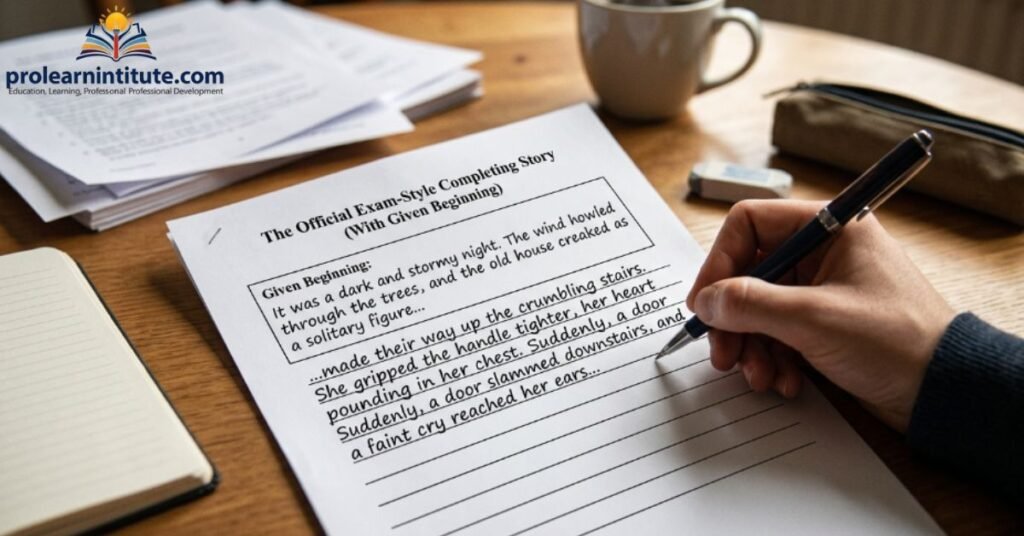
Many SSC and HSC exam papers give students this exact opening to complete, so it is worth learning in its original form. The beginning usually reads: “There was a poor boatman in a village. He was illiterate. He used to row his boat from morning till evening just to make ends meet. Knowledge meant nothing to him. Once, in the month of Baishakh, a scholar got into his boat…”
Completion: The scholar found the weather pleasant and began chatting with the boatman to pass the time. He asked whether the boatman knew about astronomy — the boatman admitted he did not. The scholar remarked that one-fourth of his life was wasted. A little later, he asked about history, and again the boatman said no, prompting the scholar to say that half his life was now spoilt. Undeterred, the scholar asked about science next; when the boatman gave the same answer, the scholar declared that three-fourths of his life had gone to waste.
Soon after, dark clouds gathered and a sudden Nor’wester — a fierce pre-monsoon storm common in Bangladesh — began to rock the boat violently. Terrified, the scholar turned pale as the boat threatened to capsize. This time, it was the boatman’s turn to ask a question: “Sir, do you know how to swim?” When the scholar tearfully admitted he did not, the boatman replied quietly, “Then, sir, I am afraid your whole life is about to be wasted.” Moments later, the boatman swam safely to shore, while the scholar — despite all his learning — could not save himself.
This version, with its progression from one-fourth to whole life wasted, is the format most commonly expected in Bangladeshi exam papers, making it worth memorizing alongside the shorter version above.
A Scholar and a Boatman Story in Bangla
এই গল্পে একজন পণ্ডিত একটি নৌকায় নদী পার হচ্ছিলেন। তিনি নিজেকে অনেক জ্ঞানী মনে করতেন এবং মাঝিকে তুচ্ছ ভাবতেন।
পণ্ডিত মাঝিকে জিজ্ঞেস করলেন, “তুমি কি ব্যাকরণ জানো?” মাঝি বললেন, “না।” পণ্ডিত বললেন, “তাহলে তোমার অর্ধেক জীবন নষ্ট।”
এরপর পণ্ডিত আবার জিজ্ঞেস করলেন, “তুমি কি গণিত জানো?” মাঝি আবারও না বললেন। পণ্ডিত বললেন, “তাহলে তোমার বেশিরভাগ জীবন নষ্ট।”
হঠাৎ ঝড় এলো এবং নৌকা ডুবতে লাগলো। মাঝি পণ্ডিতকে জিজ্ঞেস করলেন, “আপনি কি সাঁতার জানেন?” পণ্ডিত বললেন, “না!”
মাঝি বললেন, “তাহলে আপনার পুরো জীবন নষ্ট।” মাঝি নদীতে ঝাঁপ দিয়ে সাঁতরে তীরে পৌঁছে গেলেন। পণ্ডিত সাঁতার না জানার কারণে ডুবে গেলেন।
গল্পের নৈতিক শিক্ষা: বইয়ের জ্ঞানের পাশাপাশি ব্যবহারিক জ্ঞানও জীবনে অত্যন্ত গুরুত্বপূর্ণ।
A Scholar and a Boatman Story in 200 Words
One day, a proud scholar hired a boatman to row him across a river. The scholar was well-educated and loved to show off his knowledge to others.
During the trip, the scholar asked the boatman if he knew grammar. The boatman said he did not. The scholar laughed and said that half of his life was wasted.
Then the scholar asked about mathematics. Again, the boatman said no. The scholar said most of his life was wasted, too.
Suddenly, a strong storm came. The water became wild, and the boat began to sink. The boatman turned to the scholar and asked if he knew how to swim.
The scholar panicked and said he did not know how to swim at all. The boatman calmly said, “Then your whole life is wasted.” He jumped into the river and swam safely to the shore.
The poor scholar could not swim and drowned in the river. His books and degrees could not save him when it mattered the most.
Moral: Bookish knowledge alone is not enough. Practical skills are just as important as academic education in real life.
A Scholar and a Boatman Story for Junior Classes (Class 3-5)

This is a shorter and simpler version for younger students who are just starting to read moral stories.
A scholar was crossing a river in a boat. A boatman was rowing the boat for him.
The scholar asked the boatman many hard questions about books. The boatman did not know the answers.
The scholar laughed at him and said his life was useless. The boatman stayed quiet and kept rowing.
Then a storm came. The boat started to sink in the water.
The boatman asked the scholar if he could swim. The scholar said no and got very scared.
The boatman jumped into the river and swam to safety. The scholar could not swim, so he drowned.
Moral: Every skill is important. We should never make fun of others, and we should always learn useful skills for life.
The Scholar and the Boatman Completing Story
This is a complete story format often used in Bangladeshi school exams. Students are given the beginning and asked to complete it.
Beginning: Once, a scholar was crossing a wide river in a small boat. He was very proud of his studies and looked down on the uneducated boatman…
Completion:
The scholar began asking the boatman questions to show his superiority. He asked about grammar, literature, and mathematics. The boatman humbly admitted he knew none of these things.
Each time, the scholar mocked him and said parts of his life were wasted. The boatman said nothing and kept rowing quietly.
Then a sudden storm hit the river with great force. The boat rocked heavily and began to fill with water. It was clear the boat would sink very soon.
The boatman stood up calmly and asked the scholar one simple question: “Sir, do you know how to swim?”
The scholar turned pale with fear and said, “No! I have never learned to swim!” The boatman shook his head and said, “Then I am afraid your entire life is wasted today.”
The boatman dived into the water and swam powerfully to the riverbank. The scholar, with all his degrees and knowledge, could not save himself. He sank into the river and lost his life.
Moral: A person must have practical knowledge along with bookish learning. Real wisdom means knowing what to do when life puts you in danger.
Boatman Meaning in Bengali
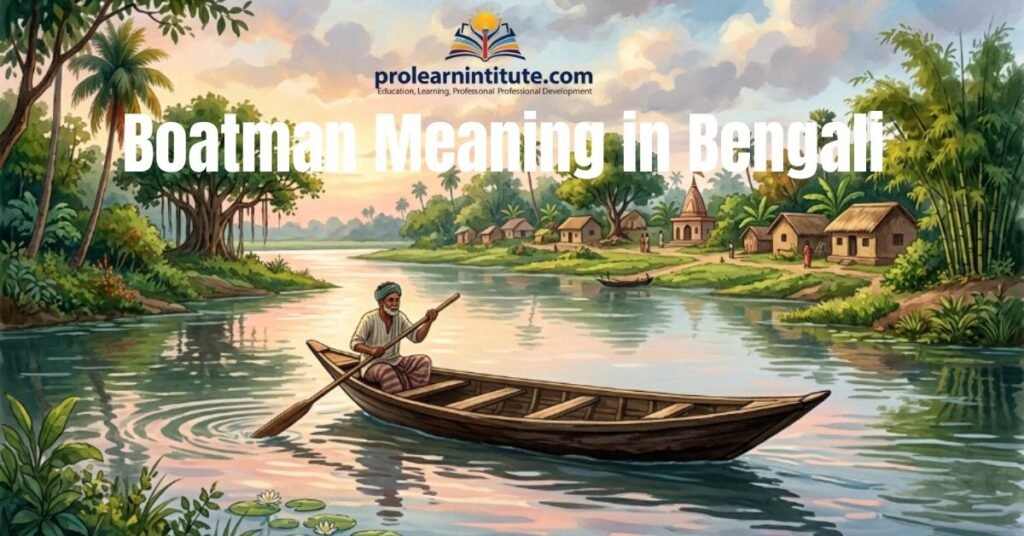
The word boatman refers to a person who rows or operates a boat. In Bengali, the word boatman is translated as মাঝি (Majhi).
Below is a quick reference table for related words:
| English Word | Bengali Meaning | Pronunciation |
| Boatman | মাঝি | Majhi |
| Scholar | পণ্ডিত | Pondit |
| River | নদী | Nodi |
| Storm | ঝড় | Jhor |
| Swim | সাঁতার | Shatar |
| Knowledge | জ্ঞান | Gyan |
| Boat | নৌকা | Nouka |
| Shore | তীর | Tir |
| Pride | অহংকার | Ohongkar |
| Wisdom | প্রজ্ঞা | Projna |
The word মাঝি (Majhi) is commonly used in Bangladeshi literature and daily conversation. It refers to someone who makes their living by ferrying people across rivers.
This profession holds a special place in Bengali culture, especially in regions crossed by major rivers like the Padma, Meghna, and Jamuna.
see also: Dialogue Aim in Life – For Class 6,7,8, SSC, HSC with Short & Long Examples
Introduction of the Story
A Scholar and a Boatman is a classic moral story that has been part of the Bengali school curriculum for many decades. It is short, easy to understand, and filled with a powerful life lesson.
The story revolves around two very different people — a highly educated scholar and a simple, uneducated boatman. Their short journey together teaches readers something that no textbook can fully explain.
This story is especially popular among students from Class 6 to Class 10. It is often used in completing story exercises, paragraph writing, and moral discussion questions in exams.
The beauty of this story is that it speaks to everyone. Whether you are a student, teacher, or adult professional, the lesson of this story is always relevant.
Characters in A Scholar and a Boatman Story
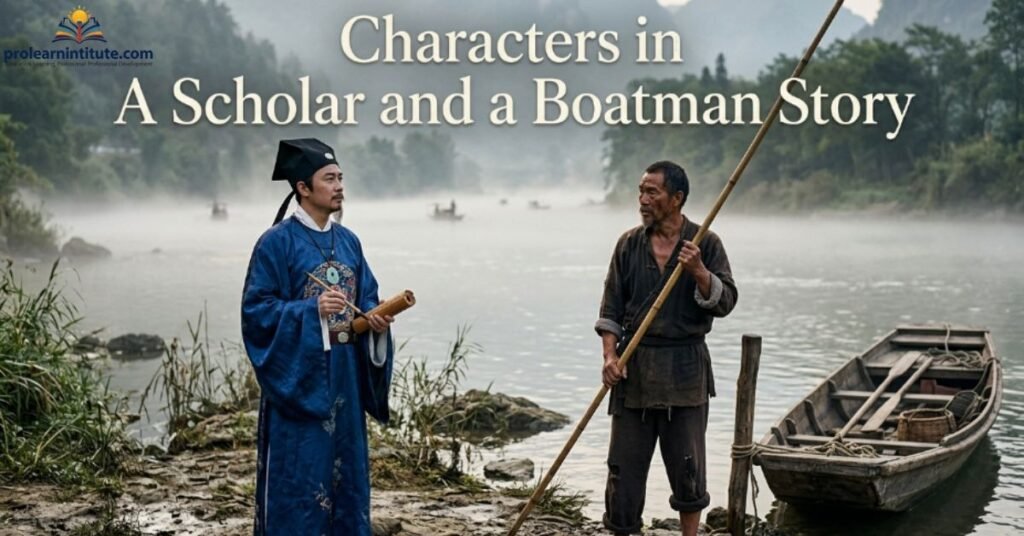
There are two main characters in this story. Both characters are simple but represent two very different types of people in society.
The Scholar:
- A highly educated man with great bookish knowledge
- Very proud and arrogant about his learning
- Looks down on people who are not educated
- Has no practical or survival skills
- Represents people who value only academic knowledge
The Boatman:
- A simple, uneducated man with no formal schooling
- Works hard every day to earn his living on the river
- Knows how to swim and handle river conditions
- Humble and quiet in nature
- Represents people with strong practical skills and real-world wisdom
| Feature | Scholar | Boatman |
| Education | Highly educated | No formal education |
| Attitude | Proud and arrogant | Humble and calm |
| Practical skill | None | Expert swimmer |
| Survival | Drowned | Survived |
| Life lesson | Overconfidence leads to loss | Practical knowledge saves lives |
Main Events of the Story Explained
The story follows a clear sequence of events. Each event leads to the final lesson in a very natural and logical way.
Event 1 – The Journey Begins: A scholar hires a boatman to cross a wide river. The scholar feels superior and starts a conversation to test the boatman’s knowledge.
Event 2 – The Grammar Question: The scholar asks if the boatman knows grammar. The boatman says no. The scholar tells him that half of his life is wasted.
Event 3 – The Mathematics Question: The scholar asks about mathematics next. Again, the boatman admits he does not know it. The scholar says most of his life is now wasted.
Event 4 – The Storm Arrives: A sudden and powerful storm hits the river. The boat begins to sink, and both men are in great danger of drowning.
Event 5 – The Boatman’s Question: The boatman asks the scholar if he knows how to swim. The scholar says no. The boatman calmly says his whole life is wasted.
Event 6 – The Final Outcome: The boatman jumps into the water and swims safely to the shore. The scholar, lacking this one practical skill, loses his life in the river.
Lesson from A Scholar and a Boatman Story
The most important lesson from this story is that bookish knowledge alone cannot save your life. Practical skills are equally important for every person.
The scholar knew many things from books. But when a real danger came, not one of those things helped him. It was a simple physical skill — swimming — that made the difference between life and death.
- Practical knowledge is as valuable as academic knowledge
- Being humble keeps you open to learning more
- Every kind of work and skill has its own value
- Pride in education should never make you look down on others
- Life tests you with real situations, not just exam questions
This lesson is not just for students. It applies to every person in every stage of life. No matter how much you study, ignoring practical life skills is always dangerous.
see also: A School Magazine paragraph for Class 6, 7, 8, 9, 10 & SSC
Why This Story Matters for Higher Secondary (HSC) Students

For HSC-level students, this story carries a more advanced meaning related to balanced education and humility in success.
At this stage of life, many students begin to feel proud of their academic achievements. This story reminds them that real intelligence includes emotional awareness and respect for all professions.
- Academic success should never lead to arrogance toward others
- Every profession, skilled or unskilled, deserves respect
- True education includes self-awareness and adaptability
- Survival and life skills matter as much as exam results
HSC students are often asked to write analytical answers on this story, connecting it to real-world examples such as job interviews, where practical experience sometimes outweighs degrees alone.
Why Bangladesh Has Made This Story a Curriculum Staple
This story has remained part of Bengali textbooks for generations because it speaks directly to a tension many Bangladeshi families understand deeply — the value placed on formal education versus the equally vital, often overlooked, practical trades that keep communities running. A বাংলা মাসের নাম (Bengali month name) like Baishakh, mentioned in the traditional opening, situates the story firmly within local seasonal life, where sudden Nor’wester storms are a real and familiar danger on rivers like the Padma and Meghna — a connection also explored in the Our National Flag Paragraph, which similarly ties national identity to shared cultural experience.
Teachers continue to assign this story because it teaches something no newspaper composition or textbook chapter can fully capture — that real wisdom is measured not by what you can recite, but by what you can do when circumstances demand it. This same theme of humility overturning pride appears across many of Bengal’s oldest moral tales, including stories like The Clever Fox and the Foolish Crow, where overconfidence similarly leads a character toward an avoidable downfall.
Importance of the Story in Real Life
This story holds great importance in real life because it reflects a common problem in modern society. Many people focus only on degrees and certificates but ignore real-world skills.
In Bangladesh and many other countries, students spend years studying hard for exams. But they often do not learn skills like cooking, first aid, basic repairs, or other life essentials. This story reminds us why that balance is needed.
- Students should learn both academic and practical subjects
- Schools should include life skills in their programs
- Parents should encourage children to learn useful hands-on skills
- Employers often prefer people who can apply knowledge in real situations
- A well-rounded person is more prepared for any challenge life brings
The boatman in this story did not fail because he lacked education. He succeeded because he had the right skill for the right moment. This is a lesson the whole world still needs today.
Moral of the Scholar and the Boatman Story
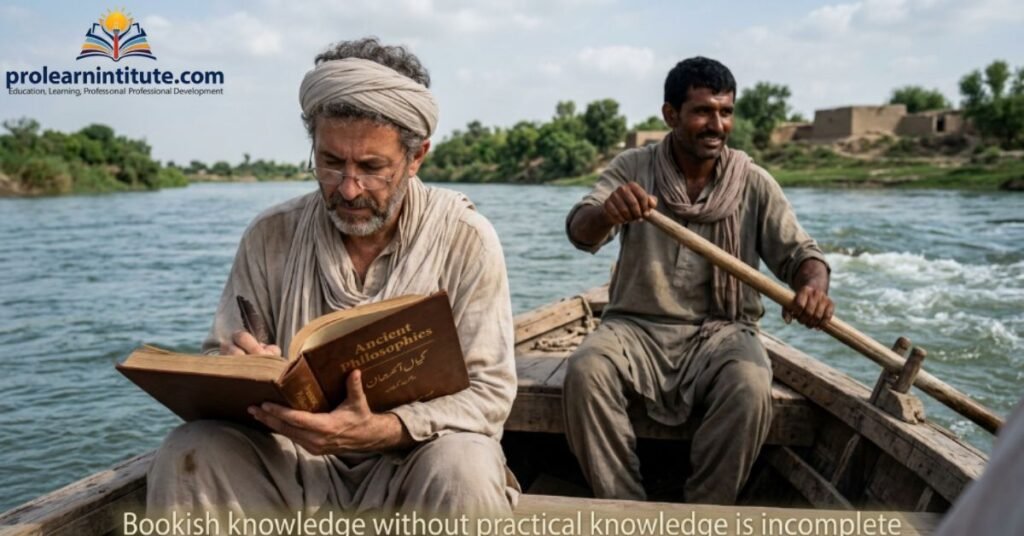
The moral of the ” A Scholar and a Boatman Story is:
“Bookish knowledge without practical knowledge is incomplete and sometimes useless.”
This moral teaches us that education should not be limited to books and classrooms only. Real education means being able to handle real situations in life with confidence and skill.
Here are different ways this moral can be written for exams:
| Format | Moral Statement |
| Short moral | Practical knowledge is as important as bookish knowledge. |
| One line moral | A person without practical skills is not truly educated. |
| Bengali moral | বাস্তব জ্ঞান ছাড়া বইয়ের জ্ঞান অসম্পূর্ণ। |
| Exam format | We should combine academic learning with practical life skills. |
| Proverb style | Knowledge is power, but only when it can be used in real life. |
Students should remember this moral clearly because it is often asked directly in school and HSC-level exams. Write it in your own words for the best marks.
Vocabulary Students Should Know From the Traditional Version
The official exam version introduces a few extra words worth learning for full marks. “Illiterate” means unable to read or write — used to describe the boatman’s lack of formal schooling. “To meet both ends meet” (also written as “make ends meet”) means to earn just enough to survive. “Baishakh” is the first month of the Bengali calendar, roughly mid-April to mid-May, known for sudden storms. A “Nor’wester” (কালবৈশাখী in Bengali) is a violent, fast-moving storm typical of this season in Bangladesh, often appearing without much warning — exactly as it does in this story. Knowing these terms helps students write a more authentic, textbook-accurate version of the story in their exams.
Conclusion
At its core, A Scholar and a Boatman Story With Moral | বাংলা অর্থসহ teaches us that book knowledge alone is not enough, and practical skills are equally important in life. In simple terms, the story reminds us to stay humble and respect the knowledge and experience of others.
Now you have a clear understanding of the valuable lesson behind this story and why it still matters today. The next step is yours—apply this message in your daily life and remember that true wisdom comes from both learning and experience.
see also: A Winter Morning Paragraph for Students (Class 6 to HSC)
FAQs
What is the moral of the ” A Scholar and a Boatman story?
The moral is that bookish knowledge without practical knowledge is incomplete. The scholar had a great education but could not swim, which cost him his life, proving that real-world skills are just as important as academic learning.
What happens in the A Scholar and a Boatman story in short?
A proud scholar mocks a boatman for not knowing grammar or math. When a storm sinks the boat, the boatman swims to safety while the scholar drowns because he never learned to swim.
How do you write A Scholar and a Boatman completing a story for an exam?
Start by introducing the scholar’s proud behavior and his mocking questions to the boatman. Then describe the storm, the boatman’s question about swimming, and end with the scholar drowning while the boatman survives. Always include the moral at the end.
What does the boatman represent in A Scholar and a Boatman story?
The boatman represents humble, practical wisdom. He has no formal education but possesses a life-saving skill — swimming — which proves that real-world knowledge and hard work are more valuable than bookish pride.
What is the meaning of boatman in Bengali or Bangla?
The meaning of boatman in Bengali is মাঝি (Majhi). It refers to a person who rows a boat and ferries people across rivers. In this story, the মাঝি is the real hero because of his practical skills.
Why did the scholar drown in A Scholar and a Boatman story?
The scholar drowned because he did not know how to swim. Despite having a great education in grammar and mathematics, he had no practical survival skills to save himself when the boat sank during the storm.
What lesson do students learn from the ” A Scholar and a Boatman story in Bangladesh?
Bangladeshi students learn that education must be balanced with practical skills. The story is taught from Class 6 to HSC level to remind students that life situations require more than just bookish knowledge to handle successfully.
How do you write a ” Scholar and a Boatman story in 200 words for a school exam?
Write the full story in simple English, covering four key parts: the scholar’s pride, his questions to the boatman, the storm, and the outcome. End with the moral. Keep each paragraph 2 to 3 lines and use simple vocabulary suitable for Class 6 to Class 10.
What is the Scholar and the Boatman story in Bangla with meaning?
In Bengali, the story is about a পণ্ডিত (scholar) who mocks a মাঝি (boatman) for lacking education. When a ঝড় (storm) comes, the মাঝি swims to safety while the পণ্ডিত drowns. The Bangla moral is: বাস্তব জ্ঞান ছাড়া বইয়ের জ্ঞান অসম্পূর্ণ।
What are the main characters in the A Scholar and a Boatman story and their traits?
The two main characters are the scholar and the boatman. The scholar is proud, educated, and arrogant but lacks practical skills. The boatman is humble, uneducated, but wise in real-life survival skills like swimming, which ultimately saves his life.

I’m Jordan Smith, a content writer with 4 years of experience and AI content expertise, creating clear, engaging, and easy-to-understand educational content.