
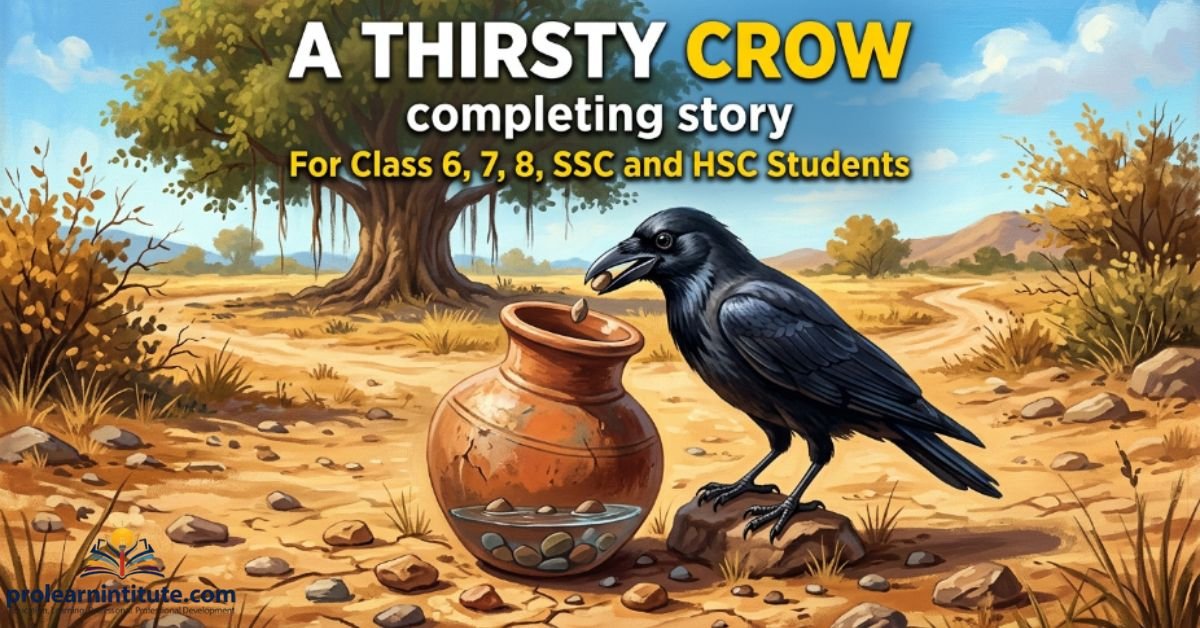
The Thirsty Crow story is one of the most famous short stories in English literature. It is loved by students of all ages because it teaches a very important life lesson. This story shows how a small bird used its brain to solve a big problem.
This article covers everything about the thirsty crow story—the full story, moral, class-wise versions, and much more. Whether you are a student of Class 6 or HSC, this guide is made just for you.
What is the story of the thirsty crow?
The thirsty crow story is about a crow that was very thirsty on a hot summer day. It found a pot of water, but the water level was too low to drink. The crow did not give up and used a clever idea to solve the problem.
Why is this story important for students?
This story teaches students the value of hard work, patience, and smart thinking. It shows that problems can be solved if we stay calm and use our minds. Every student can learn a great life lesson from this simple story.
Short Summary of the Story
A brief overview of the crow’s situation
A crow was flying on a very hot day and felt very thirsty. It searched for water everywhere but could not find it easily. Finally, it found a pot with a little water at the bottom.
How the problem was solved
The crow could not reach the water because it was too low in the pot. So the crow dropped small pebbles into the pot one by one. The water slowly rose, and the crow was able to drink it.
A Thirsty Crow Story (Complete Version)
Beginning of the Story
The crow is thirsty
It was a very hot summer day. A black crow was flying in the sky and felt very thirsty. Its throat was dry, and it needed water badly.
Searching for water on a hot day
The crow flew from one place to another looking for water. It checked ponds, rivers, and puddles, but found nothing. The sun was very hot, and the crow was getting weak.
Middle of the Story
Finding a pot with very little water
After a long search, the crow finally found an old clay pot near a house. It looked inside and saw some water at the very bottom. But the water level was too low for the crow’s beak to reach.
Struggling to drink the water
The crow tried to put its beak into the pot many times but failed. The water was just too far down. The crow felt sad but did not leave.
Climax of the Story
The crow uses intelligence.
The crow looked around and saw many small pebbles lying on the ground. Suddenly, a smart idea came to its mind. It decided to drop the pebbles into the pot one by one.
Dropping pebbles into the pot
The crow picked up pebbles and dropped them into the pot slowly and carefully. With every pebble, the water level rose a little higher. The crow kept working with full patience and effort.
Ending of the Story
Water rises up
After dropping many pebbles, the water finally rose to the top of the pot. The crow could now easily reach the water with its beak. It’s hard work, and smart thinking has paid off.
The crow drinks water happily.
The crow drank the fresh, cool water and felt very happy and satisfied. It flew away with a joyful heart. The crow had solved its problem by using its brain instead of giving up.
Moral of the Story
Hard work and intelligence always lead to success.
The crow did not sit and cry about its problem. It worked hard and used its brain to find a solution. This teaches us that effort and intelligence together always bring good results.
Never give up in difficult situations.
The crow could have flown away after failing to drink. But it stayed and tried harder. This moral reminds us to stay strong when life becomes difficult.
Lessons We Learn from the Story
Importance of problem-solving
The crow did not panic. It looked at the situation carefully and thought of a solution. Problem-solving is a skill every student must develop in life.
Using creativity in tough times
The crow used pebbles creatively and smartly. This shows that when we think outside the box, we can find answers to hard problems.
Patience and determination
The crow dropped pebbles one by one with full patience. It did not rush or give up. Patience and determination are keys to success in every field of life.
A Thirsty Crow Story for Class 6
Simple version of the story
One hot day, a crow was very thirsty. It found a pot with little water inside. The crow dropped pebbles into it, the water came up, and the crow drank it happily.
Easy vocabulary for young students
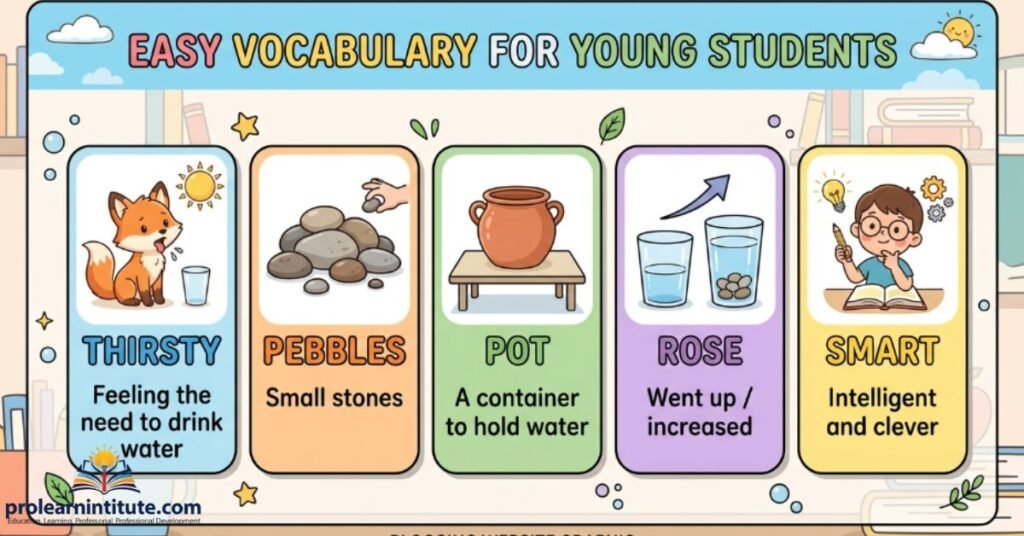
| Word | Meaning |
| Thirsty | Feeling the need to drink water |
| Pebbles | Small stones |
| Pot | A container to hold water |
| Rose | Went up / increased |
| Smart | Intelligent and clever |
A Thirsty Crow Story for Class 7
Slightly detailed version
On a hot summer afternoon, a thirsty crow searched for water everywhere. After a long search, it found a clay pot with a small amount of water at the bottom. Since the water was too low, the crow thought of a plan and started dropping pebbles into the pot. The water level slowly rose, and the crow finally drank the water.
Focus on moral understanding
The moral of this story is that smart thinking and patience solve every problem. Students of Class 7 should understand that giving up is never the right choice. If we use our minds, we can always find a way out.
A Thirsty Crow Story for Class 8
More descriptive storytelling
It was a scorching summer day, and the sky was bright with blazing sunlight. A tired and thirsty crow flew across the land in search of water. After searching for a long time, it discovered an old earthen pitcher near a garden wall. The crow peeked inside and noticed that the water level was far too low for its beak to reach. Without losing hope, the crow began collecting small pebbles from the ground and dropping them into the pitcher one by one. Slowly and steadily, the water rose to the top, and the crow finally quenched its thirst.
Emphasis on the lesson and explanation
This story gives us a powerful lesson about using intelligence over force. The crow did not break the pot or cry in frustration. It stayed calm, observed the situation, and found a practical solution. Class 8 students must learn that intelligence is always more powerful than physical strength.
Completing Story for SSC Students
Structured long answer format
Title: The Thirsty Crow
One hot summer day, a crow was flying in search of water. The heat was unbearable, and the crow’s thirst was increasing with every passing moment. After a long and tiring search, the crow spotted an old clay pot near a farmhouse. It flew down quickly and looked inside the pot with great hope. However, the water level was very low, and no matter how hard the crow tried, its beak could not reach the water. The crow felt discouraged but refused to give up.
Focus on exam writing style
Looking around carefully, the crow noticed many tiny pebbles scattered on the ground nearby. An idea flashed in its clever mind. It began picking up the pebbles one by one and dropping them into the pot. With each pebble, the water level slowly rose higher. The crow worked patiently and without stopping. After some time, the water reached the top of the pot. The crow drank the cool water with great joy. Moral: Where there is a will and wisdom, there is always a way.
Proper introduction, body, and conclusion
- Introduction: Set the scene — hot day, thirsty crow, long search
- Body: Finding the pot, low water, idea of pebbles, dropping them one by one
- Conclusion: Water rises, the crow drinks, the moral is stated clearly
Completing Story for HSC Students
Advanced version with explanation
The blazing summer sun had turned the earth into a furnace. A solitary crow, exhausted from its long flight, desperately searched for water across the dry landscape. Rivers had dried up, and ponds were empty. Just when the crow was about to lose all hope, it spotted an ancient clay pitcher resting beside an abandoned cottage. With great excitement, the crow landed and peered inside, only to find that the water sat far below the rim—completely beyond reach.
Deeper moral interpretation
Rather than surrendering to despair, the crow engaged its intellect. It observed small pebbles lying nearby and devised a scientific plan. By systematically dropping pebbles into the pitcher, the crow utilized the principle of water displacement. Each pebble raised the water level slightly until, at last, the life-giving liquid reached the rim. The crow’s triumph was not one of strength but of reason. This story symbolizes that in every crisis, calm thinking and persistent effort are the greatest tools a person can possess.
Analytical writing style
- Theme: Intelligence over helplessness
- Symbolism: The crow represents mankind; the low water represents life’s challenges
- Message: Scientific thinking and patience lead to success
- Literary Device: The story uses simple allegory to teach a deep moral truth
Alternate Ending Ideas (Creative Section)
What if the crow didn’t find pebbles?
If the crow had not found pebbles, it might have broken a small branch and used it to stir the water toward the side. Or it could have found a long, thin stick and tried to lap the water from it. There are always multiple ways to solve a problem if we think creatively.
Different possible solutions the crow could use
- Tilting the pot on its side carefully to let water flow out
- Finding a leaf to scoop the water slowly
- Calling other crows for help to move the pot
- Looking for a different water source nearby
Key Vocabulary Used in the Story
| Word | Meaning | Example Sentence |
| Thirsty | Needing water badly | The crow was very thirsty on a hot day. |
| Pebbles | Small round stones | The crow picked up small pebbles from the ground. |
| Pitcher | A clay pot for water | The pitcher had very little water inside. |
| Intelligence | The ability to think and solve problems | The crow used its intelligence to get water. |
| Problem-solving | Finding a solution to a problem | Good problem-solving skills helped the crow survive. |
| Determination | Strong will to keep trying | The crow showed great determination and did not give up. |
| Patience | Ability to wait calmly | The crow dropped pebbles with full patience. |
| Displacement | Water rises when something is added | Dropping pebbles caused water displacement in the pot. |
Final Conclusion
The thirsty crow story is a timeless lesson for students of every class. It teaches us that intelligence, patience, and hard work are the most powerful tools we have. A simple bird showed us that no problem is too big if we use our bbrains
Whether you are writing this story for Class 6 or for HSC exams, always remember its core message — never give up, and always think before you act. This story is small in words but very big in meaning, and its lesson will stay with you for life.
Frequently Asked Questions
What is the moral of the Thirsty Crow story for Class 6 students?
The moral of the Thirsty Crow story is “Where there is a will, there is a way.” It teaches students that intelligence and patience can help us solve even the hardest problems.
How does the Thirsty Crow story end completely?
The story ends when the clever crow drops pebbles one by one into a pitcher until the water rises to the top, and the crow finally drinks the water and flies away satisfied.
What happens in the Thirsty Crow story step by step?
A thirsty crow finds a pitcher with very little water, cannot reach it, then cleverly drops pebbles into it to raise the water level, and successfully drinks the water after much effort and patience.
Why is the Thirsty Crow story important for HSC students?
The Thirsty Crow story is important for HSC students because it teaches critical thinking, problem-solving, and perseverance — values that are essential for academic and real-life success.
What lesson do students learn from the Thirsty Crow story in English class?
Students learn that giving up is never the answer, and that using your mind creatively under pressure can turn a difficult situation into a successful outcome.
Who are the main characters in the Thirsty Crow story?
The only main character in the Thirsty Crow story is the clever crow itself, and the key objects are the pitcher and the pebbles that help the crow solve its problem.
What type of story is the Thirsty Crow, and where does it come from?
The Thirsty Crow is a classic fable originally from Aesop’s Fables, a collection of ancient moral stories that have been used for centuries to teach life lessons to children and students.
How can a student write the Thirsty Crow story in their own words for an exam?
A student can write it by describing a hot day, a thirsty crow finding a nearly empty pitcher, its clever idea of dropping pebbles to raise the water, and ending with the moral that hard work and smart thinking always pay off.
What is the complete moral and ending of the Thirsty Crow story for exam purposes?
The complete ending shows the crow drinking water after raising its level with pebbles, and the moral is that necessity is the mother of invention—hard work combined with intelligence always finds a solution.
Is the Thirsty Crow story suitable for both Class 6 and HSC-level English exams?
Yes, the Thirsty Crow story is suitable for both Class 6 and HSC levels because its simple language works for younger students, while its deeper moral about perseverance and problem-solving is meaningful for higher-level academic discussions.

I’m Jordan Smith, a content writer with 4 years of experience and AI content expertise, creating clear, engaging, and easy-to-understand educational content.