
Introduction to Tree Plantation Dialogue
Tree plantation refers to the process of planting trees in previously empty or open areas to enhance the environment’s greenery and overall health. It is one of the most important activities for saving our planet from pollution and climate change.
Dialogues are a very common part of school exams, especially in English. Writing a good dialogue shows your language skills and helps you get high marks easily.
What is tree plantation?
Tree planting is the process of planting new trees in places where trees are missing or have been cut down. It helps clean the air, conserve water, and provide homes for animals and birds.
Why dialogues are important for exams
Dialogues test how well you can write a conversation in natural English. They appear in Class 6, 7, 8, 9, 10, and SSC exams almost every year.
Dialogue on Tree Plantation for Class 6–7 (Simple & Easy)
This section has very easy and short dialogues for young students. The language is simple, and the sentences are short, so every student can understand and learn quickly.
Short Vocabulary
- Plant — to put a seed or small tree in the ground
- Environment — the natural world around us
- Oxygen — the air we breathe
- Pollution — dirt and harmful gases in the air
- Shade — shadow made by trees
Very Short Dialogue (Class 6 Level)
Ali: Sara, what are you doing in the garden?
Sara: I am planting a small tree. Ali.
Ali: Why are you doing this?
Sara: Trees give us fresh air and shade. They are very useful.
Ali: That is a great idea. Can I also plant one?
Sara: Yes, of course! Come and help me.
Easy Dialogue for Class 7 Students
Hamza: Ayesha, why did our school start a tree plantation drive?
Ayesha: Because our area has very few trees now. We need more greenery.
Hamza: What are the benefits of planting trees?
Ayesha: Trees give us oxygen, clean the air, and stop soil from washing away.
Hamza: That sounds really important. How can I help?
Ayesha: You can plant a tree at home or in your street.
Hamza: I will surely do that today.
Ayesha: Great! Every tree we plant is a gift to the future.
Dialogue on Tree Plantation for Class 8 (Moderate Level)
Class 8 students need to write slightly longer dialogues with more detail. These dialogues include environmental awareness and stronger vocabulary to impress the examiner.
10-Line Dialogue for Class 8
Usman: Zara, I noticed you were late to class today. Where were you?
Zara: I was helping our teacher plant trees on the school grounds.
Usman: Oh! Is tree planting really that important?
Zara: Yes, very much. Trees reduce air pollution and control the temperature.
Usman: I have heard that many trees are being cut down for buildings.
Zara: That is called deforestation. It is a serious problem for our environment.
Usman: What happens when too many trees are cut down?
Zara: Floods, droughts, and global warming become worse without enough trees.
Usman: So we should plant more trees to balance this?
Zara: Exactly. Even planting one tree per person can make a big difference.
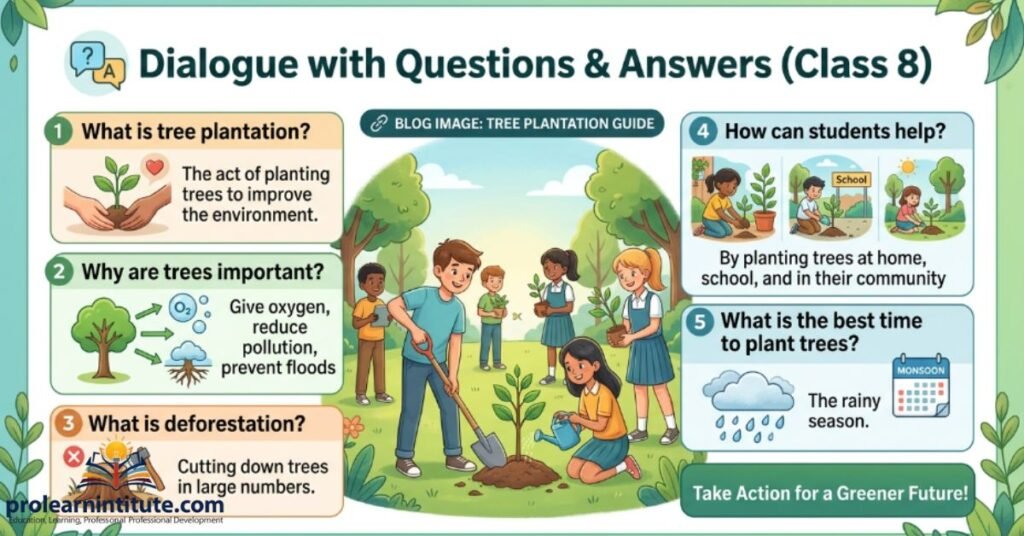
Dialogue with Questions & Answers (Class 8)
| Question | Answer |
| What is tree plantation? | It is the act of planting trees to improve the environment. |
| Why are trees important? | They give oxygen, reduce pollution, and prevent floods. |
| What is deforestation? | Cutting down trees in large numbers is called deforestation. |
| How can students help? | By planting trees at home, at school, and in their community. |
| What is the best time to plant trees? | The rainy season is the best time to plant trees. |
Why June and July Are the Best Months for Tree Plantation
Timing matters a great deal when it comes to tree plantation, and this is a detail that often earns extra marks in exam answers. In Bangladesh, the months of June and July mark the beginning of the monsoon season, when regular rainfall provides newly planted saplings with the consistent moisture they need to establish strong root systems. Planting during the dry winter months, by contrast, often leads to poor survival rates since young saplings struggle without enough water.
This is also why the National Tree Plantation Campaign and Tree Fair is held every year starting in early June, aligning the government’s own planting schedule with this natural rainy-season advantage. A single mature tree can absorb roughly 22 kilograms of carbon dioxide per year, meaning that trees planted during this optimal window and given proper care for their first few years go on to deliver years of environmental benefit. Students who understand this reasoning — not just the fact that trees should be planted, but why timing matters — write noticeably stronger dialogue and composition answers.
Dialogue on Tree Plantation for Class 9–10 (SSC Level)
SSC-level dialogues need advanced vocabulary and strong points. These dialogues should show awareness of global problems like climate change and deforestation.
Long Dialogue for SSC Exams
Bilal: Sana, our city is getting hotter every summer. What do you think is the reason?
Sana: The main reason is the rapid cutting of trees and the rise in pollution levels.
Bilal: I agree. There used to be many trees in our neighborhood, but now most of them are gone.
Sana: This is called deforestation. It is one of the biggest environmental threats today.
Bilal: What can be done to solve this problem?
Sana: Governments and individuals must both work together to plant more trees.
Bilal: Has our government taken any steps toward tree planting?
Sana: Yes, Pakistan launched the Billion Tree Tsunami project, which planted billions of trees.
Bilal: That is impressive. But what role can students like us play?
Sana: We can start small. Plant a tree on your birthday or in your backyard.
Bilal: That is a wonderful idea. Small actions do create big changes over time.
Sana: Exactly. If every student plants one tree, imagine how green our country would become.
Bilal: I am definitely going to start a tree plantation drive in my school.
Sana: I will join you. Together, we can inspire others to take action too.
Dialogue with Moral Lesson (Class 9–10)
Raza: Sir, why do you always talk about planting trees in your lessons?
Teacher: Because trees are the lungs of the Earth, Raza. Without them, life cannot survive.
Raza: But people keep cutting them for factories and roads.
Teacher: That is true. And we are already seeing the results in the form of floods and heat waves.
Raza: So what is the moral lesson here?
Teacher: The moral is simple — what you destroy today, you will miss tomorrow. Protect nature now.
Raza: I understand, Sir. I will spread this message to my friends and family.
Teacher: That is the spirit. A responsible student can change the whole community.
5+ Short Dialogues on Tree Plantation (Quick Practice)
These short dialogues are perfect for last-minute exam practice. You can memorize them quickly and use them in different exam questions.
Dialogue Between Two Friends
Ahmed: Why are you carrying a small plant?
Rania: I am going to plant it near our gate. Trees make the air fresh and clean.
Ahmed: Good idea! I should also plant one near my house.
Rania: Yes, let us make our street greener together.
Dialogue Between Teacher and Student
Teacher: Do you know why we celebrate World Environment Day?
Student: Yes, Ma’am. It is to remind us to protect nature and plant more trees.
Teacher: Correct! What have you done for the environment?
Student: I planted two trees last month with my family.
Teacher: Excellent! That is the right spirit for a responsible citizen.
Dialogue About Environmental Protection
Nadia: The weather is getting very extreme these days. Summers are too hot, and winters are too cold.
Hina: It is because of climate change. Cutting trees has disturbed the balance of nature.
Nadia: What can ordinary people do about this?
Hina: We can start by planting trees, reducing plastic, and saving water every day.
Nadia: You are right. Small habits can lead to big environmental changes.
Hina: Exactly. Nature gives us everything. It is our duty to protect it.
Key Points to Include in Tree Plantation Dialogue
A strong dialogue on tree planting should always include some key ideas. These points help you write a complete and high-scoring answer in exams.
Importance of trees
- Trees produce oxygen, which every living being needs to breathe.
- They provide wood, food, and medicine to humans.
- Trees give shade, reduce heat, and make the environment comfortable.
Environmental benefits
- Trees absorb carbon dioxide and reduce global warming.
- They prevent floods by holding the soil together with their roots.
- Forests are home to thousands of animals, birds, and insects.
Role of students
- Students can plant trees in schools, homes, and public areas.
- They can raise awareness in their community about deforestation.
- Participating in tree plantation drives organized by schools is very helpful.
Government initiatives
- Pakistan’s Billion Tree Tsunami planted over a billion trees across the country.
- The Clean Green Pakistan campaign encourages citizens to plant trees.
- Many governments around the world have laws to protect forests and green areas.
Bangladesh’s Own Tree Plantation Movement
While government programs vary by country, students in Bangladesh should also know about their own nation’s major afforestation effort, since exam answers score higher with locally relevant, current examples. In 2026, Bangladesh launched a nationwide five-year campaign to plant 250 million trees, inaugurated as part of the government’s National Green Mission and the annual National Tree Plantation Campaign and Tree Fair. The initiative prioritizes fast-growing indigenous species like mahogany, neem, jackfruit, and jarul over imported ones, along with mangrove planting in coastal districts to strengthen protection against cyclones.
This program also aims to create hundreds of thousands of green jobs through community nurseries, showing students that tree plantation is not just an environmental duty but also an economic opportunity. Mentioning a real, current national initiative like this — alongside international examples — makes a dialogue or paragraph feel far more authentic and well-researched. For students exploring how national development connects to environmental awareness, the Dhaka Metro Rail Paragraph offers another example of how infrastructure and sustainability themes often overlap in exam topics.
Common Exam Questions About Tree Plantation Dialogue
These are the most common questions that appear in Class 6 to SSC exams. Knowing these will help you prepare better and feel confident in your exam.
How to Write a Dialogue on Tree Plantation?
Writing a good dialogue is easy if you follow a few simple steps. First, decide who is talking — it can be two friends, a teacher and student, or a parent and child. Give each speaker a name and keep the conversation natural and easy to read. Always include a clear message about why trees are important and end the dialogue with a positive note or moral lesson.
Important Lines to Use in Exams

| Situation | Useful Line |
| Starting the dialogue | “Have you heard about the tree plantation drive?” |
| Explaining importance | “Trees are essential for clean air and a healthy life.” |
| Mentioning deforestation | “Cutting trees is destroying our environment badly.” |
| Encouraging action | “We should all plant at least one tree this year.” |
| Ending with a moral | “A tree planted today is a gift to the next generation.” |
Tips to Write a High-Scoring Dialogue
Follow these tips to get the best marks on your dialogue writing question. A neat, clear, and well-organized dialogue always impresses the examiner.
Use simple English
- Avoid using very difficult or complex words in your dialogue.
- Write in short and clear sentences that are easy to understand
- Simple English makes your dialogue natural and readable.
Keep sentences short
- Long and confusing sentences can reduce your marks.
- Each line in the dialogue should carry one clear idea.
- Short lines make the conversation flow smoothly and look professional.
Add a moral message
- Always end your dialogue with a positive message or lesson.
- A moral shows that your dialogue has a purpose and depth
- Lines like “every tree is a gift to future generations” leave a strong impression
Connecting Tree Plantation to Bigger Environmental Themes
A high-scoring dialogue on tree plantation often goes beyond the immediate topic to show awareness of broader environmental and global issues, which examiners appreciate at the SSC and HSC levels. Deforestation doesn’t just remove trees — it contributes to soil erosion, disrupted rainfall patterns, and rising local temperatures, all of which connect directly to larger conversations around globalization and how interconnected environmental and economic decisions have become worldwide.
Students preparing for higher-level exams can strengthen their environmental vocabulary by exploring related topics like the Globalization Paragraph, which touches on how local environmental choices ripple into global consequences. Similarly, showing awareness of community initiatives — such as writing about a school magazine campaign encouraging students to plant trees — demonstrates the kind of well-rounded thinking that separates an average dialogue from an exceptional one.
Conclusion
Tree plantation is not just a topic for exams—it is a real and urgent need of our time. Planting trees is one of the easiest and most powerful ways students can help save the environment.
Use these dialogues to prepare for your exams and also inspire others around you. Remember, a good student does not just study — a good student also takes action for a better world.
Frequently Asked Questions
1. What is a short tree plantation dialogue for Class 6 students in English?
A tree plantation dialogue for Class 6 is a simple conversation between two students discussing why planting trees is important for the environment, clean air, and wildlife—usually 6–10 lines long and written in easy, everyday English.
2. How do I write a tree plantation dialogue between two friends for an SSC exam?
To write a tree plantation dialogue for SSC, start with a greeting, introduce the topic naturally, exchange 3–4 points about the benefits of planting trees, and close with a commitment to take action—keeping the language formal yet conversational.
3. What are some good example lines to use in a tree plantation dialogue for class 8?
Good example lines include: “Did you know that one tree can absorb over 48 pounds of CO₂ per year?” or “We should join our school’s tree plantation drive this Saturday” — these make dialogues sound natural and fact-based.
4. Why is tree plantation dialogue important for students in Classes 6 through 10?
Tree plantation dialogues help students practice conversational English, learn environmental vocabulary, develop awareness about climate change, and prepare for school exams and SSC written assignments all at once.
5. How long should a tree plantation dialogue be for a Class 10 English assignment?
A tree plantation dialogue for Class 10 should typically be 10–15 lines long, feature two or more speakers, include at least two environmental facts, and end with a positive resolution or call to action.
6. What topics should be covered in a tree plantation dialogue for SSC students?
An SSC tree plantation dialogue should cover why trees are essential, the effects of deforestation, how students can participate in plantation drives, the role of government initiatives, and simple steps every individual can take to help.
7. Can you give me an example of a tree plantation dialogue between a teacher and a student?
Sure! Teacher: “Do you know what day is celebrated as World Environment Day?” Student: “Yes, sir, it’s June 5th. Our school is organizing a tree plantation program that day.” Teacher: “Excellent! Every tree we plant is a gift to future generations.”
8. How do I make a tree plantation dialogue sound natural and conversational for voice practice?
Use short sentences; contractions like “we’ve” and “it’s”; ask and answer questions naturally; include real facts; and avoid overly formal words—this makes the dialogue flow smoothly whether spoken aloud or read in class.
9. What is the best format to follow when writing a tree plantation dialogue for Class 7 or Class 9?
The best format is: Speaker A introduces the topic → Speaker B asks a question → both exchange 3–4 facts or opinions → dialogue ends with an agreement or plan—this structure works perfectly for Class 7, 8, and 9 assignments.
10. Where can students find ready-made tree plantation dialogue examples with Bengali or Urdu meanings for exam preparation?
Students can find tree plantation dialogue examples with translations on educational websites like 10minuteschool.com, englishbangla.com, and various SSC preparation blogs that provide bilingual versions specifically designed for Bangladeshi and Pakistani exam formats.

I’m Jordan Smith, a content writer with 4 years of experience and AI content expertise, creating clear, engaging, and easy-to-understand educational content.