

A student’s life is full of learning, growing, and building a strong foundation for the future. Every student carries certain duties that shape not only their academic journey but also their entire personality.
These duties are not just rules given by teachers or parents. Whether you need a duties of a student composition 150 words for class 6, a 300-word or 500-word essay for class 9 and 10, or a complete composition on duties and responsibilities of a student for SSC and HSC exams — this page has everything you need. You can also use this as a duties of a student paragraph for short assignments or as a full essay for board-level preparation.
Introduction to Duties of a Student
What is a student’s duty?
A student’s duty means all the responsibilities a student must fulfill during their school or college life. It includes attending classes, respecting teachers, studying hard, and maintaining good behavior.
Writing about the duties of a student is one of the most common topics asked in school and board exams. Students often search for short compositions of 150 words, medium-length essays of 200 to 300 words, and detailed compositions of 500 to 1000 words. This article covers all of these in one place — making it ideal for my duties as a student assignments, responsibilities of a student essay questions, and write about your duties as a student prompts from teachers.
These duties are not a burden. They are stepping stones that help every student grow into a better human being and a productive member of society.
Why responsibilities matter in student life
Responsibilities teach students how to manage time, respect others, and work with dedication. Without a sense of duty, even a talented student can waste their potential.
When students take their duties seriously, they build habits that stay with them throughout life. These habits help them in their career, relationships, and personal growth.
Duties of a Student Composition by Word Count (150, 200, 300, 500 Words)

Students are often asked to write a composition on the duties of a student in a specific word count. Below are ready-to-use versions for every word limit commonly asked in school exams.
Duties of a Student Composition 150 Words:
A student’s most important duty is to study sincerely and attend school regularly. Every student must respect their teachers, complete homework on time, and maintain good discipline. Punctuality, honesty, and cleanliness are values every student should practice daily.
Beyond academics, a student must also be a good person. This means helping classmates, obeying parents, and contributing positively to the school environment. A student who fulfills these duties not only scores well in exams but also builds a strong character for life.
The habits formed during student life stay forever. A dutiful student becomes a responsible adult, a caring citizen, and a successful professional. That is why every student must take their duties and responsibilities seriously from the very beginning.
Duties of a Student Composition 200 Words:
Student life is a time of learning, discipline, and character-building. The duties of a student go beyond just studying — they include being punctual, honest, respectful, and responsible in every situation.
The first duty of every student is to attend school regularly and pay full attention in class. Missing lessons leads to gaps in knowledge that are difficult to fill later. A student must also complete all homework and assignments on time without excuses.
Respecting teachers and elders is another key duty. Teachers work hard to pass on knowledge, and students must honor that effort by listening carefully and following instructions. Respect also extends to classmates — every student should treat others with kindness and fairness.
A good student also keeps the school environment clean, participates in co-curricular activities, and avoids bad company. Outside school, a student must help parents at home and behave responsibly in the community.
When students take their duties seriously, they grow into confident, disciplined, and successful individuals. Student life is short — using it well makes all the difference.
Duties of a Student Composition 300 Words:
Every student carries a set of duties that define their success — not just in exams, but in life. The duties of a student can be divided into academic duties, social duties, and moral duties. Together, they build a well-rounded and responsible individual.
Academic duties are the first priority. A student must attend school every day without fail, arrive on time, and give full attention during lessons. Homework must be completed sincerely, and exam preparation must begin well in advance. A student who studies regularly does not feel pressured before exams.
Social duties are equally important. A student must respect teachers, classmates, and all school staff. Being helpful, kind, and fair in dealing with others reflects good upbringing and strong values. Taking part in group activities, school events, and community service also falls under social responsibility.
Moral duties shape a student’s inner character. Honesty, truthfulness, and integrity must guide every action. A student should never cheat in exams, bully others, or behave dishonestly. These values, once built, last a lifetime.
At home, a student’s duties include helping parents with small tasks, keeping their room clean, and completing studies without being reminded. A student who is responsible at home is naturally responsible everywhere.
The importance of fulfilling these duties cannot be overstated. Students who follow their duties consistently become leaders, professionals, and positive members of society. Every great person in history was once a dutiful student. The foundation of all success is built in student life.
Duties of a Student Composition 500 Words:
Introduction:
Student life is often called the most important phase of a person’s life — and rightly so. It is during this time that habits are formed, values are shaped, and the groundwork for future success is laid. The duties of a student are not burdens but responsibilities that guide them toward a meaningful and successful life.
Academic Duties:
The most visible duty of every student is to study sincerely and perform well in academics. This includes attending school punctually every day, paying full attention during lessons, taking clear notes, completing all homework and assignments on time, and preparing thoroughly for every test and exam.
A good student does not wait for exam pressure to start studying. Instead, they revise regularly, clear doubts by asking teachers, and read beyond textbooks to deepen their understanding. This habit of consistent study leads to strong academic performance throughout the year.
Social Duties:
A student is not just a learner but also a member of a school community. Social duties include treating teachers with respect and gratitude, being kind and supportive to classmates, and contributing positively to the school environment.
Participation in school events, sports, cultural programs, and community service activities helps students develop teamwork, leadership, and empathy. A student who is active in social responsibilities becomes a confident communicator and a natural leader.
Moral Duties:
Moral duties are the core of a student’s character. Every student must practice honesty — in exams, in conversations, and in daily life. Cheating, lying, or bullying are serious failures of moral duty that damage a student’s integrity.
A morally strong student sets an example for others. They stand up for what is right, support those who are struggling, and show gratitude to everyone who helps them. These values, built during student life, become the foundation of a trustworthy and respected adult.
Duties at Home:
Student duties do not end at the school gate. At home, a student must help parents with small household tasks, manage their own belongings, and complete studies independently. Reducing screen time, sleeping on time, and maintaining a healthy routine are also important duties that support academic performance.
Duties of a Student Towards the Nation and Society

Every student carries a responsibility that extends far beyond the classroom and home — a duty toward their nation. Students are often called the backbone of a country because today’s disciplined, honest, and hardworking students become tomorrow’s doctors, engineers, teachers, and leaders. This idea is closely tied to global citizenship education frameworks promoted by organizations like UNESCO, which emphasize that schools should raise students who feel responsible not just for their grades but for their communities and nations.
A student fulfills this national duty in simple, everyday ways: staying away from corruption and dishonesty, respecting the law, participating in social work such as tree plantation or cleanliness drives, and standing against injustice when they see it. Just as strong family bonds shape a student’s early values — something explored in Our Family, Your Family, My Family Paragraph — a sense of duty toward the wider nation grows naturally out of the respect and responsibility first learned at home. A student who understands this connection between personal duty and national progress grows into a truly responsible citizen.
10 Duties of a Student (Quick Summary):
- Attend school regularly and on time
- Study sincerely and revise daily
- Complete all homework and assignments
- Respect teachers, parents, and elders
- Maintain discipline inside and outside school
- Be honest and avoid cheating
- Keep the school and home environment clean
- Participate in co-curricular and community activities
- Manage time wisely with a proper daily routine
- Take care of physical and mental health
Conclusion:
The duties of a student are the stepping stones to a great future. A student who understands and follows their responsibilities — academic, social, moral, and personal — builds a life of purpose and achievement. Student life is short, but the habits and values formed during this time last forever.
Duties of a Student Composition for Class 6, 7, 8 (Simple Version)
Students in middle school are at an important stage of life. This is the time when basic habits and values are formed. Every student at this level must follow these important duties.
1. Be Regular and Punctual in School
Coming to school on time every day is one of the most basic duties of a student. Regular attendance helps students stay updated with lessons and avoid missing important topics.
Punctuality shows that a student values time and takes education seriously. It also creates a good impression on teachers and classmates.
2. Respect Teachers and Elders
Teachers spend their time and energy to help students learn and grow. Every student must show respect to their teachers by listening carefully and following their instructions.
Respecting elders, whether at school or home, is a sign of good character. A student who is respectful is always loved and trusted by everyone around them.
3. Complete Homework and Classwork on Time
Doing homework on time is a very important duty for every student. It helps them revise what they have learned in class and strengthens their understanding.
Classwork also helps students practice new concepts. A student who completes both regularly performs much better in exams.
4. Maintain Discipline in School
Discipline means following school rules, behaving properly in class, and not disturbing others. A disciplined student creates a peaceful environment for everyone to learn.
Without discipline, no school can function properly. Every student must understand that discipline is not just a rule but a life skill.
5. Keep School Environment Clean
Keeping the school clean is a shared responsibility of all students. Students must not throw garbage on the floor and should use the dustbins properly.
A clean school reflects the values of its students. It also creates a healthy and pleasant environment for studying.
6. Focus on Studies and Good Behavior
Studies are the main purpose of going to school, and every student must give them full attention. Good behavior inside and outside the classroom shows the true character of a student.
A student who focuses on both studies and behavior grows into a well-rounded and respected individual.
Duties of a Student Composition for SSC Level (Class 9 & 10)
At the SSC level, students face more academic pressure and social responsibilities. This is a critical stage where discipline and focus can determine a student’s future. The duties become more serious and demanding.
1. Serious Commitment to Studies
SSC students must develop a deep commitment to their studies. They need to understand that these years will shape their academic and career future.
Regular study, proper revision, and exam preparation must be a top priority. A student who studies consistently performs better than one who studies only at the last minute.
2. Time Management and Routine Discipline
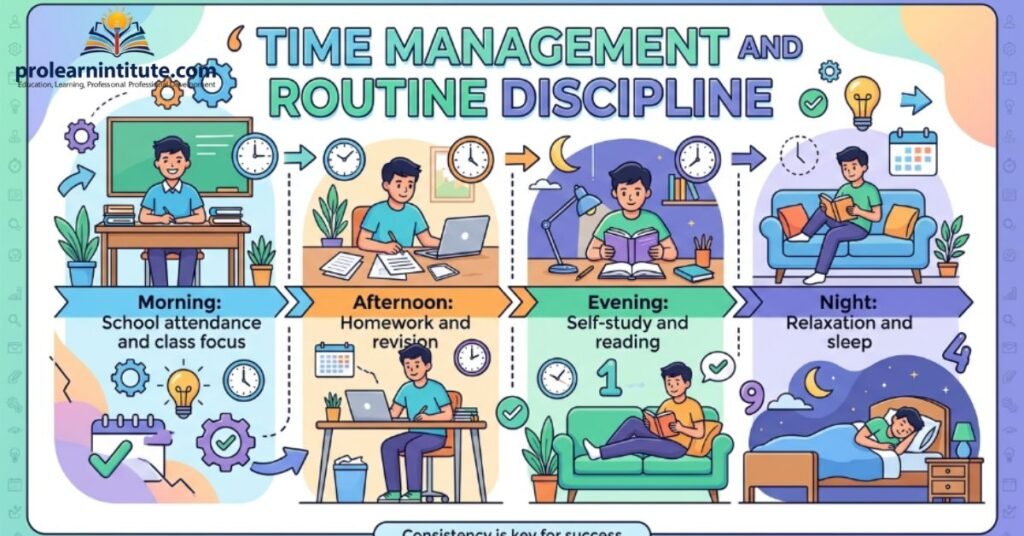
Managing time properly is one of the most important duties at this level. Students must create a daily routine that gives enough time to all subjects.
Wasting time on useless activities leads to poor performance. A well-planned routine helps students stay focused and stress-free.
| Time Block | Recommended Activity |
| Morning | School attendance and class focus |
| Afternoon | Homework and revision |
| Evening | Self-study and reading |
| Night | Relaxation and sleep |
3. Active Participation in Class Activities
Students must not sit silently in class. They should ask questions, participate in discussions, and take part in group activities.
Active participation improves understanding and builds confidence. It also helps teachers know where the student needs more guidance.
4. Moral and Social Responsibility
A student must be honest, kind, and helpful to others. Moral values like truthfulness, fairness, and empathy are just as important as academic results.
Social responsibility means caring about the community and being a good citizen. Students who develop these values become great leaders in the future.
5. Respect for Rules and Regulations
Every institution has rules that must be followed by all students. Respecting these rules creates order and fairness in the school environment.
Breaking rules not only harms the student but also disturbs the entire school community. A responsible student always follows rules willingly and encourages others to do the same.
6. Contribution to School Environment
Students should actively contribute to keeping the school environment positive and productive. This includes helping new students, supporting school events, and maintaining cleanliness.
A student who contributes positively to their school environment gains respect and builds leadership qualities. They become role models for younger students.
Duties of a Student Composition for HSC Level (Intermediate)
The intermediate or HSC level is the bridge between school life and professional life. Students at this stage must handle both academic pressure and personal growth with maturity. Their duties become more complex and career-focused.
1. Focus on Career-Oriented Study Goals
At the HSC level, every student must have a clear idea of their career goals. Studies must be directed toward choosing the right subjects and fields for the future.
Career planning at this stage saves time and energy. A student who knows their goal studies with more purpose and passion.
2. Self-Discipline and Independence
At the intermediate level, students must develop self-discipline without constant supervision. They must manage their own schedule, control distractions, and stay motivated.
Independence in study habits is a key skill that prepares students for university life and beyond. Self-disciplined students achieve more and face fewer obstacles.
3. Leadership and Responsibility in College Life
College life offers many opportunities to take leadership roles. Students should participate in societies, clubs, and student councils to develop leadership skills.
Being a leader means taking responsibility, solving problems, and guiding others. These experiences shape a student’s personality and prepare them for real-world challenges.
4. Contribution to Society and Community
HSC students are nearly adults and must feel a sense of responsibility toward society. They should participate in community service, awareness campaigns, and social work.
Contributing to society builds empathy and gratitude. It teaches students that success is not only personal but also about uplifting others.
5. Preparation for Future Challenges
Students at this level must mentally and academically prepare themselves for the challenges ahead. This includes entrance exams, competitive tests, and skill development.
Reading beyond textbooks, taking online courses, and developing soft skills are all part of this preparation. A well-prepared student faces the future with confidence.
6. Balanced Academic and Personal Life
While studies are important, a student must also take care of their physical and mental health. A balanced life includes proper sleep, exercise, hobbies, and social connections.
Burning out due to over-studying is harmful. A balanced student performs better academically and lives a healthier and happier life.
Duty to Maintain Good Health
A student’s duty is not only to books but also to their own body and mind. Good health is the foundation that makes every other duty possible — a tired or unwell student cannot study effectively, participate actively, or maintain discipline. This duty includes getting proper sleep, eating nutritious food, and taking regular physical exercise instead of spending all free time on screens.
Waking up early is one of the simplest habits that supports this duty, since it naturally builds a structured, healthy daily routine — a connection explored further in the Early Rising Paragraph for Students. Students who neglect their health often struggle with concentration and consistency, no matter how disciplined they try to be in other areas. Even during difficult circumstances — such as when load shedding disrupts study schedules and sleep patterns — a responsible student adapts their routine rather than abandoning healthy habits altogether. A healthy student is, quite simply, a more capable student.
Importance of Duties of a Student

Understanding and fulfilling student duties brings many long-term benefits. These benefits go beyond school and shape a person’s entire life journey.
- Builds character and personality — Fulfilling duties teaches honesty, patience, and responsibility. These qualities become part of a student’s character and define who they are.
- Helps in academic success — Students who take their duties seriously study regularly and perform better in exams. Good habits directly lead to better grades and academic achievements.
- Prepares for professional life — The discipline, time management, and responsibility learned as a student are exactly what employers look for. Dutiful students transition smoothly into professional life.
- Develops discipline and responsibility — Every duty a student fulfills builds their sense of discipline. Over time, this discipline becomes a natural part of their personality and decision-making.
Students from all classes — whether looking for a short duties of a student paragraph of 3–4 lines, a composition on duties and responsibilities of a student for SSC, or a detailed 1000-word essay for HSC — must understand that these duties are universal.
The role of students in school and society is directly shaped by how seriously they take these responsibilities. Whether you write about your duties as a student for a class assignment or a board exam, the core message remains the same: discipline, respect, and dedication define a truly dutiful student.
| Duty | Benefit |
| Regular attendance | Better understanding of subjects |
| Respect for teachers | Stronger teacher-student relationship |
| Time management | Less stress and better performance |
| Moral responsibility | Strong character and values |
| Community contribution | Leadership and empathy |
Conclusion
Every student must remember that their duties today are building blocks of their success tomorrow. Following these responsibilities with honesty and dedication creates a strong foundation for a bright future.
A student who understands the true value of their duties does not just become successful in exams but becomes a truly great person. The habits formed in student life last forever and define the quality of one’s entire life.
Duties of a Student Composition — Bangla Meaning (বাংলা অর্থ)
নিচে সংক্ষিপ্ত বাংলা অনুবাদ দেওয়া হলো, যা বাংলা মাধ্যমের শিক্ষার্থীদের জন্য সহায়ক হবে:
একজন শিক্ষার্থীর প্রধান দায়িত্ব হলো নিয়মিত ক্লাসে উপস্থিত থাকা এবং মনোযোগ দিয়ে পড়াশোনা করা। শিক্ষকদের প্রতি সম্মান দেখানো, সময়মতো বাড়ির কাজ শেষ করা এবং সৎ থাকা প্রতিটি শিক্ষার্থীর কর্তব্য। এছাড়া, একজন শিক্ষার্থীর উচিত পরিবার ও সমাজের প্রতি দায়িত্বশীল হওয়া এবং দেশের ভবিষ্যৎ গড়ার জন্য নিজেকে প্রস্তুত করা। শৃঙ্খলা, সততা ও পরিশ্রম — এই তিনটি গুণ একজন আদর্শ শিক্ষার্থীকে গড়ে তোলে।
মূলকথা: একজন শিক্ষার্থীর দায়িত্ব শুধু পড়াশোনার মধ্যে সীমাবদ্ধ নয়, বরং এটি একটি সুন্দর ভবিষ্যৎ গড়ার ভিত্তি।
Frequently Asked Questions
1. What are the main duties of a student that should be included in an English essay for school exams?
The main duties of a student essay should cover attending school regularly, studying sincerely, respecting teachers and parents, maintaining discipline, participating in co-curricular activities, and serving the community—these six points form the backbone of a complete and high-scoring essay.
2. How do I write an essay on the duties of a student for Class 5 or Class 6 in simple English?
To write a duties of a student essay for Class 5 or 6, open with one sentence defining a student’s role; list 3–4 simple duties like studying hard and obeying teachers; explain why each duty matters; and close with a personal commitment—keep it under 150 words and use easy, everyday language.
3. What is the best introduction line for an essay on the duties of a student in English?
A strong introduction line could be “A student’s life is not just about books and exams—it is a golden period of building habits, values, and responsibilities that shape the entire future.” This immediately sets a thoughtful, mature tone perfect for Class 8 and above.
4. How long should an essay on duties of a student be for Class 9 and Class 10 students?
A duties of a student essay for Class 9 and 10 should be between 300–500 words, organized into a clear introduction, three well-developed body paragraphs covering academic, social, and moral duties, and a strong conclusion that reinforces the importance of responsible student life.
5. What are the academic duties of a student that every essay should mention for all classes?
Every duties of a student essay should mention attending classes punctually, completing homework on time, preparing thoroughly for exams, asking questions to clear doubts, reading beyond the syllabus, and developing a genuine love for learning—these are the core academic responsibilities of every student.
6. What is the difference between the duties of a student at home and the duties of a student at school in an essay?
Duties at school include obeying teachers, maintaining discipline, and studying sincerely, while duties at home include helping parents, completing assignments independently, managing time wisely, and avoiding distractions like excessive screen time—a well-rounded essay should address both sides clearly.
7. How can I write a 10-line essay on the duties of a student for primary school kids in Class 3 or Class 4?
For Class 3 or 4, write one simple sentence per duty—for example, “I should go to school every day,” “I must listen to my teacher,” and “I should help my parents at home”—ten such lines make a perfect, age-appropriate essay that is easy to memorize and recite.
8. Why is writing an essay on duties of a student important for SSC and board exam preparation?
Essays on duties of a student are frequently asked in SSC and board exams because they test a student’s awareness of civic values, moral responsibilities, and social behavior—mastering this topic boosts both your essay-writing score and your overall English composition marks.
9. What moral and social duties of a student should be highlighted in an essay for Class 7 and Class 8?
Moral and social duties to highlight include being honest and truthful; showing kindness to classmates; respecting elders and diversity; protecting school property; participating in community service; and setting a positive example for younger students—these points elevate a basic essay into an exceptional one.
10. Where can students find a complete guide with sample essays on duties of a student for all classes from Class 1 to Class 12?
Students can find complete sample essays on duties of a student across all class levels on trusted educational websites like BYJU’S, Toppr, Grammarly Blog, and Vedantu—these platforms offer essays sorted by word count, difficulty level, and class grade for fast and effective exam preparation.
11. What are the duties of a student in school — a short list for quick revision?
The 10 main duties of a student in school are: attend regularly, study sincerely, complete homework, respect teachers, maintain discipline, be honest, keep surroundings clean, participate in activities, manage time well, and support classmates. This list covers all key points needed for any exam composition.
12. How do I write duties of a student composition 500 words for SSC or class 10?
A 500-word duties of a student composition should have a strong introduction (50–60 words), four body sections covering academic duties, social duties, moral duties, and home duties (around 80–100 words each), a quick 10-point summary list, and a conclusion (50 words). The full 500-word version on this page follows exactly this format.
13. What is the duties of a student composition 300 words format for class 9?
For a 300-word composition, divide it into three parts: academic duties (100 words covering study habits and attendance), social duties (100 words covering respect and participation), and moral duties plus conclusion (100 words covering honesty, values, and a closing thought). Keep sentences short and clear.
14. How do I write “my duties as a student” in a personal essay format?
To write a personal “my duties as a student” essay, use first-person voice. Start with “As a student, my first duty is…” then list your academic duties, your behavior toward teachers and classmates, your responsibilities at home, and end with how following these duties helps you grow. This personal format is often asked in Class 7 and Class 8 composition topics.
15. What is the difference between duties of a student composition and responsibilities of a student essay?
Both topics are essentially the same. “Duties” refers to tasks a student must do — like studying and attending class. “Responsibilities” is a broader term that includes duties plus moral and social obligations. In exam writing, both titles can use the same structure: introduction, academic duties, social and moral responsibilities, and conclusion.
16. How do I write a duties of a student composition for class 5 in easy English?
For class 5, write 5–6 simple sentences: (1) A student must go to school every day. (2) We should listen carefully in class. (3) Homework must be finished on time. (4) We must respect our teachers and parents. (5) We should be honest and kind to everyone. (6) Keeping our school clean is also our duty. This simple format earns full marks at the primary level.

I’m Jordan Smith, a content writer with 4 years of experience and AI content expertise, creating clear, engaging, and easy-to-understand educational content.