
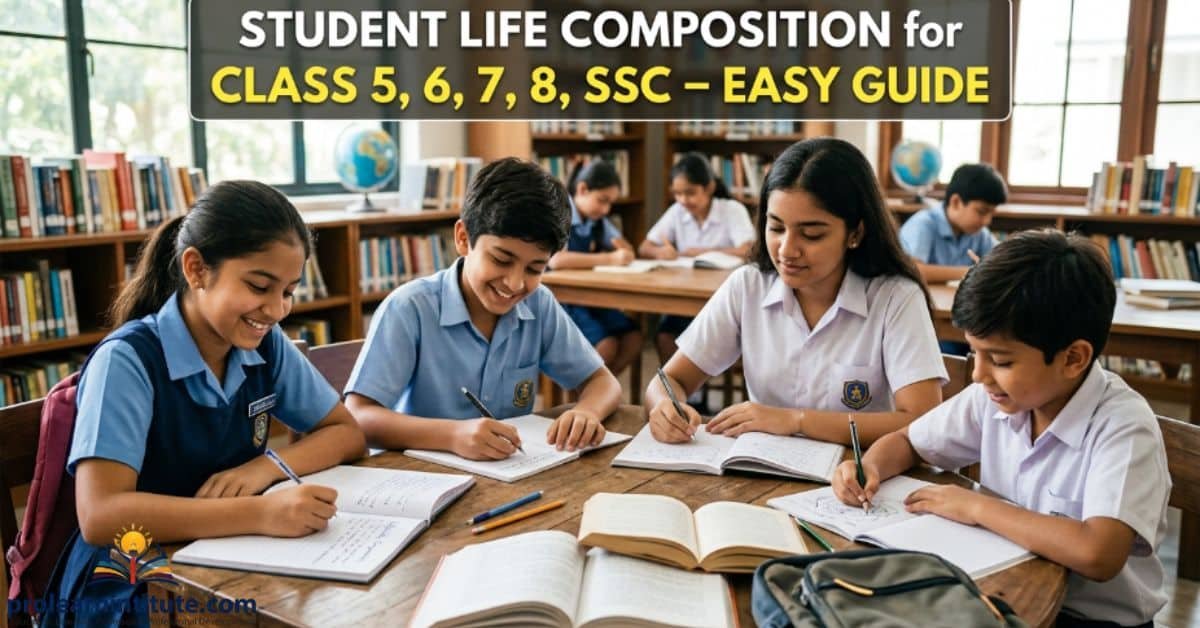
Student life is the most important and beautiful stage of a person’s life. It is the time when a student learns, grows, and prepares for the future. This guide is written for all class levels from class 5 to SSC.
This article covers every important topic about student life in simple and easy English. You will find essays, paragraphs, duties, challenges, and much more in one place. Read it carefully and use it for your exams, assignments, and school projects.
Introduction
Student life is a golden period that every person goes through in their early years. It is a time full of learning, friendship, discipline, and new experiences every single day. No other stage in life offers as many opportunities to grow and improve as student life does.
This stage shapes who you become in the future as a person and as a professional. The habits, values, and knowledge you build during student life stay with you forever. That is why every student must take this time seriously and make the most of every single day.
Understanding Student Life

What is Student Life
Student life is the period in a person’s life when they attend school or college to gain education and knowledge. It starts from the very first day of school and continues until a person completes their formal education. During this time, a student learns subjects, develops skills, and builds their character step by step.
Student life is not just about books and exams—it is about growing as a complete human being. A student learns how to think, how to behave, and how to face challenges during this important phase. Every experience in student life, whether good or bad, teaches something valuable and useful.
Why This Stage Matters
This stage matters because it builds the foundation of a person’s entire future life. The knowledge and habits formed during student life directly affect a person’s career, relationships, and success. A strong student life leads to a strong and successful adult life.
If a student wastes this time, it becomes very difficult to recover those lost years later. Good students understand the value of this stage and use it wisely to build their skills and knowledge. Student life is a once-in-a-lifetime opportunity that should never be taken for granted.
Nature of Student Life
Learning and Education
The primary nature of student life is learning and gaining education every single day. Students go to school, attend classes, read books, and complete assignments as part of their daily learning process. Education is the main purpose and the greatest gift of student life.
Learning in student life is not limited to textbooks and classrooms alone. Students also learn from teachers, friends, experiences, and the world around them. Every day brings new lessons that help a student become more knowledgeable and capable.
- Attending classes regularly and paying attention
- Completing homework and assignments on time
- Reading books beyond the school syllabus
- Asking questions and clearing doubts from teachers
- Reviewing daily lessons to strengthen understanding
Personal Development
Student life is also a time of deep personal development and self-discovery. A student learns about their own strengths, weaknesses, interests, and talents during this stage. This self-awareness helps them choose the right path for their future career and life.
Personal development includes building good habits like punctuality, honesty, hard work, and responsibility. These habits are formed slowly through daily practice and the right guidance from teachers and parents. A student who focuses on personal development becomes a confident and capable person in life.
| Personal Quality | How It Develops | Why It Matters |
| Confidence | Through participation in class | Helps in interviews and public speaking |
| Honesty | By avoiding cheating in exams | Builds trust and a good reputation |
| Punctuality | By reaching school on time | Creates discipline for professional life |
| Responsibility | By completing tasks on time | Makes a person reliable and trustworthy |
| Patience | By studying difficult subjects | Helps handle pressure and tough situations |
Social Growth
Social growth is an equally important part of student life that many students overlook. Students meet people from different backgrounds, cultures, and personalities in school every day. These social interactions teach students how to communicate, cooperate, and build meaningful relationships.
Friendship formed during student life is often the strongest and most lasting. Working in groups, playing together, and solving problems as a team teach social skills that are useful throughout life. A socially strong student becomes a better team player and leader in their professional future.
Daily Routine of a Student
School Activities
A student’s day at school is filled with a variety of activities that contribute to their overall growth. From attending classes and writing notes to participating in sports and cultural events, school keeps students busy and active. Every school activity has a purpose and plays a role in shaping a well-rounded student.
Students who participate actively in school activities learn more and perform better than those who stay passive. Raising your hand in class, joining the debate team, or playing in school sports all build different important skills. A good student engages fully with every school activity with energy and enthusiasm.
- Attending all classes on time and with full attention
- Taking clear and organized notes during lessons
- Participating in sports, arts, and cultural events
- Joining school clubs and extracurricular activities
- Showing respect to teachers, staff, and fellow students
Study Time at Home
Study time at home is just as important as the time spent in school. After school, a student must review the lessons taught that day and complete all homework before sleeping. Regular home study builds a strong understanding of subjects and reduces stress before exams.
A fixed study schedule at home helps students stay organized and avoid last-minute pressure. Studying in a quiet place without phone distractions leads to better focus and faster learning. Even one to two hours of focused daily study at home makes a huge difference in a student’s performance.
| Study Time Tip | Benefit |
| Study at the same time daily | Builds a strong study habit |
| Keep your phone away during study | Improves focus and concentration |
| Take short breaks every hour | Keeps the mind fresh and alert |
| Review the day’s lessons at night | Strengthens memory and understanding |
| Prepare a weekly study plan | Reduces exam stress and confusion |
Rest and Recreation
Rest and recreation are necessary parts of a healthy student routine that are often ignored. A student who does not rest properly cannot focus well in class or study effectively at home. The brain needs rest to process information and prepare for the next day’s learning.
Recreation includes outdoor games, hobbies, reading for fun, and spending quality time with family. These activities refresh the mind, reduce stress, and bring balance to a student’s busy daily life. A student who balances study with proper rest and recreation performs better in both academics and life.
Duties and Responsibilities
Academic Responsibilities
Every student has clear academic responsibilities that must be fulfilled with honesty and dedication. Attending school regularly, completing homework, preparing for exams, and paying attention in class are the core academic duties. A student who takes their academic responsibilities seriously always achieves good results.
Copying homework or cheating in exams may seem like an easy shortcut, but it destroys real learning. Academic responsibility means doing your own work with full effort, even when it is difficult. Students who are academically responsible grow into skilled and knowledgeable professionals in the future.
- Attending school every day without unnecessary absences
- Completing and submitting all assignments on time
- Preparing thoroughly for tests and examinations
- Maintaining a clean and organized school notebook
- Asking for help when struggling with any subject
Moral Responsibilities
Moral responsibilities are about being a good, honest, and respectful person in every situation. A student must speak the truth, respect elders, treat classmates fairly, and avoid bad behavior at all times. Good moral character is as important as good grades in building a successful and respected life.
Moral responsibility also means standing against bullying, cheating, and dishonesty in school. A morally strong student is an example for others and earns the respect of teachers and classmates. Schools teach academic knowledge, but moral responsibility is what truly defines the quality of a person.
| Moral Responsibility | Example in School Life |
| Honesty | Not cheating in tests or copying homework |
| Respect | Listening quietly when a teacher is speaking |
| Fairness | Treating all classmates equally and kindly |
| Courage | Reporting bullying to a teacher without fear |
| Gratitude | Thanking teachers and parents for their support |
Social Responsibilities
A student also has important social responsibilities toward their school, family, and community. Keeping the school environment clean, helping classmates who are struggling, and behaving well in public are all social duties. A socially responsible student makes their school and community a better place for everyone.
Social responsibility also includes being kind to those who need help and avoiding selfish behavior. Students who develop social responsibility during school life become caring and contributing members of society as adults. Every small good action by a student creates a positive ripple effect in the entire community.
Importance of Discipline
Time Management
Time management is one of the most valuable skills a student can develop during their school years. Managing time well means dividing your day properly between study, rest, play, and family time. A student who manages time well never feels stressed, rushed, or behind on their responsibilities.
Poor time management leads to incomplete homework, exam panic, and a habit of procrastination that is very hard to break. Simple tools like a daily planner, a study timetable, or a to-do list can help students manage their time effectively. Students who master time management in school carry this skill into their careers and succeed faster than others.
- Wake up early to start the day with enough time
- Follow a fixed daily timetable for all activities
- Complete difficult tasks first before easier ones
- Avoid spending too much time on phones or TV
- Review your schedule every evening for the next day
Self-Control
Self-control is the ability to manage your own actions, emotions, and desires in a responsible way. For students, self-control means resisting the temptation to skip studying, use phones during class, or choose fun over responsibility. It is a quality that separates disciplined students from those who struggle to achieve their goals.
Self-control is not something you are born with — it is a skill that grows through daily practice and conscious effort. Every time you choose to study instead of watching videos, you are training your self-control muscle more strongly. Students with strong self-control perform better in exams, make smarter decisions, and lead more successful lives.
Consistency in Work
Consistency means doing the right things regularly, day after day, without giving up when it gets boring or hard. A student who studies consistently for thirty minutes every day will learn far more than a student who studies five hours only before exams. Consistency is the secret behind every successful student’s performance.
Consistent effort in daily study, exercise, and good habits builds strong results over time. Many students start with great enthusiasm, but stop after a few days when the excitement fades. True discipline means continuing your good habits even on the days when you do not feel like it.
| Consistent Habit | Result Over Time |
| Reading 20 minutes daily | Strong vocabulary and better comprehension |
| Reviewing lessons every evening | Better exam performance and memory |
| Exercising or playing daily | Better health and energy for studying |
| Writing a diary or journal | Improved writing and thinking skills |
| Sleeping at a fixed time nightly | More focus and alertness in class |
Role of Teachers and Parents
Guidance of Teachers
Teachers play the most important role in shaping a student’s academic and personal life. They not only teach subjects but also guide students on how to think, behave, and face challenges with courage. A good teacher inspires students to work hard, dream big, and believe in their own abilities.
The relationship between a teacher and student is one of the most powerful forces in education. Students who respect their teachers and follow their guidance always perform better and grow faster. A great teacher can change the entire direction of a student’s life with just the right words at the right time.
- Teachers explain difficult concepts in simple and clear ways
- They correct mistakes and guide students toward improvement
- Teachers motivate students during difficult and stressful periods
- They identify each student’s unique talent and encourage it
- Good teachers are role models for honesty and hard work
Support from Parents
Parents are the first and most constant support system in every student’s life. They provide the home environment, the resources, and the emotional security that a student needs to focus on studies. A student whose parents are supportive and involved almost always performs better in school.
Parents who show interest in their child’s education by checking homework, attending school meetings, and discussing school life make a huge positive difference. Emotional support from parents gives students the confidence to try new things and recover from failures. Every student should appreciate and respect their parents for the countless sacrifices they make every single day.
Challenges in Student Life
Academic Pressure
Academic pressure is one of the biggest challenges that students face in today’s competitive world. The pressure of scoring high marks, passing tough exams, and meeting parent and teacher expectations can feel overwhelming. Many students experience stress, anxiety, and burnout because of excessive academic pressure.
Managing academic pressure requires a balanced approach of consistent study, proper rest, and a positive mindset. Students should focus on learning and understanding rather than just chasing marks and grades. Talking to teachers or parents when feeling overwhelmed is a brave and smart thing to do.
| Source of Academic Pressure | Healthy Way to Handle It |
| Fear of failing exams | Study consistently instead of cramming at the last minute |
| High parental expectations | Have an honest conversation with parents about feelings |
| Difficult subjects | Ask teachers for extra help or join a study group |
| Competition with classmates | Focus on personal improvement rather than comparison |
| Too many assignments at once | Prioritize tasks and make a manageable schedule |
Distractions
Distractions are everywhere in a student’s life, and they are one of the biggest obstacles to success. Mobile phones, social media, television, and unnecessary socializing steal valuable study time every single day. A student who cannot control distractions will always struggle to reach their full potential.
The most dangerous distractions are those that seem harmless, like spending just five more minutes on a phone that turns into two hours. Students must identify their personal distractions and create a study environment that removes or reduces them. Setting clear boundaries for phone use and entertainment is a key habit of every successful student.
- Social media scrolling during study hours
- Playing mobile games instead of completing homework
- Watching videos or television for too many hours
- Spending too much time on unnecessary conversations
- Noisy or disorganized study environment at home
Lack of Motivation
Lack of motivation is a challenge that almost every student faces at some point in their academic journey. There are days when studying feels pointless, boring, and completely impossible to continue. This feeling is normal, but it must be addressed before it becomes a permanent habit of giving up.
Motivation comes back when a student reminds themselves of their goals, dreams, and the reasons why they started. Reading about successful people, talking to a mentor, or simply taking a short break can bring back the energy to continue. A motivated student views every challenge as a stepping stone rather than a stopping point on their journey.
Benefits of Student Life
Skill Development
Student life is the best time to develop a wide range of skills that will be useful throughout life. Academic skills like reading, writing, mathematics, and science are learned during this stage through regular practice. But student life also develops soft skills like communication, teamwork, leadership, and problem-solving that no textbook can fully teach.
Every school project, group activity, debate, or sports event is an opportunity to develop a new skill. Students who actively participate in diverse activities come out with a much richer skill set than those who only focus on books. The skills developed during student life become the tools that a person uses to build their entire future career.
| Skill Type | Where It Is Developed | Future Use |
| Communication | Class presentations and debates | Job interviews and professional meetings |
| Teamwork | Group projects and sports | Working effectively in any workplace |
| Critical Thinking | Solving math and science problems | Making smart decisions in real life |
| Creativity | Art, writing, and school projects | Innovation and problem-solving in careers |
| Leadership | Class captain and team leader roles | Managing teams and taking initiative |
Character Building
Student life builds a person’s character in ways that last for their entire lifetime. The values of honesty, kindness, hard work, courage, and respect are all formed through daily experiences in school and at home. A student with strong character is trusted, respected, and admired by everyone around them.
Character is not built overnight—it grows slowly through making the right choices consistently over many years. Every time a student chooses honesty over cheating or effort over laziness, their character becomes stronger. Good character is ultimately more valuable than any degree or certificate a student can earn.
Preparation for Future
Student life is essentially one long preparation for the future that lies ahead. Every subject learned, every skill developed, and every challenge overcome during student life prepares a person for adult responsibilities. The stronger your student life foundation, the more confidently you can face the real world after graduation.
Career choices, professional skills, and personal values all begin to form during the student years. A student who takes their studies, discipline, and personal development seriously enters adulthood with a huge advantage over those who wasted their time. Student life is not just preparation for an exam — it is preparation for life itself.
Student Life for Different Levels
For Class 5–8 (Simple Learning Stage)
Students in classes 5 to 8 are at the simple learning stage where building basic habits and skills is the top priority. At this level, developing a love for reading, practicing good handwriting, and learning to study regularly are the most important goals. This is also the time when students discover what subjects and activities they enjoy the most.
Friendships formed at this stage are very important because they shape a student’s social behavior and communication skills. Students at this level should focus on being curious, asking questions, and enjoying the learning process without too much pressure. A strong foundation built in classes 5 to 8 makes the higher classes much easier and more manageable.
- Focus on understanding basics rather than memorizing facts
- Develop a daily reading and writing habit
- Participate in school sports and arts activities
- Build strong friendships based on honesty and kindness
- Learn to organize your school bag, notebook, and study space
For SSC Level (Serious and Career-Oriented Stage)
The SSC level is a serious and career-oriented stage where students must take their academic life more seriously than ever before. SSC exams are board-level exams that have a direct impact on a student’s future education and career options. Every mark and every subject at this level plays an important role in determining what path a student can take next.
At this stage, students should focus on choosing subjects that align with their career interests and future goals. Time management, consistent study, proper exam preparation, and stress management become critical skills for SSC students. This is also the time to develop a strong sense of responsibility, ambition, and professional attitude toward life.
| Priority for SSC Students | Why It Matters |
| Daily subject revision | Prevents last-minute panic before board exams |
| Choosing the right subjects | Aligns with future career and university choices |
| Solving past exam papers | Builds exam confidence and time management skills |
| Taking health seriously | A healthy body supports a healthy and sharp mind |
| Setting clear future goals | Gives direction, purpose, and strong motivation |
Conclusion
Student life is the foundation of everything a person will achieve in their future. The habits, values, knowledge, and skills built during this stage stay with a person for their entire lifetime. Every student must treat this golden period with the respect, effort, and dedication it deserves.
Make the most of your student life by studying honestly, respecting your teachers and parents, staying disciplined, and dreaming big every day. Remember that the choices you make today as a student will shape the person you become tomorrow. Work hard, stay focused, and use your student life to build the future you truly deserve.
Frequently Asked Questions
1. What is the best way to write a student life essay for Class 5 students?
The best way is to start with a simple introduction about school and daily routine, use short sentences, and end with what you enjoy most about being a student.
2. How do I write a student life essay for SSC exams that scores full marks?
For SSC-level essays, structure your writing into a clear introduction, 2–3 body paragraphs covering duties, challenges, and goals, and a motivating conclusion—all in formal, error-free English.
3. What should I include in a student life essay to make it stand out?
Include personal daily routines, academic responsibilities, extracurricular activities, friendships, challenges faced, and future ambitions to make your essay engaging and complete.
4. How long should a student life essay be for middle school classes like 6, 7, and 8?
A student life essay for Classes 6–8 should ideally be 200–300 words, covering school life, hobbies, and learning experiences in clear, simple paragraphs.
5. Can you give me an easy outline for a student life essay for all classes from 5 to SSC?
Yes—use this outline: Introduction (what student life means), Body Paragraph 1 (daily routine and studies), Body Paragraph 2 (activities and friendships), Body Paragraph 3 (challenges and goals), and a strong Conclusion.
6. What are the most important points to mention in a student life essay for Class 9 and 10?
For Class 9 and 10, focus on academic pressure, time management, career goals, the importance of discipline, and the role of teachers and peers in shaping your future.
7. How do I start a student life essay with an attention-grabbing introduction?
Begin with a powerful quote about education, a thought-provoking question, or a vivid description of your school morning to immediately hook the reader from the very first line.
8. What is the importance of student life that I should write about in my essay?
Student life is the foundation of a person’s future—it builds knowledge, character, discipline, social skills, and the habits that determine lifelong success and values.
9. How can I write a student life essay in simple English for younger classes like 5 and 6?
Use short, clear sentences, familiar vocabulary, and write about things you actually do—like going to school, doing homework, playing with friends, and learning new things every day.
10. What is a good concluding paragraph for a student life essay that teachers will appreciate?
End by reflecting on the value of your school years, expressing gratitude toward teachers and parents, and stating your determination to work hard and achieve your dreams—keeping the tone positive and sincere.

I’m Jordan Smith, a content writer with 4 years of experience and AI content expertise, creating clear, engaging, and easy-to-understand educational content.
1 Comment
Pingback: The Season I Like Most Composition for Class 6, 7, 8, 9, 10, SSC & HSC